


Free Space Extends Milliken’s History of Material Precision
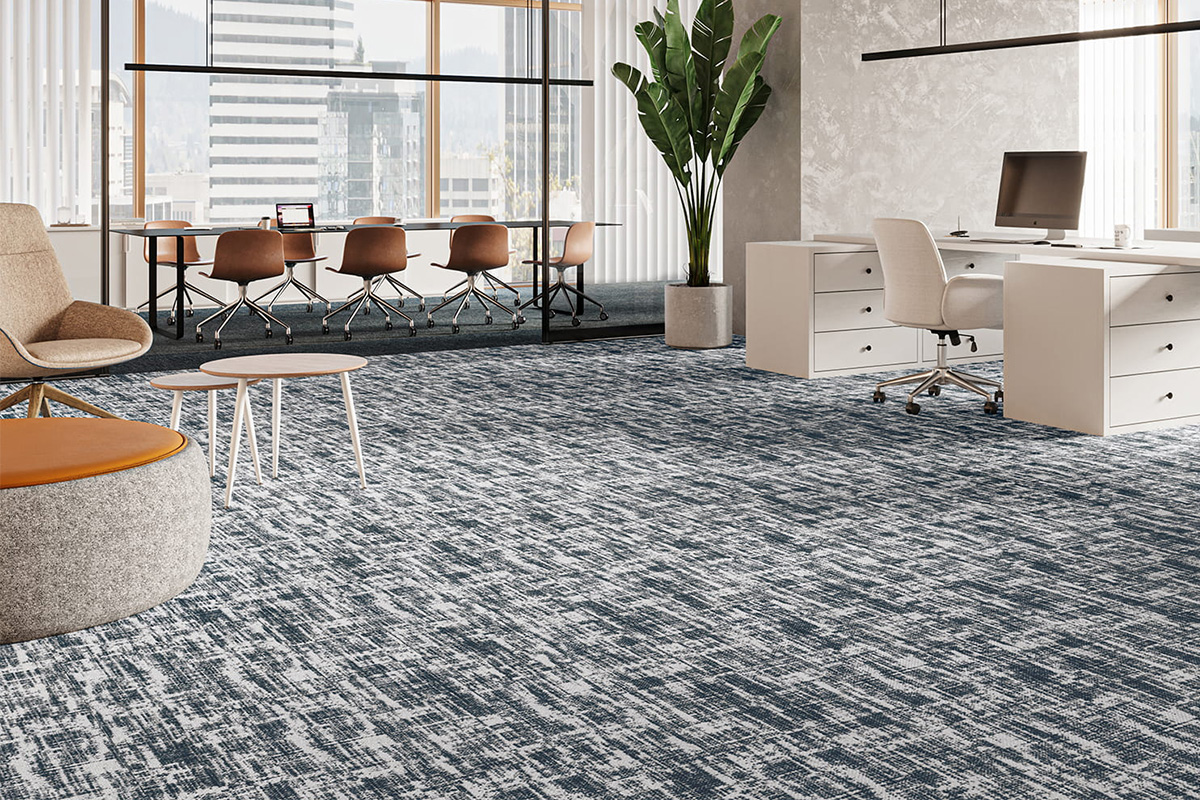
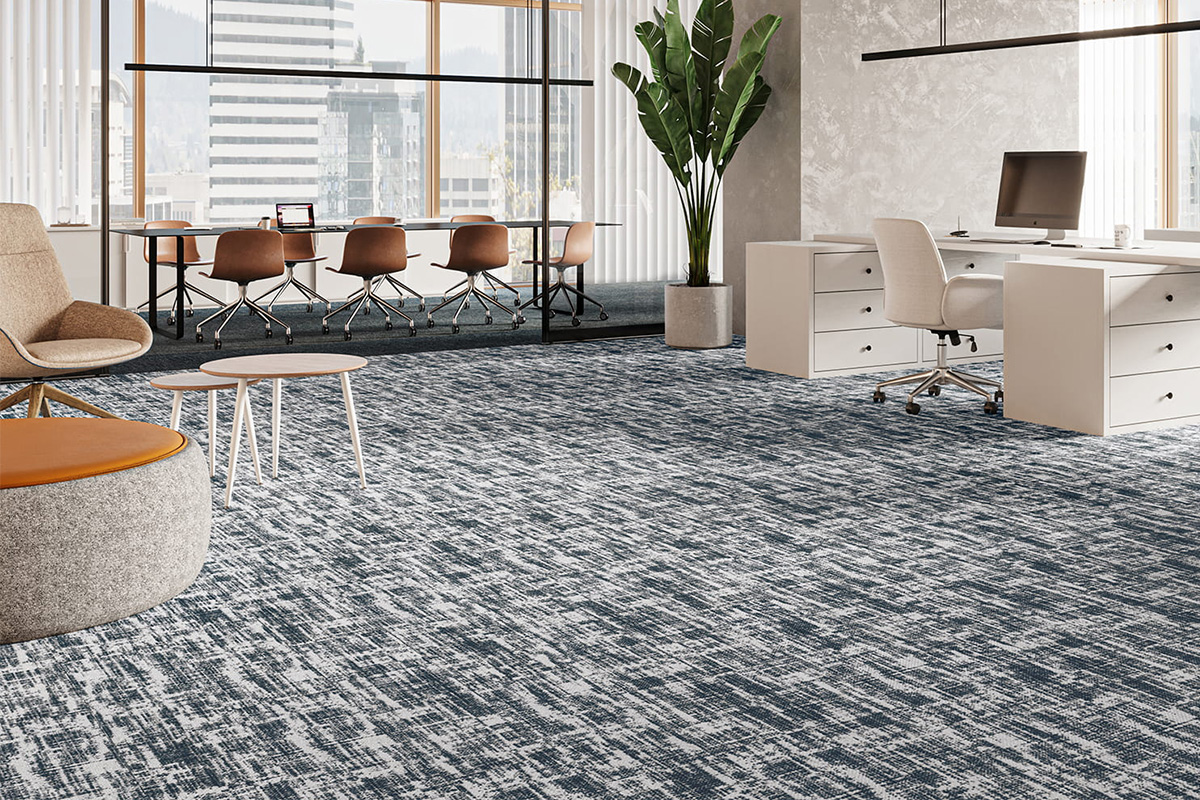
Ink moves across fiber in calibrated layers. Colors multiply, forming grids, crosshatches, and brushstrokes. Free Space is a modular study in rhythm, shaped by the visual logic of textiles and the mechanics of print. At Milliken, design begins on the line itself, through a system refined over decades. Behind each surface is a longer story.
Developed using Milliken’s proprietary PrintWorks® technology, Free Space reflects the company’s long-standing investment in engineered color and scalable customization. With patterns that reference movement, gathering, and texture, the collection speaks directly to the way shared spaces are used, and to the technical systems that support them. That logic—of scalable, engineered design—connects directly to Milliken’s deeper history in material innovation.
“At the core, we are a research company, and this curiosity is what makes us unique,” says Senior Designer Holly Nguyen. “Milliken developed our own digital dye method for printing carpets in the 1970s, which gives us the ultimate flexibility with pattern and color, while lowering manufacturing complexities. We continue to innovate these machines and make them better every decade. Free Space was created on a range that allows us to add over 4,000 colors into one design if we wanted to!”
Founded in 1865, Milliken began as a dry goods business before shifting into textile manufacturing and material innovation. Over generations, the company developed its own dye methods, engineered fiber systems, and built machinery tailored to precision. Flooring became a natural extension—an application of processes already honed across multiple industries. Today, that history is visible in every aspect of Milliken’s approach, from recycled yarns to PrintWorks® customization.
Systems and Sustainability
Milliken’s product development is grounded in environmental responsibility and a focus on human-centered design. These priorities shape both materials and performance. In Free Space, cushion-backed tiles support acoustics and comfort in high-traffic interiors, while modular patterns flex across programs and scales. The company’s PrintWorks® technology enables low-waste customization and individualized solutions that respond to identity, context, and use. PVC-free constructions, Red List Free materials, and products that meet WELL and Living Building Challenge criteria reflect a broader alignment between design intent and performance. Every detail—backing, fiber, dye—is part of a system that considers the full lifespan of the product.

Milliken was the first flooring manufacturer to set validated science-based net zero targets and continues to prioritize low-carbon materials and circularity. Free Space is constructed from 100% recycled nylon with a PVC-free cushion backing and contributes to NSF-140 certification and the global M/PACT™ program. More than 1,000 products now incorporate recycled yarn and backing. All carpet, LVT, and entryway tiles are carbon offset. The N/XT Life™ program supports take-back and reuse—keeping materials in circulation and reducing waste. These efforts reflect a systems-based approach that integrates performance, wellness, and environmental accountability across every stage of product development.
Space in Use
Free Space draws from the concept of third spaces: shared environments for gathering, working, and reconnecting with others. Its six patterns mix organic and geometric structures, scaled for flexibility across programs. The visual language is grounded in movement: shifting linework, layered brushstrokes, and soft grids that offer definition without enclosure.
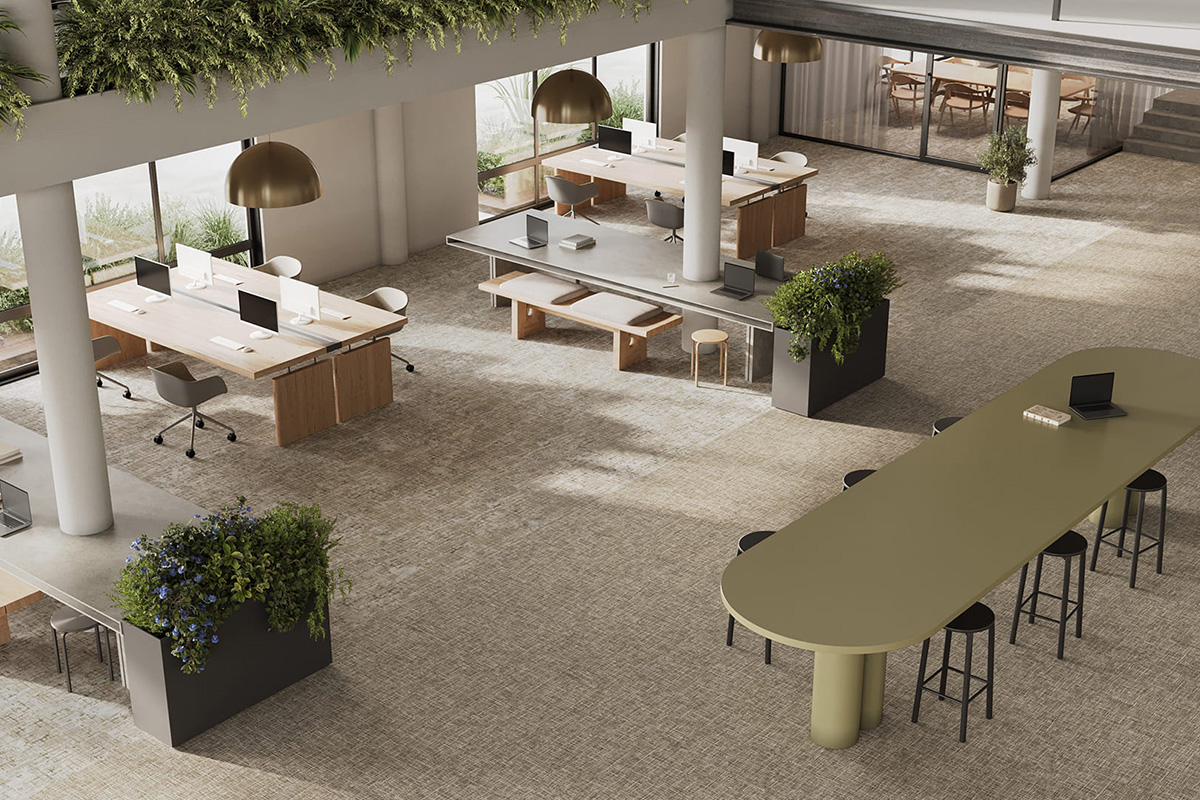
“Free Spaces are public areas within cities that are designed to be accessible to everyone to enhance the quality of life for the residents and visitors,” says Nguyen. “These spaces provide relaxation, recreation, social, and cultural activities. This is where community comes together to learn, share and be creative. This is at the core of the inspiration for the patterns in Free Space. These are designed to go into any type of commercial space, inspired by the natural environment around us.” Each pattern draws from the natural environment, using scale and variation to coordinate across open-plan commercial interiors. The collection is intended to adapt—visually and functionally—to a broad range of use cases.
Milliken’s flooring innovations continue to build on the company’s foundation in science, materials, and modular design. From engineered print systems to low-carbon manufacturing and customer-informed customization, every product carries forward a layered history that has been refined through decades of research and iteration. As the company evolves its customization tools and resilient flooring options, it remains focused on developing performance-driven, recyclable solutions that reduce waste and contribute to healthier built environments.