
Love Schack Architecture
Aska’s Animal Haus
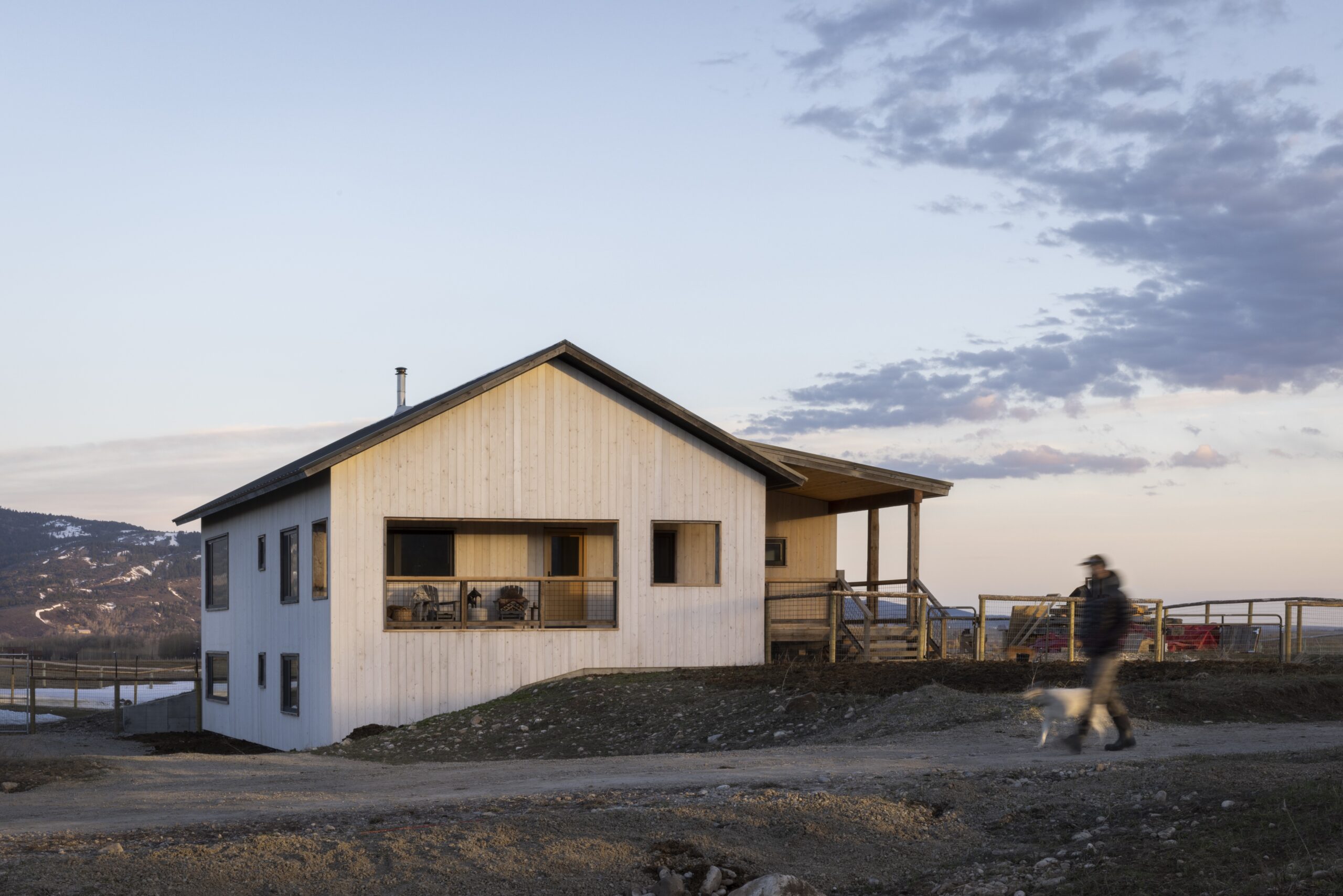
Aska’s Animal Haus is a single-family residence in rural Idaho designed for health, wellness, and sustainability. Love Schack Architecture paired prefabricated straw panels with Passive House strategies to create a non-toxic, energy-efficient home that supports both human and animal occupants.
At the heart of the project is prefabricated straw panel construction, a material rarely used in residential construction in the Rocky Mountain West. While straw has been employed historically in experimental builds, Love Schack has elevated it to a high-performance, Passive House-compatible system, demonstrating that low-carbon, bio-based materials can meet rigorous energy-efficiency standards in extreme climates. This positions the firm as a pioneer in sustainable and natural-material architecture, proving that regenerative approaches can be practical, durable, and replicable.
Straw panels are a triple-impact solution: they provide superior insulation, sequester carbon, and are entirely renewable and biodegradable. Paired with airtight detailing, balanced ventilation, and thermal continuity, the panels deliver energy-efficient comfort while improving indoor air quality, critical during Idaho’s wildfire season. Love Schack Architecture’s team worked closely with local builders and code officials to integrate this non-traditional material, demonstrating its adaptability in cold, dry climates.
Located in rural Idaho, the project serves as both a family residence and a home for Aska’s Animals, a nonprofit animal rescue founded by the homeowners. Aska’s Animals needed a space for pets in their care that was close, but not inside, the family home. The solution was to build the home into the topography of the site, allowing for a two-story structure with a walk-out basement. The lower level could be finished to be durable and cleanable for the animals in their care, and have convenient access to the outdoors and natural light. Upstairs, Aska’s family had ample space to live, gather, and host. Ultimately, the home’s design simultaneously supports human and animal health, creating a non-toxic environment for the family and the rescue animals that inhabit the property.
Beyond the building itself, the project has created a regional ripple effect in sustainable design. Integrating straw panels with Passive House strategies required coordination and knowledge transfer with local builders and code officials. Love Schack’s approach served as a hands-on educational opportunity, equipping the local construction community with the skills and confidence to work with low-impact materials in high-performance applications. This kind of knowledge-sharing multiplies the environmental benefits far beyond a single project, enabling future sustainable builds and fostering a culture of regenerative design in the region.
By pioneering the integration of straw panels into a Passive House framework, Aska’s Animal Haus demonstrates innovation in the use of biobased materials by redefining what is possible in sustainable construction, showing that thoughtful, regenerative architecture can be both high-performing and aesthetic. The project exemplifies leadership in material innovation, regional impact, and educational influence, offering a replicable model for environmentally responsible building that will resonate nationally.
- No tags selected
More Planet Positive Awards
Winner
Tabernacle Terrace: Leveraging Black Churches to Build Beloved Community
Tabernacle Terrace | Master of Architecture