
2026 Planet Positive Awards > Hospitality > Honorable Mention
studio ksa
Hårtwood Treehouse Hotel
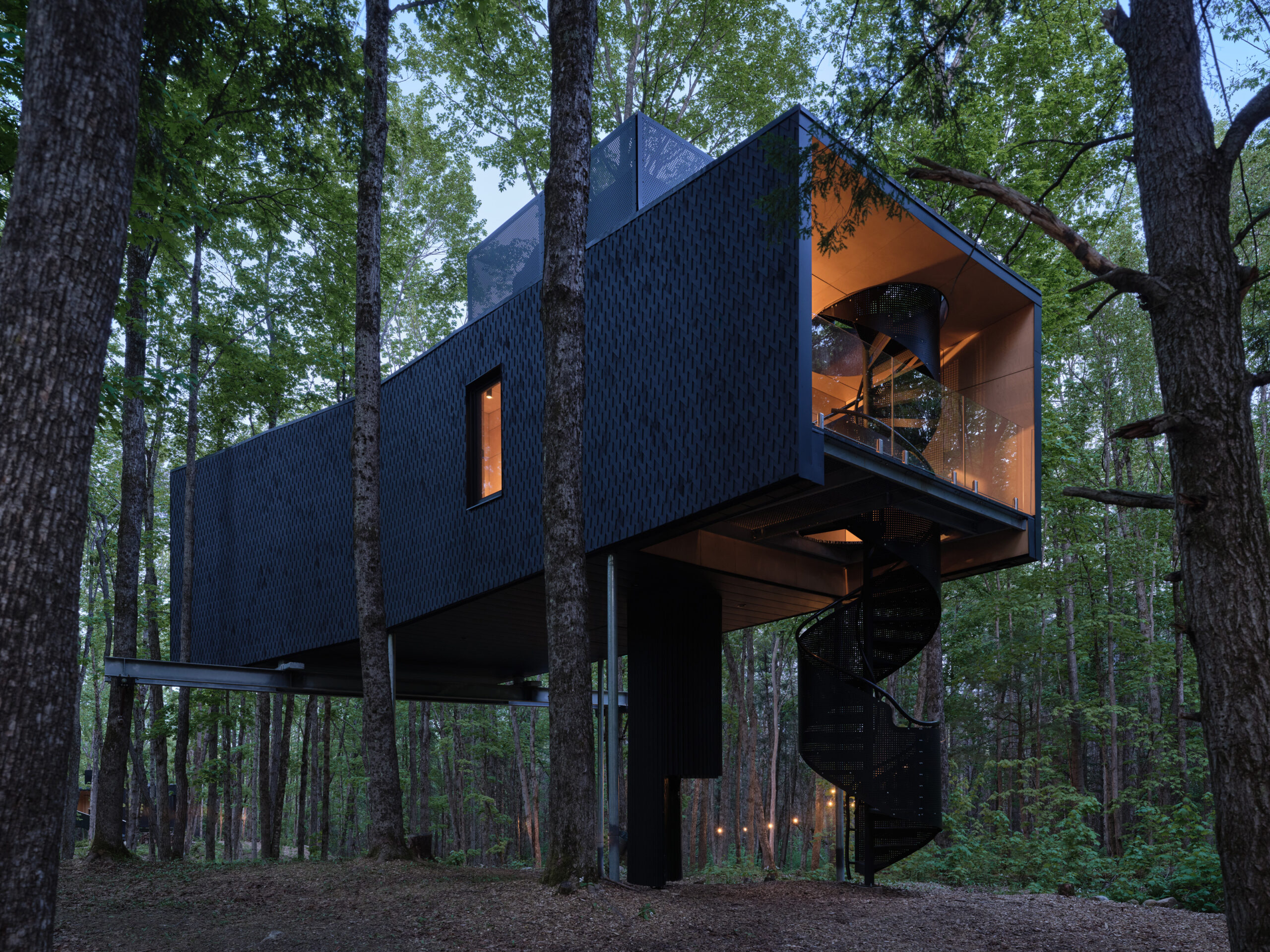
The Hårtwood Treehouse Hotel represents an alternative model for hospitality development: one that prioritizes ecological preservation, reduced resource consumption, and long-term coexistence with a living landscape. Due to the project’s unique scale, off-grid operation, and tree-integrated structural approach, conventional building benchmarks are not directly comparable. Rather than measuring performance against a typical hospitality project of similar size, the project’s impact is best understood through the resources and disturbances it avoids.
The most significant positive impact is the preservation of an existing forest ecosystem. The 15-acre site remains largely intact, with only three small-scale dwellings inserted into existing canopy openings. Unlike conventional construction, which would typically require clearing, grading, and extensive foundation systems, the project minimizes excavation, protects root zones, and maintains existing vegetation and habitat continuity.
The project reduces embodied carbon through its extensive use of wood as the primary structural and architectural material. The lightweight construction strategy minimizes foundation requirements and reduces reliance on higher-carbon structural materials. Careful construction sequencing further reduces the environmental impact of building within a sensitive forest environment, placing minimal disturbance above speed or convenience.
Operationally, each treehouse is fully off-grid and designed to minimize energy demand. Passive design strategies—including carefully oriented glazing, protective roof overhangs, natural ventilation, and thermal buffering—reduce reliance on mechanical systems. Water and energy infrastructure are intentionally scaled to support a low-impact hospitality model rather than a conventional serviced accommodation approach.
The project also establishes a different relationship between architecture and living systems. By incorporating carefully selected host trees into the structural strategy, the buildings adapt to existing ecological conditions rather than replacing them. Specialized tree attachment systems allow movement and continued growth while minimizing damage to living organisms. This approach creates a rare example of architecture designed around biological change rather than resisting it.
The project’s impact extends beyond operational performance to the experience it provides. By limiting density and emphasizing connection to place, the treehouses encourage a slower, more mindful engagement with nature. Sustainability becomes not only a technical outcome, but an experiential one—helping visitors develop a deeper appreciation for forest ecosystems and the value of protecting them.
The Hårtwood Treehouse Hotel demonstrates that sustainable design can be achieved through reduction, precision, and respect for existing conditions. Its success is not measured by the scale of intervention, but by how little it requires from the landscape while creating a meaningful and enduring architectural experience.
- No tags selected
More Planet Positive Awards
Winner
Tabernacle Terrace: Leveraging Black Churches to Build Beloved Community
Tabernacle Terrace | Master of Architecture