

Gensler
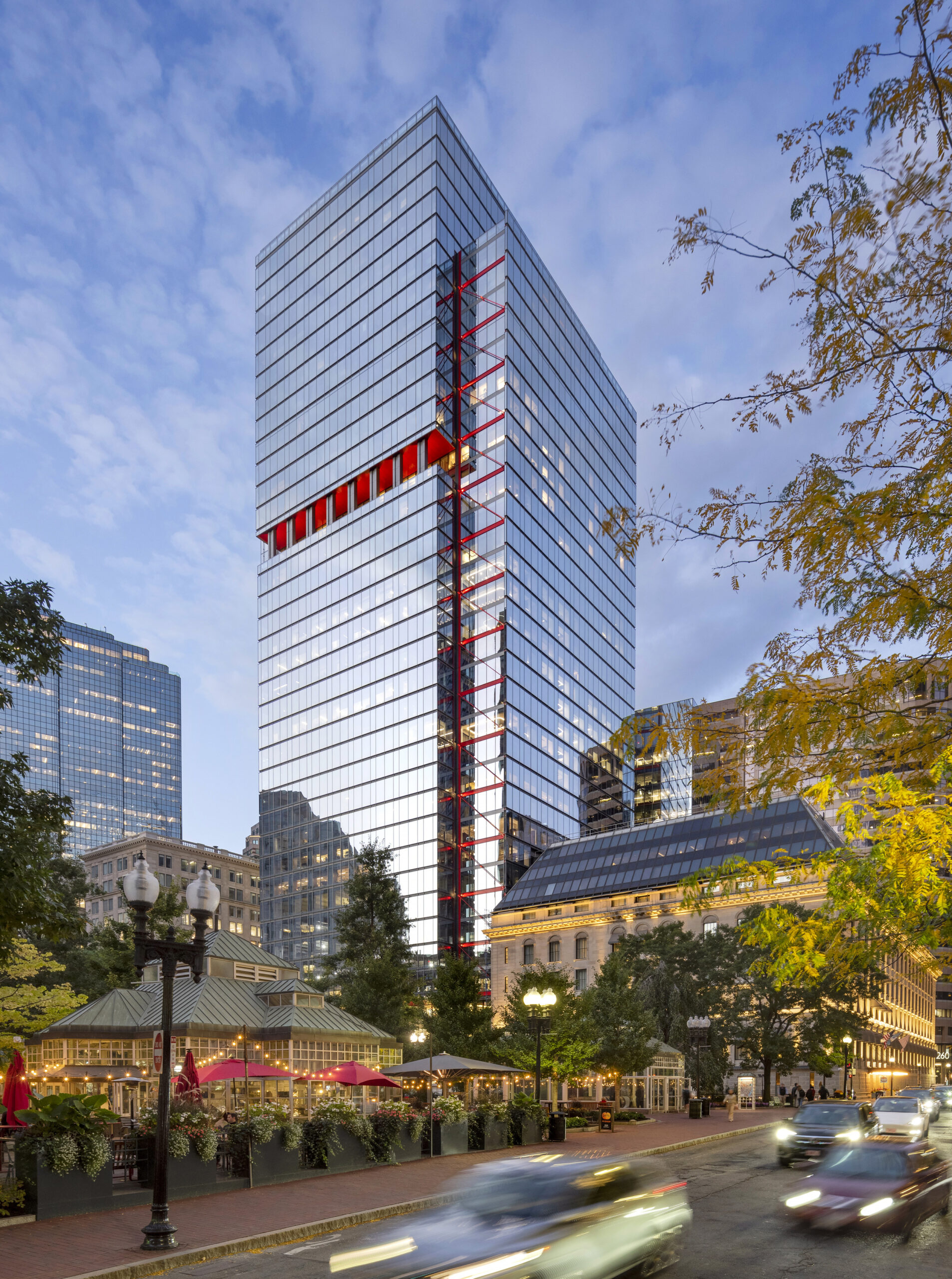
One Post Office Square
By reducing embodied carbon by 44% compared to an equivalent new construction scenario, One Post Office Square (OPOS) demonstrates how repositioning existing buildings can be one of the most effective strategies for decarbonizing the built environment. As Boston’s first major commercial office repositioning to combine a market-driven redevelopment strategy with a carbon-first design approach, the project provides a scalable model for addressing the climate impact of the existing building stock, which is expected to represent 80% of occupied buildings by 2050.
Rather than demolishing and rebuilding an aging office tower, the project preserved the majority of its existing steel and concrete superstructure, recognizing the significant carbon already embedded within the building. Through structural reuse, a high-performance triple-glazed curtain wall, and a new HVAC system featuring active chilled beams, OPOS transformed a dated asset into a high-performance workplace while dramatically reducing its environmental impact.
To quantify the benefits of this approach, the team conducted a full life cycle assessment (LCA) comparing the repositioning strategy to an equivalent new construction scenario over a 60-year period. The analysis found that embodied carbon intensity was reduced from 26.84 kg CO2e/SF in the new construction case to 15.09 kg CO2e/SF in the reuse case. By avoiding the carbon-intensive production and transportation of new structural materials, the project significantly reduced upfront emissions while extending the life of an existing urban asset.
The results challenge conventional assumptions about sustainable development. OPOS achieves an embodied carbon intensity that is less than half that of a comparable best-in-class new mass timber building, demonstrating that adaptive reuse can outperform even highly sustainable new construction when evaluated through a whole-life carbon lens.
The project’s innovation lies not only in reducing embodied carbon, but also in demonstrating the value of targeted carbon investments. While the new façade and mechanical systems required additional embodied carbon, the LCA found that these upgrades offset their carbon cost in less than four years through operational emissions reductions. This rapid carbon payback illustrates how strategic interventions can deliver both immediate and long-term climate benefits.
The repositioning also improved building performance, reducing Energy Use Intensity from 67.9 kBTU/SF to 41.4 kBTU/SF and lowering operational carbon emissions sufficiently to remain below Boston’s Building Emissions Reduction and Disclosure Ordinance (BERDO) performance limits through 2045. The embodied carbon savings achieved through structural reuse are equivalent to the carbon-absorbing capacity of approximately 139 Boston Commons’ worth of trees.
One Post Office Square proves that adaptive reuse is not simply a preservation strategy but a resilience-by-design strategy that has created a model for impactful urban intervention. By combining structural retention, high-performance systems, and rigorous carbon analysis, the project delivers measurable embodied carbon reductions while enhancing building value, operational efficiency, and occupant experience. Most importantly, it offers a practical, economically viable roadmap for decarbonizing existing buildings at scale.
- No tags selected
More Planet Positive Awards
Winner
Tabernacle Terrace: Leveraging Black Churches to Build Beloved Community
Tabernacle Terrace | Master of Architecture