



January 8, 2026
Designing for Health, Designing with Care
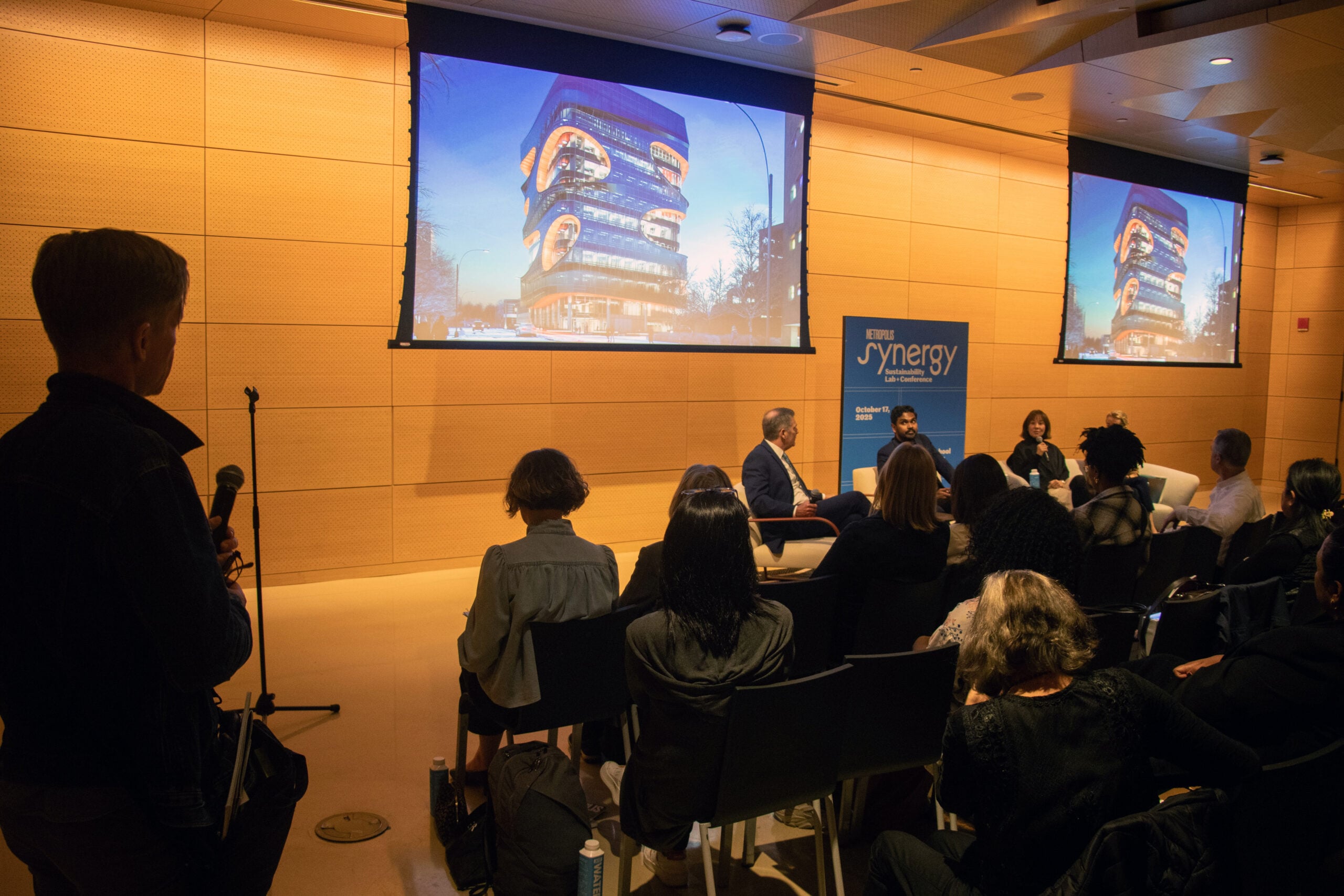
Representing Memorial Sloan Kettering Cancer Center, Suzen L. Heeley, executive director, design + construction, highlighted the scale of MSK’s operations—the company has more than 800,000 square feet of facilities in the New York City area—and how its guiding principle to “do no harm,” extends beyond patients to ecological and environmental systems. MSK’s sustainability framework encompasses organizational culture, climate action, energy efficiency, water reduction, waste and materials management, sustainable sourcing, and green building. Its green building portfolio alone dates to 2010 and has been recognized through repeated Practice Greenhealth Top Environmental Excellence awards.
Looking ahead, MSK is preparing to open the 90,000-square-foot Kenneth C. Griffin Pavilion in 2030 on Manhattan’s Upper East Side. The 27-floor tower will make use of a comprehensive set of design strategies: lifecycle assessments, systems engineering, construction waste reduction, asset reuse, modular construction, electrification, decarbonization, energy efficiency, advanced filtration, and high-performing water systems.
Victoria Kocian, project manager for energy and sustainability, real estate development and facilities, NYU Langone Health, detailed the system’s commitment to carbon neutrality by 2050 and a 50 percent emissions reduction by 2030. NYU Langone recently completed its first full GHG inventory—Scopes 1, 2, and 3—and published its first public sustainability report in 2023. Its 500+ page 2025 Design Guidelines will set a new bar for transparency.

Kocian was candid about implementation barriers, particularly budget constraints and late-stage sustainability rework. To address this, NYU Langone is developing a project estimating tool that brings sustainability considerations to the table earlier and has overhauled its internal site assessment checklists to guide infrastructure decisions. “How do you innovate in a risk-averse environment?” she asked, pointing to the system’s extensive use of pilot projects to test materials and technologies. She emphasized the importance of architects engaging the sustainability team early and integrating lifecycle cost analysis from the start. A major milestone for NYU Langone is the all-electric Brooklyn Ambulatory Hub designed by Perkins Eastman, opening in early 2026.
For Ken Potts, project manager at Mayo Clinic, sustainability is written into their values. Mayo Clinic’s Environmental Statement states: Mayo Clinic is committed to advancing the health and well-being of our patients, staff, and communities through the highest standards of medical practice. Potts explains, “We recognize that the health of the environment is intrinsically linked to the health of our patients and communities.” He outlined how this commitment is embedded in HDR’s design for Mayo Clinic’s Anna-Maria and Stephen Kellen Building in Rochester, Minnesota.
Together, the panelists and projects advocate for a future where designing for health inherently means designing with climate responsibility—and where sustainable decisions become foundational, not exceptional, in healthcare design and architecture.
Would you like to comment on this article? Send your thoughts to: [email protected]
- No tags selected
Latest

Projects
UC Berkeley’s Newest Building Is All About Human Interactions
The Barbara and Gerson Bakar Gateway—home to the university’s College of Computing, Data Science, and Society—gently reminds data scientists and AI researchers of what’s really important.

Projects
ZD+A Brings a Modernist Mexico City House in Line with its Context
Architect Yuri Zagoin Alazraki reorganized the speculative house to respond to its site and create unique spaces for contemplation.