



February 19, 2026
Closing the Loop at Interface
Since its visionary founder, Ray Anderson, challenged the industry to do better in the mid-1990s, Interface has worked to reduce its environmental impact, draw down carbon emissions, fight waste and climate change, and help accelerate the transition to a circular economy.
In the latest episode of Deep Green, host Avinash Rajagopal is joined by Jay Lanier, global head of market sustainability, and Mikhail Davis, director of global market sustainability, to discuss the company’s journey and its ongoing efforts around circularity. Read an excerpt of their conversation below or listen to the full episode on the Surround Podcast Network.
Avi Rajagopal (AR): Interface’s journey of addressing environmental impact goes way back to Ray Anderson, assembling an Eco Dream Team in the early nineties. You’ve spent about three decades addressing climate change. Can you tell us how circularity became an important part of your efforts?
Mikhail Davis (MD): The fun thing is that back when I was fresh out of college, I was an assistant to one of those Eco Dream Team members. I had a good ponytail going back then, and I got to see the late nineties Interface—at least this sort of snapshot outsider’s view of the ideas that were going on to transform the company. Interface was a company that made a product that I had never really thought about before, which was carpet squares. But suddenly everything was up for question. We said, “What if we made it upside down? Could we use less yarn and give it a different look?” There were all these wild ideas in the air in the late nineties. By then, the organization had turned a corner and really started to understand what their founder—who’d had a personal epiphany in 1994—was thinking. You hear lots of funny stories about how crazy they thought he was back then before people really started to get it. By the time I was there in 1998, there was this excitement to question everything.
But in the middle of all that, circularity was always part of it. In the original Interface corporate sustainability report in 1997—which was likely the first corporate sustainability report in the U.S.—Ray included a brief introductory letter. Today, all CEOs write a letter at the start of their sustainability reports, but that wasn’t the thing back then. His letter laid out a vision for circularity, including ending the use of petro materials. He wrote about looking forward to the day when factories would have no smokestacks and said, “If successful, we’ll spend the rest of our days harvesting yesteryear’s carpets, recycling old petrochemicals into new materials, and converting sunlight into energy.” Circularity was always part of the vision.
When we came back and revisited that 25 years later, we acknowledged that circularity—closing the loop—was still a really important strategy, but it did not go according to plan. So we did a report called Lessons for the Future and tried to distill what we’d learned in 25 years of really trying to go all out on sustainability and circularity.
One of the things we learned is that it was way harder than we thought. We lifted the curtain on it and said, “Some of our best years we got back 8 percent as much as we sold.” That’s not what we expected. Other things like the smoke stacks and then ending the liquid effluence went really well. There’s plenty that we’ve learned, but it’s all about how to get onto the next stage of implementation. How do we make this real? Because it’s been an idea we’ve loved (even if we didn’t call it circularity back in 1997) and it’s been so key to everyone’s vision of how we turn the corner on sustainable design. But how do we turn circularity from a great idea into a great reality?
Jay Lanier (JL): I think it’s always been a part of the foundation of Interface’s sustainability vision. We talked about some of the themes that showed up in that very first sustainability report three years after Ray’s epiphany, and what we noticed was that the connection between circularity and carbon was inherent.
So much of that realization was noticing that fortunately, being in a circle means that you can get on the carousel pretty much any point that you want. Meaning with inputs on your product, extension of life, what’s on the floor, as well as the end of life—that oftentimes becomes the real focus of the way people tend to think about circularity and the solutions that are in play. But while doing so, they sometimes deemphasize the elements that are available to us to make a meaningful change right here and right now.
AR: Jay, looking at this from your clients’ point of view—architects, designers, organizations—what makes flooring a good place to think about circularity? A lot of folks are thinking about how they can be more efficient in how they use materials. Why should flooring be part of that strategy?
JL: There are several reasons why, Avi. One of the big reasons is that when you think about the six sides of the interior cube—if a room is a cube and we live on the inside of it—the only wall that we actually touch is the floor that we walk on. It’s the one we touch, and it provides the most opportunity to build in performance, with longevity being an important part of how that operates as well. But it also presents the challenges of being a composite material. So with those elements, in many cases—outside of a few different types of commercial flooring—it really is a sticky challenge, but one that I think really provides opportunity for cross-functionality.
If you’re a designer and you’re thinking, “Man, I really do want to incorporate sustainable, circular design philosophies into both the practice as a whole and maybe this project I’m focused on right now,” I think flooring provides a really good place to set an example for other trades, because of the maturity of the industry—which I’d like to believe we had a hand in guiding to where we are over the course of the last 30 years.
And finding ourselves competing over having the strongest connection to circularity and sustainability as a whole—both by utilizing those recycled materials on the front end that you can specify today, and by being the piece that has to perform over a long period of time. When we think about Nora Rubber Flooring, for example, I’m in my mid-forties, and the odds that I’ll live to see the end of many of the Nora installations happening this year are probably low. I think that’s a real testament to the performance and premium focus of that particular brand. So it’s a great place to start, because you’ve got touchpoints at the front end, in the middle, and at the end as well.
MD: And from the carbon footprint perspective, it’s an important opportunity because in a renovation, you have certain heavy hitters. If you’re rebuilding the building, it’s going to be structural materials. If it’s just a renovation, the flooring actually really matters in terms of the overall footprint. And then it brings in circularity, because one of the main ways to assess whether flooring is a big part of the carbon footprint—or actually pretty low—is to look at how much recycled material you used. That often determines whether you have a very high-footprint flooring or very low-footprint flooring. It’s a lot of petrochemicals, a lot of things that could have quite a high footprint—unless you get them from the circular economy.
AR: So obviously, we can’t think about lowering carbon emissions in the built environment—while also making a positive impact—without thinking about circularity. And as you both just argued, quite convincingly, flooring is a good place for us to focus. Can you talk about your ReEntry program? Tell us what the journey has been and what you’re doing with it today?
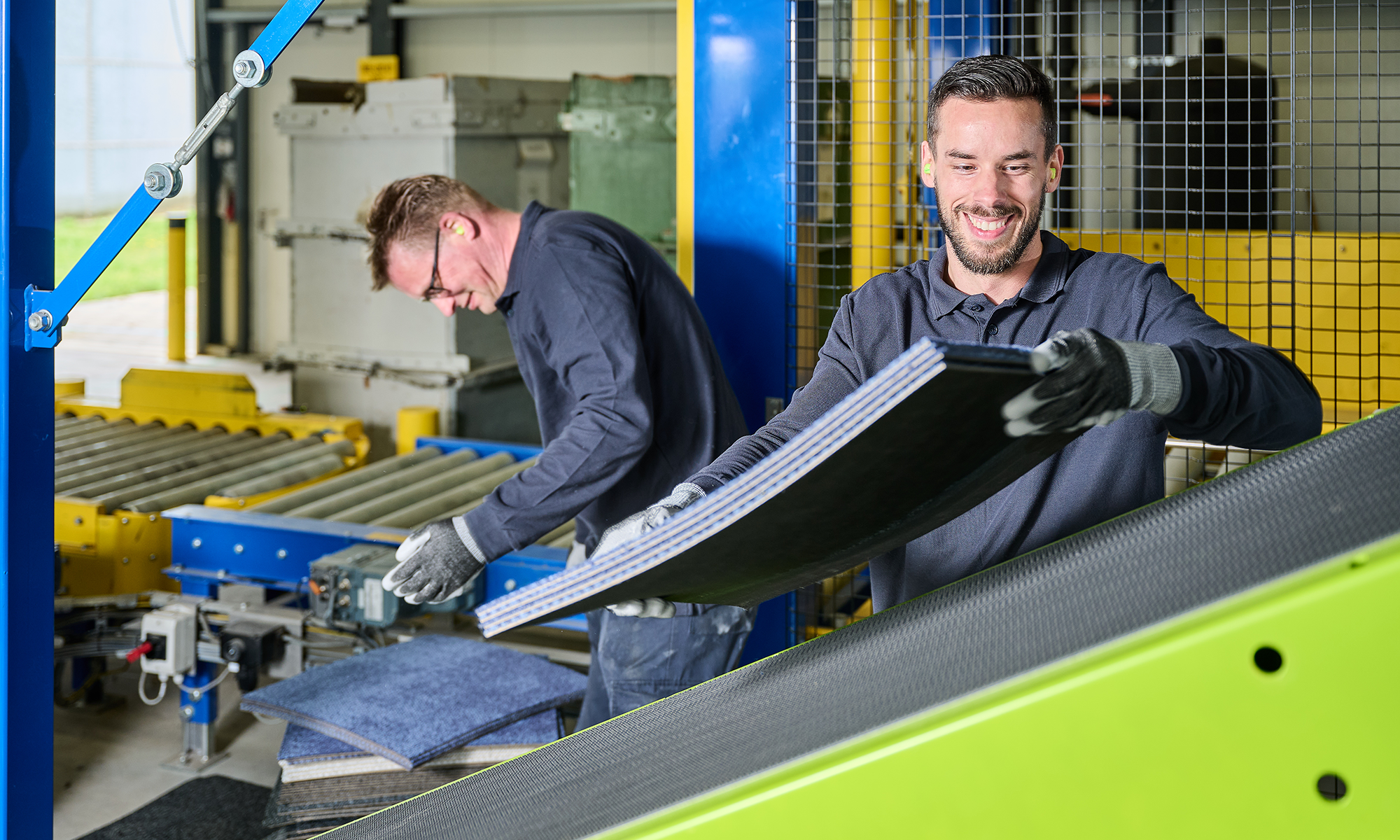
MD: It’s interesting. The journey has gone from something where we were initially trying to technically outsource it and find someone who could do something with the products we were taking back, to realizing that we just had to invent a system from scratch. Because in the circular economy, there are always multiple moving parts. So you have to figure out: What can we do with this? Let’s make sure if we do get it back, what can we do with it? Can we do something economical with it?
That’s why I say the circular economy has two interconnected, very important parts. First, the circular part: can we circulate it? Then the economy part: would we circulate it? Those are two interconnected challenges, which we’ve been working on during my time at Interface. In 15 years, I’ve seen about four generations of technology focused on finding the most efficient way to reuse materials—for example, the carpet tile that we take back.
Of course, it’s a regional challenge. Everywhere we operate in the world has to try to figure out the best approaches. One of the things you’re grappling with is the fact that the product is not designed for recycling. People get confused about that, but in the abstract, you would never take that many different plastics and put them together that tightly if you were expected to pull apart each of them and recycle them separately, which is our traditional model. What we’ve actually done is designed a system that can tolerate and use a mixed material. Those layers are supposed to stay together. If they don’t, it’s a manufacturing defect in the carpet called delamination, which we really try to avoid. Does the product last on the floor? You don’t want to compromise that.
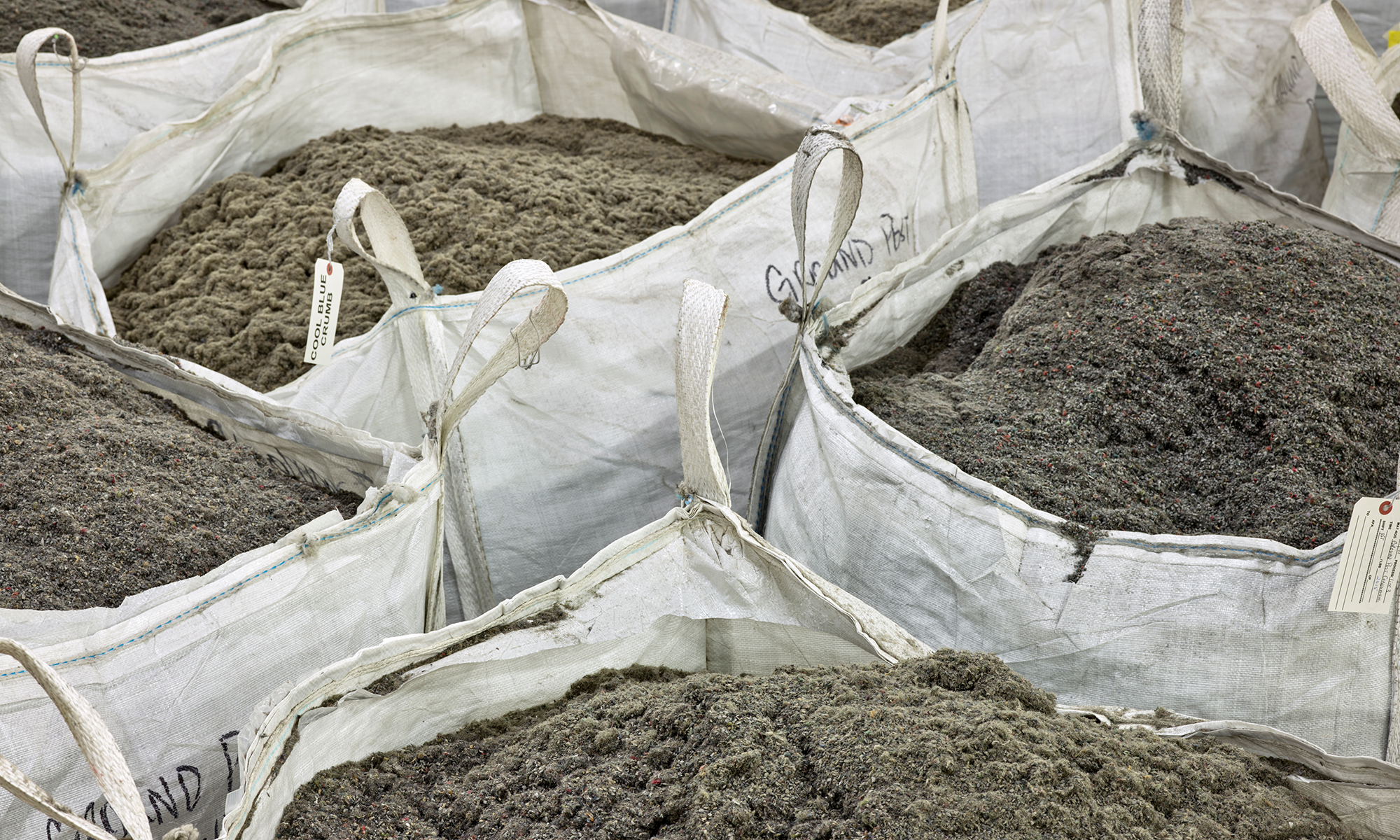
At this point, our system takes a whole tile and grinds it into a powder. That’s probably not the optimal use of some of those expensive plastics, like nylon, but it does get the product back into a form we can reliably put into most of the products we’re making right now.
Of course the other part of that is that you have to have logistics in place to actually take it back. You have to have a system that people can actually use. Because we tried the ‘we’ll pay for anything, we’ll take anything’ approach and we got some stuff that looked like a crime scene. So we have to find the right balance where we actually get material back, but only material we can actually use, because the economics break down really quickly.
If you’re taking back material you don’t have a solution for, and you have to pay someone else to waste the energy and incinerate it, that’s not a business model. It’s not economical, and it’s not something you can reliably keep doing.
AR: The other exciting part of Interface’s circularity story is bio-based materials. I remember being at a trade show in Chicago the first year Interface introduced bio-based plastics into your product. What set you down that path? And why are bio-based materials an important solution for the circular economy, alongside producing durable products and making sure we have a way to take them back and turn them into new forms?
MD: In 2017 we launched the prototype, which is what you would have seen. The year before, at NeoCon, we launched our new mission. Our previous mission had been about doing zero harm, but that wasn’t enough. We had to figure out how to run a company in a way that contributed to reversing global warming. So we sent our R&D teams out and said, “You’ve got to show that it’s possible for a manufacturer to make a product that could help reverse global warming.”
For that first prototype, they went out and tested all these bio-based materials—materials created by nature pulling carbon out of the atmosphere and turning it into something—and figured out how to make something that looked like a carpet tile.
So that prototype had a negative two-kilo-per-square-meter footprint. They accomplished what they needed to: it performed well on the floor. But it was really expensive to produce the six or seven tiles we made for the prototype, so we had a lot of work to do to get that to commercialize.
There were all these cool materials—seashells, and materials similar to rayon. Some of it was either not economical or not durable enough, so we had to immerse ourselves in the world of materials and captured carbon, and then narrow that down to what we could economically turn into a high-performance flooring product.
But of course, where bio-based materials become important is that they allow you to go beyond zero. Bio-based materials let you store carbon in a product, whereas recycled materials are always lower impact—maybe even close to zero—but they don’t necessarily let you create a product that actively stores carbon.
I also like to point out that bio-based materials leverage the fact that nature already has a circular economy for carbon. On the front end, we already have this cycle where carbon goes into the atmosphere—sometimes from nature, sometimes from us—and then is cycled out, turned into a leaf, grass, or shell. We’re leveraging that front-end circular economy that nature already provides, and then we just have to figure out how to make it work on the back end.
JL: I think that’s really well put, Mikhail. The system we have in place for managing our carpet tile backings now reflects the growth of those two platforms: one with a bio-based backing—our CQuest Bio line—and the other, which is one of the very few that incorporates post-consumer recycled content, is now our standard backing. That was a big change we made over the course of the last 18 months; moving to a place where, whether you want it or not, material we’ve brought back from the field is turned into our new backing, as Mikhail described earlier.
And essentially, that becomes a lower-footprint system that allows us to serve a large number of our customers with a significant portion of it, while still giving us the opportunity to continue improving the post-consumer recycled content of tiles that have already been returned.
And then, supplementing that with a bio-based system allows us to drive toward negative carbon in some areas. There’s still room to grow in realizing that vision. But if you can bring one of those two product loops very low through recycling and circularity, and meet the rest of the need to push toward carbon negativity with the bio-based system, you can find a nice balance between the two—rather than over-reliance on one of those systems that couldn’t take you as far as both working together.
MD: Just to point out, right now we’re certified at 1 percent closed-loop material in that standard backing. Meanwhile, California has laws requiring that all carpet sold there by 2028 must contain 5 percent post-consumer carpet material. So all we have to do is move from 1 percent to 5 percent. I don’t know what everyone else will do, but we’re already on that track. We have a very incremental amount of work to do to meet that goal in California. It’s interesting to see that legislative mandate intersecting with a direction we were already heading. As a leader, that’s exactly where you want to be—you don’t want to be shocked by a legislative change because you’re already trying to do the right thing.
JL: And the fun part is that the formulation can go much, much higher than that 5 percent. A lot of it comes down to making sure we’re getting enough material back—it’s a partnership situation. We’ll need industry partners to help with that, especially listeners to this podcast. Readers of METROPOLIS are in a good position to help move that along, for sure.
Listen to “Closing the Loop at Interface” on the Surround Podcast Network.
Would you like to comment on this article? Send your thoughts to: [email protected]
Related

Viewpoints
MIT Future Fest Offered a Hopeful View of What’s Next
The inaugural five-day event brought together visionary leaders across design, technology, and art to address the world’s most pressing problems.
Viewpoints
Celebrating the Craft of Architecture
METROPOLIS’s July/August 2026 issue, produced in partnership with Architizer, spotlights 25 standout projects and practices from the 2026 A+Awards.