



January 26, 2026
Boss Design’s New Label Changes How Designers Specify
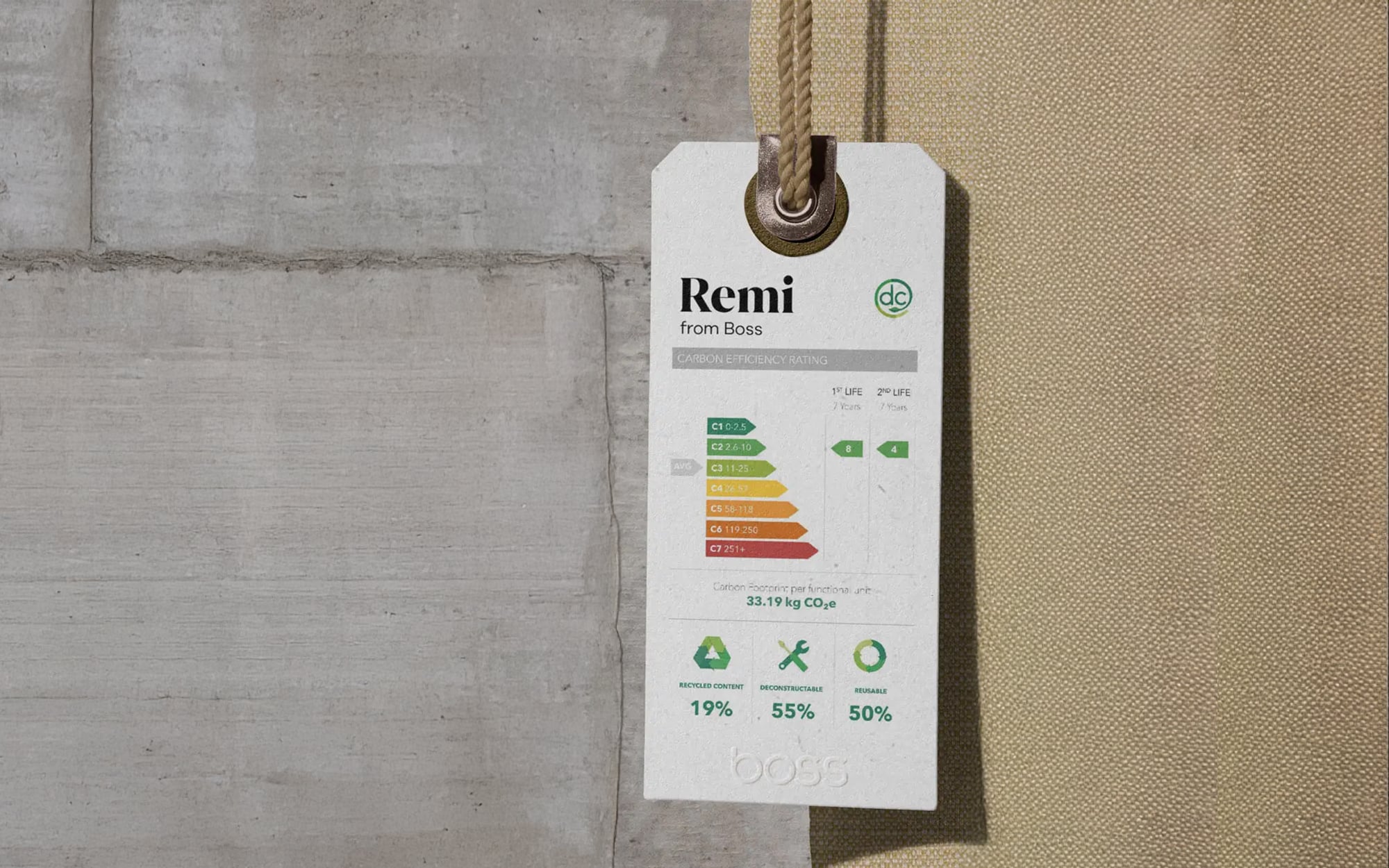
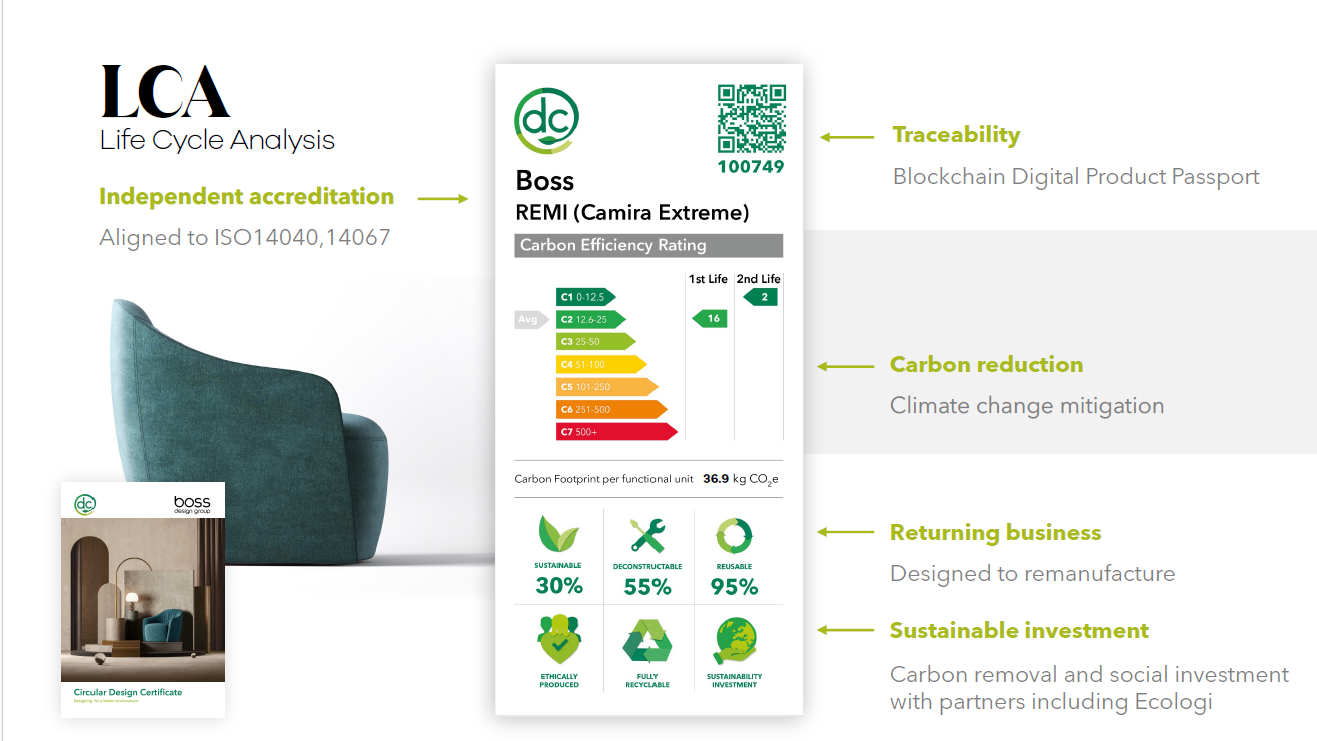
In an industry filled with acronyms—EPDs, HPDs, LCAs, FSC certifications—Boss Design has introduced something refreshingly direct: a carbon efficiency label that reads less like a compliance document and more like a conversation starter. Modeled after familiar energy-efficiency ratings, the label distills complex lifecycle data into visual clarity while acknowledging an often-overlooked truth: not all carbon footprints are created equal.
Consider two task chairs with identical carbon footprints—58 kilograms of CO2 equivalent. One lasts five years; the other continues to serve its purpose at 15 years, having been reupholstered once and relocated to a different office. For Boss Design sustainability manager Mark Winsper and creative director Ceri Lovett, this disconnect between theoretical carbon figures and a product’s actual lifespan—and second-life potential—sparked a rethink of how the industry measures environmental impact.
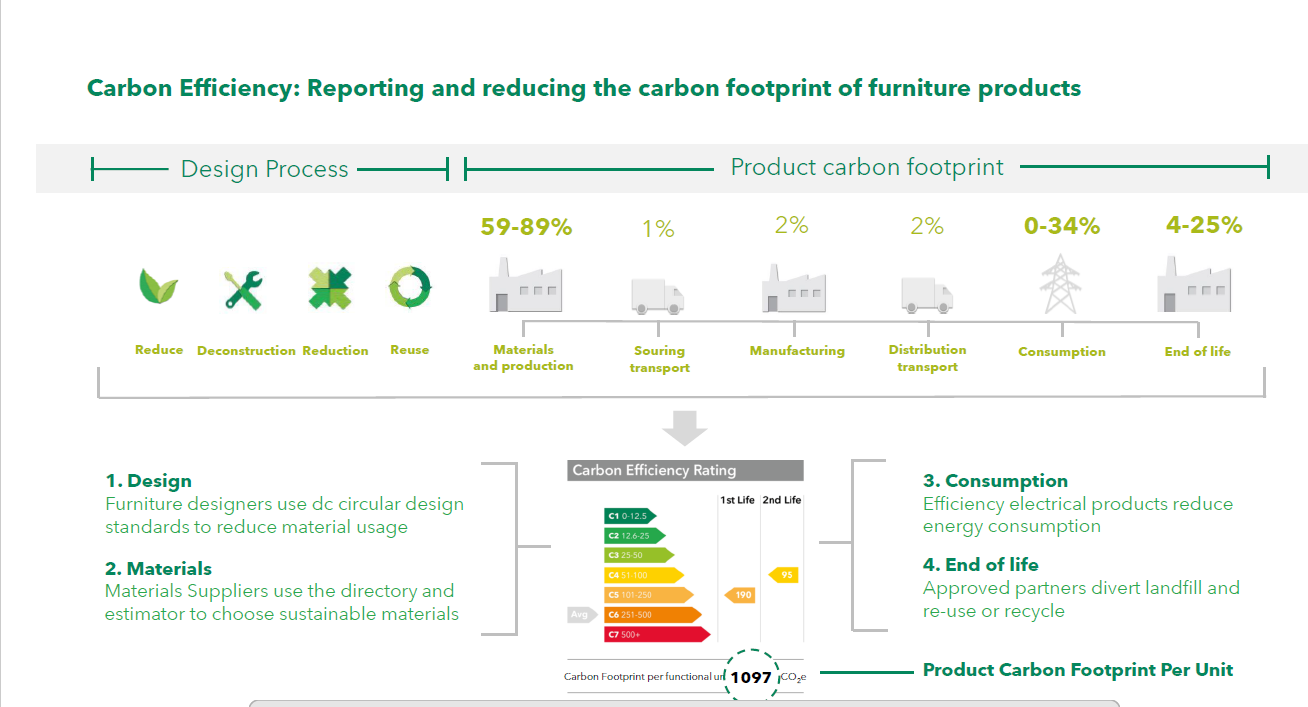
While lifecycle assessments (LCAs) document every emission from raw material extraction to gate, they often treat product lifespan as an afterthought. For Boss Design, longevity isn’t just a footnote—it’s central to carbon measurement.
Turning Lifecycle Data Into a Tool Designers Can Actually Use
That insight, Lovett says, evolved from Boss Design’s early focus on recycled content and grew into today’s labeling system through one key mechanism: conversation. “The more conversations you have, the more diverse people’s requirements are,” he notes. Designers navigating sustainability mandates kept asking deeper questions: How much material is renewable? Can the product be deconstructed? What happens at the end of life?
Each question revealed both knowledge and confusion. “Between CPD, FSC, LCAs—they all mean a lot in their silos, but it becomes confusing when you’re trying to talk to a designer who wants to do the right thing,” Lovett says. Boss Design realized that education couldn’t happen through dense documentation. The carbon efficiency label became a translation tool—visual, digestible, and comparable. Not everyone needs to parse a 20-page LCA, but everyone should be able to see whether a product aligns with their sustainability goals.
Boss Design’s label focuses on six circularity metrics: reused, deconstructable, reusable, recycled, recyclable, renewable, and second-life potential. These aren’t arbitrary—they reflect where regulation and market expectations are heading.
“This is a growing trend we’re seeing,” Winsper says. “As a manufacturer, we have to be ready for it. We have all the facilities to take a piece of furniture, reupholster it, mend it,” Winsper notes. What once might have been seen as repair services now positions Boss Design at the center of an emerging circular economy.
Making Sustainability Click at a Glance
In showrooms and specification meetings, the labels, with their simple visual format, prompt immediate engagement. “At first people don’t recognize it because it’s not something they’ve seen before, but then it just clicks. It’s transparent, it’s obvious,” Winsper explains. Boss Design worked with Design Conformity, an organization backed by university research, to ensure third-party verification. Design Conformity reviews comparable products across the market, contextualizing Boss Design’s ratings within the competitive landscape.
Not every designer has the time or expertise to evaluate competing sustainability claims. By presenting information in an accessible format, Boss Design lowers the barrier to informed specification. “You don’t have to understand all of it,” Lovett says. “You just need to know what’s relevant to you—and that the data is there.”
As the market shifts toward circularity, companies built on disposability will need to reinvent themselves. Boss Design’s advantage is that it’s been playing the long game all along. It just needed the right way to tell the story. The carbon efficiency label simply makes that story visible.
Would you like to comment on this article? Send your thoughts to: [email protected]
Latest

Profiles
Beyond Symbolism: Farshid Moussavi on the Ismaili Center in Houston
The cultural building and community center reinterprets Islamic design philosophy through geometry, climate-responsive design, and generous civic spaces.

Projects
Art Stages Built Into A Hillside & An Old School
PS21 and The Campus Upstate are reimagining cultural infrastructure from within.