


September 27, 2022
Gregor Sailer’s Photographs Explore Architecture’s Political, Military, and Economic Implications

Just taking one shot per subject, Sailer’s photographs are devoid of human life. The son of an architect, he often portrays buildings as self-contained solitaires and thus elevates them to independent aesthetic structures with a sculptural presence—a look reminiscent of the work of Bernd and Hilla Becher.
In addition to working with a view camera, Sailer and the Becher’s common preoccupation is the use of evenly diffused light, as shadows or reflections mean atmospheric distractions.


Sailer studied visual communication from 2002 to 2007 at Dortmund Academy, placing his focus on photography and experimental film. This time brought him in touch with the “Düsseldorf School” of seeing, a term coined by the meanwhile legendary first generation of Becher students.
While there are typological approaches, Sailer’s work isn’t as exclusively and consistently defined by it as the Becher’s. Ignoring the too striking and too literal, Sailer uses architecture in his pictures to sensitize people to socially critical issues in a roundabout way.

His latest show, titled Unseen Places is on view through February 19, 2023 at Kunst Haus Wien in Vienna. “Gregor Sailer is a photographer who gives a lot of thought to his compositions, and with his elaborate pictures counteracts the fast-moving, volatile floods of images by offering tranquillity and precision instead,” says Verena Kaspar-Eisert the exhibition’s curator.

Gregor Sailer, military station, Norway, 2020, from the series ‘The Polar Silk Road’ © Gregor Sailer, image right Vienna 2022 
Gregor Sailer, research station, EastGRIP, Greenland, 2019, from the series ‘The Polar Silk Road’ © Gregor Sailer, image right Vienna 2022 
Gregor Sailer Portrait, KHW 2022 © Elsa Okazaki
Would you like to comment on this article? Send your thoughts to: [email protected]
Latest

Products
6 Material Trends Shaping Interior Design
From playful plaids and painterly botanicals to sculptural forms, discover what’s next in textiles, surfaces, and acoustic products.
Viewpoints
Are Data Centers the Biggest Design Problem of This Era?
AI is driving a data center boom. Can architects rethink the typology to meet growing demand without overwhelming communities and ecosystems?
Projects
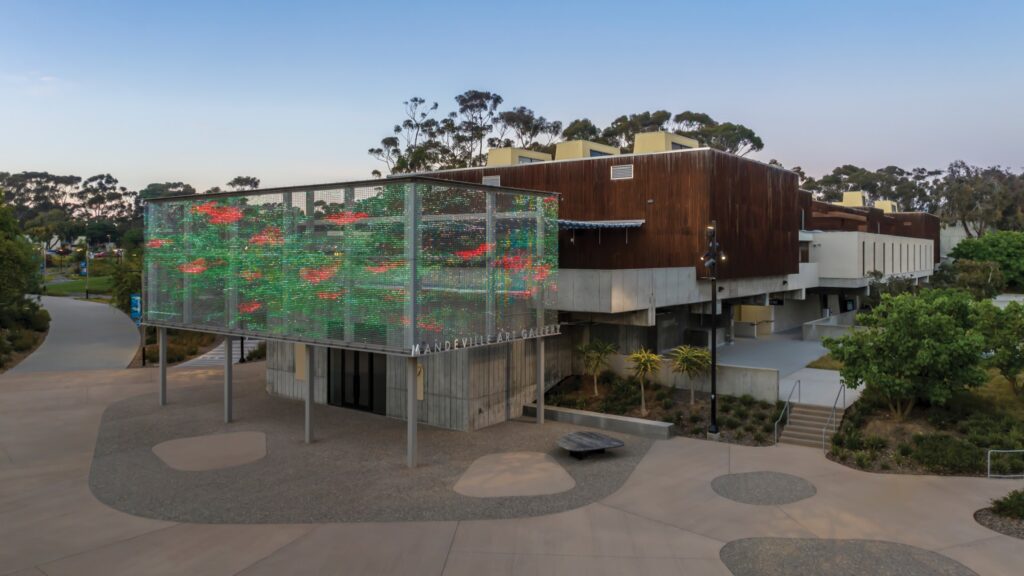
UC San Diego Transforms a Facade into a Dynamic Display for Digital Art
With the help of Studio E Architects, The Mandeville Center for the Arts now showcases innovative art, inside and out.