


November 5, 2026
7 Takeaways from Sustainability Leaders at Greenbuild 2026
As the architecture and design industries continue to confront the environmental costs of construction, the conversation around sustainability is shifting from carbon metrics toward a more systemic question: How can the built environment move away from a culture of consumption and replacement toward one of reuse, repair, and regeneration?
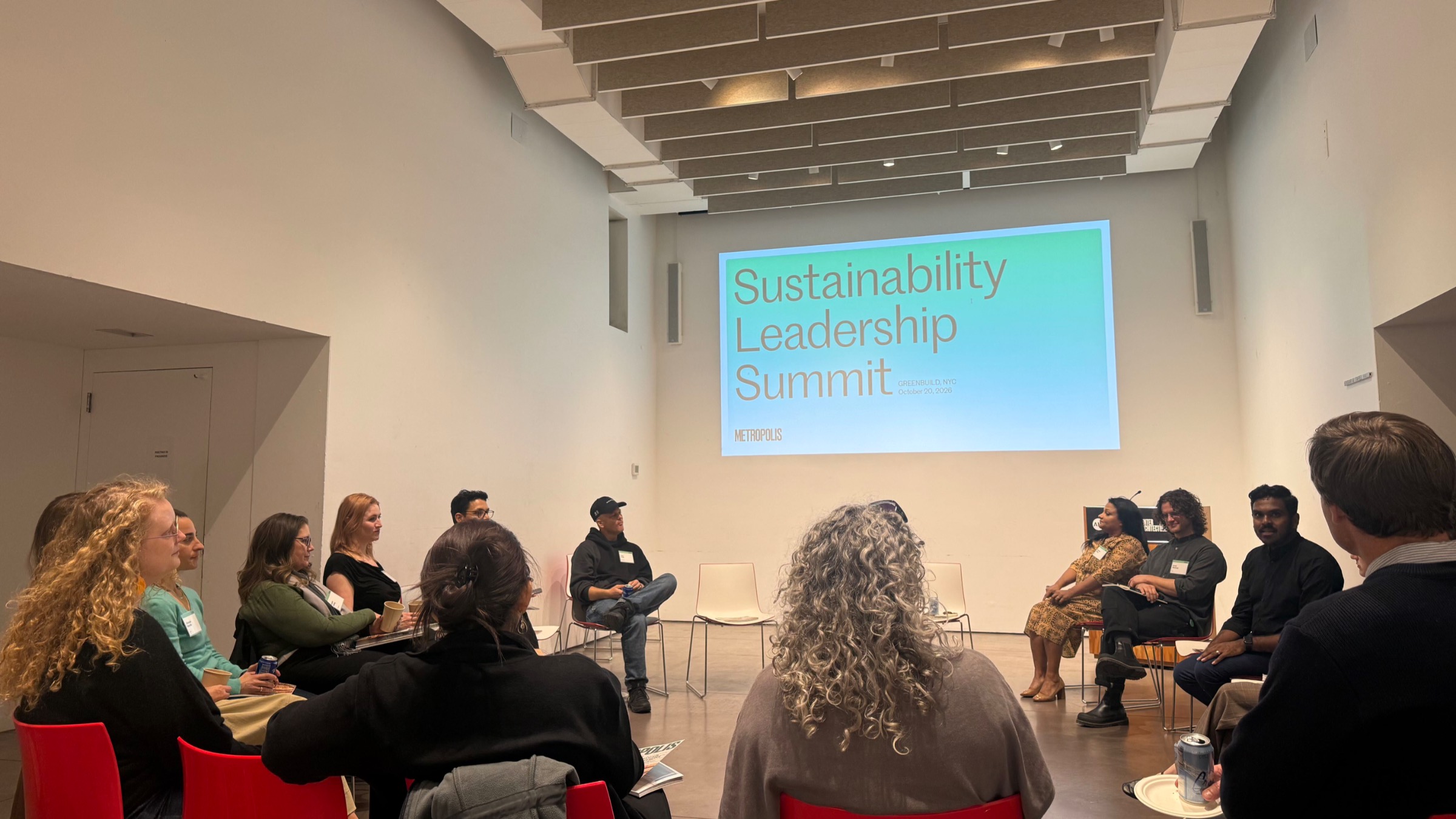
At Greenbuild 2026 in New York, METROPOLIS Editor-in-Chief Avinash Rajagopal convened a group of sustainability leaders, architects, designers, and manufacturers for a roundtable discussion exploring two interconnected subjects, circularity and beauty, and its impact on design culture and the industry.
01 Circularity must become a process across design scales, not an individual initiative
A clear message from the discussion was that circularity still depends too heavily on “individual champions.” Architects and interior designers may be committed to salvaging materials, but without established procedures and procurement requirements among project teams, opportunities are easily lost.
While adaptive reuse and retaining existing building elements are gaining popularity, furniture remains a more complicated category. Christine Vandover (HOK) observed that clients in New York are increasingly willing to reuse materials during tenant improvement projects, but refurbished furniture and secondhand products present additional challenges.
Designers must spend considerable time sourcing and assessing individual pieces, often without additional compensation. Allison Smith (HKS) pointed to another opportunity: designing interiors around fewer furniture types and products. Standardizing certain selections, retaining existing frames, replacing upholstery, and refurbishing components can extend product life while making future maintenance more manageable.
02 Take-back programs need to begin at specification—not demolition
Manufacturers have made progress establishing take-back programs, but the panel highlighted a persistent problem: what happens to a material 10 or 20 years after installation, when the original designer, contractor, and facilities team may no longer be involved? Moniqua Minter (Interface) discussed the importance of communicating take-back opportunities at the beginning of a project rather than treating them as an afterthought.
She also acknowledged the need for better tracking systems, including QR codes, and material documentation. Circularity requires considering a material’s end-of-life pathway when specifying it. Otherwise, even products designed for recovery can become construction waste simply because nobody knows where they came from or what to do with them.
03 Regulation and economic incentives can change the equation
Good intentions alone will not overcome the financial and logistical barriers to reuse. Contractors may perceive deconstruction as additional labor and expense, particularly when conventional demolition and disposal are already embedded in established business models. Yet Gracia Anderson (Shaw Industries) offered a different perspective: recovering materials can actually generate savings for contractors by reducing disposal and tipping fees. The discussion suggested that effective policy should support both manufacturer take-back programs and broader, shared recycling infrastructure rather than relying on individual companies to manage the entire process.
A circular economy needs more than products that can theoretically be recycled. It requires places and businesses that can collect, store, and redistribute recovered materials. The group highlighted the Lifecycle Building Center in Atlanta as a model for a more comprehensive approach, bringing together material recovery and local workforce development. Participants also discussed an emerging reclamation initiative in New York’s Hudson Valley, the Ulster County Resource Recovery Agency, intended to serve a broader regional network while training deconstruction crews. Ariane Laxo (HGA) emphasized these centers’ potential to remove multiple barriers at once. Reclamation centers could make secondhand materials easier to source and specify—and potentially establish viable regional business and educational models across the whole industry.
04 Recycling is not the same as circularity
One of the most important distinctions raised during the conversation was the difference between diverting materials from landfill and actually closing the material loop. Jack Rusk (C.Scale) discussed the challenges facing companies such as Chief Bricks, which reclaims and reuses existing masonry. Recovering bricks is only half the challenge; getting them specified and installed in another project is equally important.
This requires architects to understand reclaimed products, contractors to trust their performance, and project specifications to accommodate them. The discussion also raised questions about structural materials, which represent a significant portion of a building’s embodied carbon but are particularly difficult to recover and reuse in new construction. Ultimately, preserving an existing structure remains the most direct way to avoid the processing, transportation, and replacement impacts associated with new materials.
05 Beauty and sustainability should not be opposing values
The assumption that new materials and products are inherently more desirable than existing ones is a cultural challenge. The core question was whether the design industry so often associates newness with quality and progress. Ramya Shivkumar (BEYOND-HLW) suggested that simplicity, adaptability, and utility allow objects to remain relevant across generations.
If reuse is to become culturally desirable, the industry may need to rethink its relationship with perfection. Drew Shula (Verdical Group) proposed that the beauty of reuse lies partly in imperfection, arguing that cities themselves are layered environments shaped by successive generations rather than pristine, finished objects.
Minter reinforced the importance of storytelling, arguing that designers and manufacturers need to communicate the real value of reuse through compelling, truthful narratives rather than generic sustainability claims. A recovered material is not simply an alternative to a new product; it can carry a history that a newly manufactured product cannot replicate.
06 Design can transform the perception—and market value—of reclaimed materials
The challenge is not simply convincing clients to accept secondhand products. It is demonstrating what thoughtful design can make possible with them. Participants discussed how reclaimed materials can be repositioned through creative applications, new combinations, and unexpected uses. It also raises a broader question about designers’ role in the circular economy: Can architects and interior designers become agents of material transformation rather than simply selectors of new products? The group also considered the value of making reclaimed materials easier to discover through accessible marketplaces such as Orbit Exchange, which help integrate secondhand sourcing into designers’ existing workflows.
07 Sustainability needs a cultural narrative, not just better metrics
The final takeaway was perhaps the most challenging: making sustainable design mainstream requires changing what society considers desirable.
The discussion extended this idea to architecture, where an existing building can be seen as less valuable than a new development, regardless of its potential for adaptation. Rajagopal observed that the design industry and media play an active role in shaping these perceptions, pointing to how biophilic design has evolved into a widely accepted architectural value.
The group also considered how physical spaces themselves can communicate sustainability in an increasingly digital culture.
Buildings are becoming backdrops for the images and stories people share online. Their materiality, authenticity, and relationship to the environment can therefore become part of their cultural appeal.
The Bigger Picture
The Greenbuild 2026 discussion highlighted that the transition toward circularity is not exclusively a technical challenge. The industry already has many of the necessary tools, from material take-back programs and lifecycle assessments to reclamation centers and digital marketplaces.
What remains is the difficult work of connecting these resources through policy, business models, design education, and cultural change.
Perhaps the most consequential shift is moving away from the idea that sustainability means producing a better version of something new and toward developing the systems and design sensibilities to keep the value of an existing building and object alive.
The 2026 METROPOLIS Sustainability Leadership Summit series was hosted in partnership with:
Formica continually strives to create surfacing solutions that support sustainable design and contribute to a healthier environment. In 2025, Formica Brand Laminate and Formica Compact achieved 72% Biobased Content certification from the USDA’s BioPreferred Program.

For over 70 years, iF Design is known for outstanding design and social engagement. The iF DESIGN AWARD is a major seal of design excellence around the world, and sustainability criteria represent 20% of the total evaluation scores.

Built for the full life cycle, Interface products and endure. So they stay in use longer and reduce impact at every stage. The company harnesses low-carbon materials and pioneers flooring that can be reused, recycled, or repurposed.

Samples from Material Bank are now supercharged with MTag. See color ways, search for similar samples, or call your rep: all one tap away. Material Bank samples are delivered overnight, always free.
Shaw Contract designs all products with the end in mind. From the Ecologix® backing, to Reworx™ products, and the re[TURN]® reclamation program, it invites customers to participate in the circular economy.
Would you like to comment on this article? Send your thoughts to: [email protected]
- No tags selected
Latest

Products
6 Material Trends Shaping Interior Design
From playful plaids and painterly botanicals to sculptural forms, discover what’s next in textiles, surfaces, and acoustic products.

Viewpoints
Are Data Centers the Biggest Design Problem of This Era?
AI is driving a data center boom. Can architects rethink the typology to meet growing demand without overwhelming communities and ecosystems?