November 3, 2026
Data Centers: Rethinking the Typology
The speed at which data centers morphed from inconspicuous curios to controversial gigawatt-scale campuses parallels the rapid uptake of AI. The numbers are staggering. Hyperscale data centers, which house 5,000 or more servers and draw at least 100 megawatts of power, will account for two-thirds of all capacity by 2031, according to Synergy Research Group. By 2050, data center servers alone will consume up to one-third of total commercial building electricity use, the U.S. Energy Information Administration estimates.
Breathtaking stats on land and water usage likewise abound. Still, one metric is particularly germane to architecture: Data center construction has exceeded a seasonally adjusted annual rate of $50 billion, according to the U.S. Census Bureau, making it the largest segment in private office construction. As everyday workflows and research breakthroughs have become reliant on AI, so too has the building sector.
Viewed with an optimistic lens, data centers are the design problem of this era. Meeting their resource demands while benefiting communities and ecosystems requires systems thinking and holistic solutions of the highest order—which is why industry leaders are stepping in.
Energy and Engagement
Designers can help developers reduce the environmental impact of their data center templates and builds by recommending the use of lightweight or prefabricated shells, low-carbon concrete, and a flexible topology to maximize building lifespan, says Jennifer DiMambro, the global science, industry, and technology leader at Arup. But according to the company’s research, more than 80 percent of a data center’s carbon emissions come from its operation: powering and cooling computing hardware. On-site generation and battery storage can offset demand slightly, but for the foreseeable future, clean power purchase agreements provide a short-term solution. Already, data centers are moving away from resource-intensive air- and evaporative-cooling methods to liquid cooling, which uses dielectric fluid in a closed loop, DiMambro says. “There’s nothing burning off or disappearing from the system.”
Beyond improving performance, Arup believes, data centers can be good neighbors. The firm has developed community engagement plans for clients to encourage up-front conversations and transparency. That proactive approach “is certainly not widespread,” DiMambro says, “but could become the growing trend. However, as data center design becomes more sophisticated alongside the quite negative publicity at the moment, we’re going to see [developers] take engagement.”
Municipalities also need help updating their zoning guidelines to account for next-generation data centers. The fact that the projects’ resource demand and externalities seem unethical but are often entirely within the law only heightens tensions between local officials and residents, DiMambro says. The Global Urban Data Centres Pact, a C40 Cities initiative for which Arup provided technical expertise, offers a framework for local leadership and utility companies to have an “informed conversation with data center operators,” she says. Ultimately, she hopes, we will “see a much more balanced approach to development.”
Values and Accountability
Global developer Iron Mountain Data Centers (IMDC) stands apart from the cutthroat industry due to its commitment to decarbonization and willingness to share its progress. It has committed to matching its portfolio’s energy usage to 24/7 carbon-free electricity by 2040 and to pursuing green building certification on all new colocation projects. To date, 12 data centers have received BREEAM ratings from “very good” to “outstanding,” according to the developer’s latest sustainability report. “We oftentimes find that reducing carbon also reduces costs,” says Chris Pennington, IMDC’s senior director of energy and sustainability. “It actually saves money to make a greener building.”
To minimize its portfolio’s cooling load, IMDC is exploring technologies such as highly efficient magnetic-bearing chillers and free-air cooling, where windows or doors automatically open to leverage nighttime air. Industry-wide, backup power still relies heavily on fossil fuels, but Pennington sees movement toward Tier 4 generators, which meet the Environmental Protection Agency’s strictest emissions standard. IMDC is currently outfitting an existing data center in New Jersey with utility-scale batteries to help the local grid shed load when burdened, with the hope of demonstrating “how data centers can be part of grid solutions,” he says.
IMDC also provides a critical downstream service: e-waste recycling. Unlike data center facilities with decades-long lifespans, the IT equipment they house lasts three to seven years tops. “A very big piece of our business today,” Pennington says, “is enabling a lot of materials to stay in the circular economy.”
Paradigm Revamp
The spread of data centers “like mushrooms” merits a deep interrogation of the typology itself, says architect and data center researcher Marina Otero Verzier: Why have “we quickly accepted that we have to design around the needs of data centers instead of thinking what are our needs as a society and how data centers could be designed to support those?”
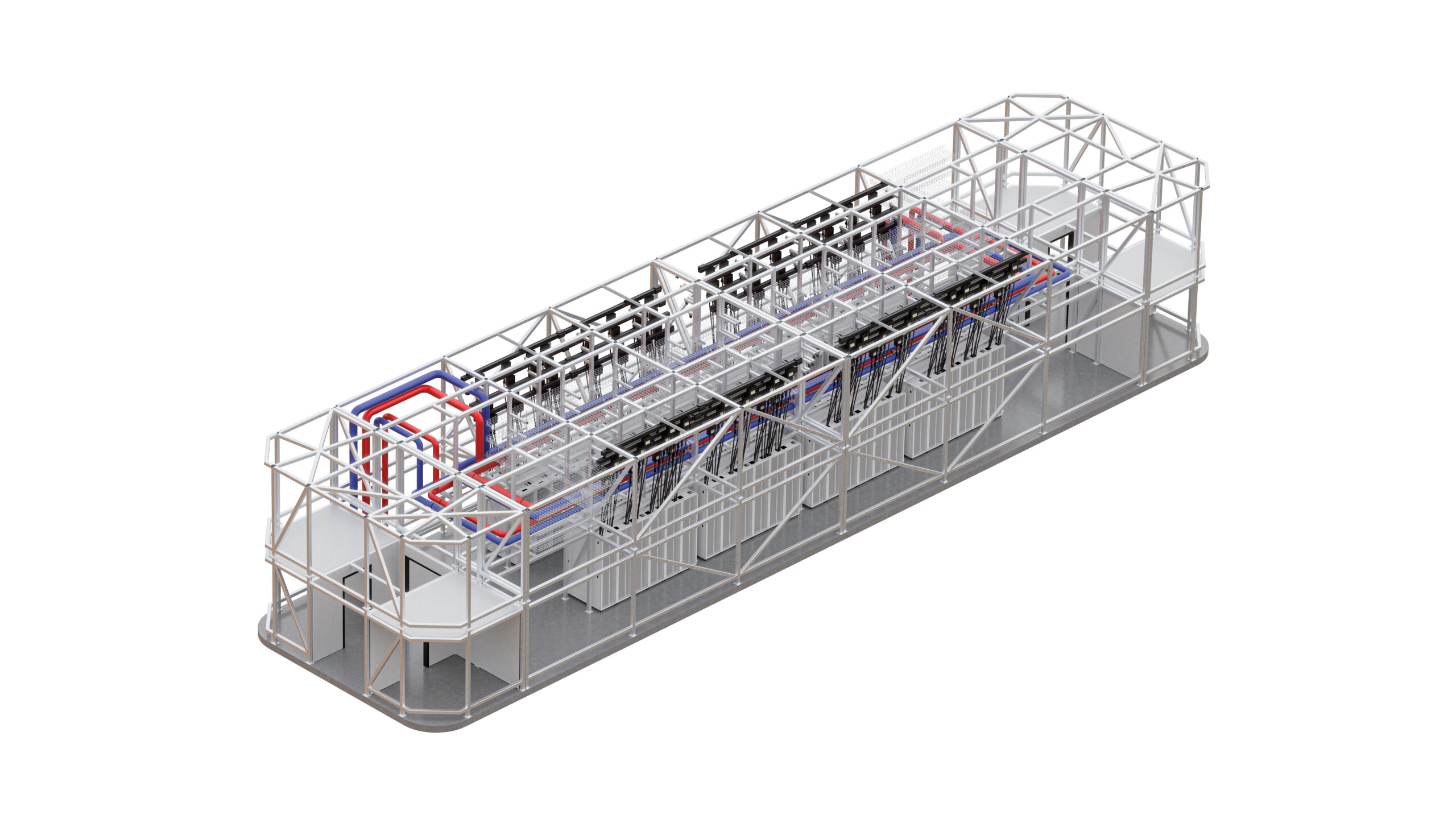
Enter Flexnode, a start-up whose founders come from multidisciplinary architecture and engineering backgrounds. With funding from tech giants and Arup Ventures, the consultancy’s venture-capital arm, Flexnode applies the benefits of modularity and factory construction to data centers. Its flagship, NX module, at 28 feet wide, 100 feet long, and 18 feet tall, can support 4.5 megawatts of IT load. Up to four modules can gang together in a monocoque enclosure that integrates building systems from lighting to perimeter security, says chief growth officer Zak Kostura. “You don’t need anything else on the site except for a concrete pad.”
NX’s scale allows developers to activate small land parcels within neighborhoods with limited grid availability. Data center modules, Kostura envisions, could become forms of civic infrastructure as commonplace as post offices. “It doesn’t create a heat island effect because of its scale,” notes Flexnode creative director Alex Harristhal, “and it is rightsized for the deployment.”
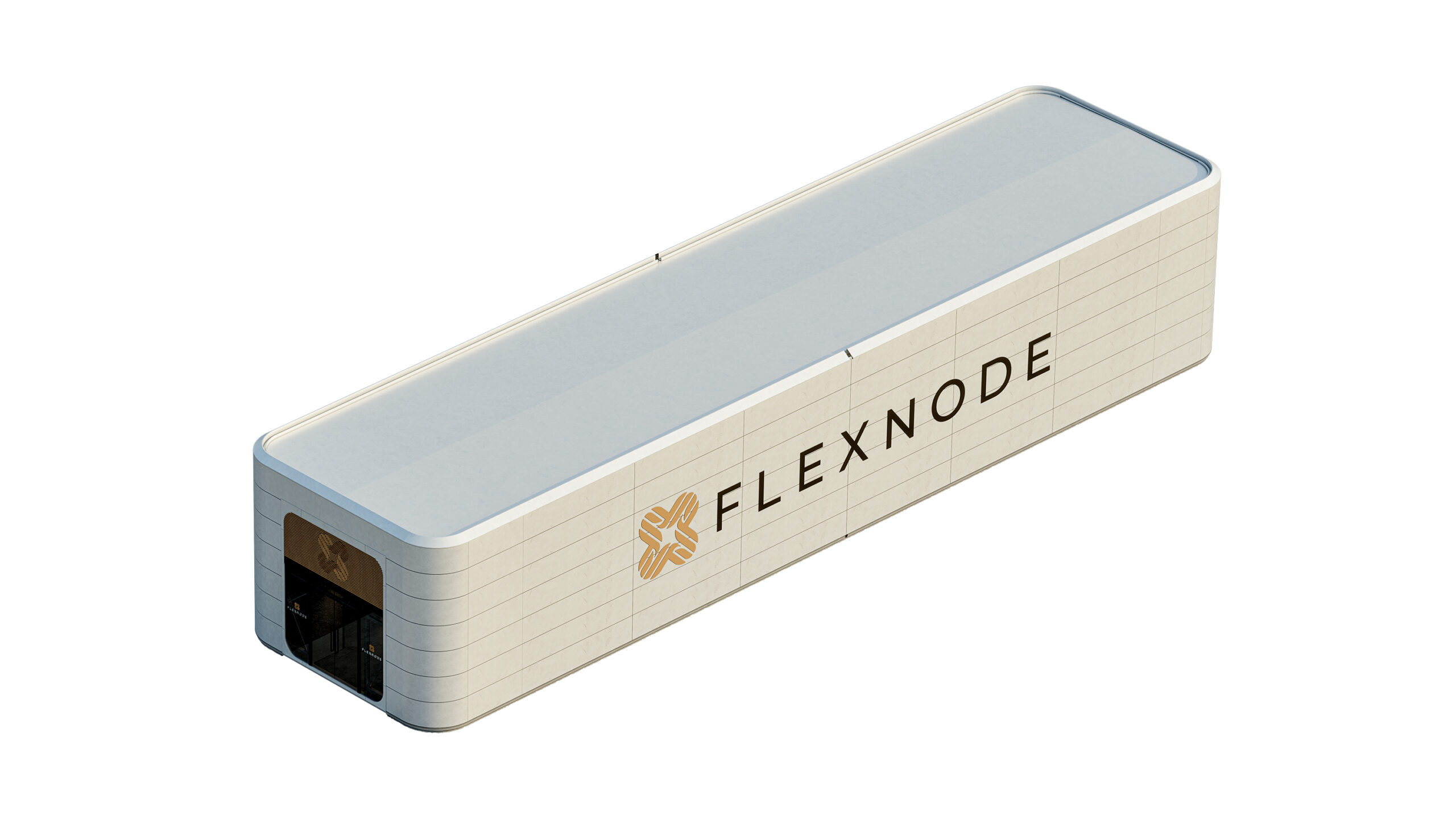
Multiple, distributed NX clusters can subsequently interconnect to deliver the computing power of a centralized data center at a competitive cost per megawatt, Kostura says. The first modules are now in domestic production and will be ready for on-site commissioning by early 2027.
Wrong or right, data centers have become a proxy for many things: the power grab of local resources by billionaire tech companies and a loss of agency to the products they create. “We’re on a really early part of this AI journey,” DiMambro says, and she expects the growing pains to ease over time. “It’s not really about technology versus people or communities. It’s about how the two can come together … and forge a way forward.”
Marina Otero Verzier on Data Centers
Having toured approximately 30 data centers since 2015, Marina Otero Verzier knows the innovations touted as solutions for the typology—such as repurposing waste heat for district-wide heating, greenhouses, and even swimming pools—and her excitement about them has faded. She has seen promising prototypes fail to sustain success and investment. With the frenetic pace of change in AI, she says, “the industry wants to have a few things known and, unfortunately, that is the architecture [of it].”
Now the architect and researcher believes real efficiency gains can come from rethinking our need for immediate access to high-resolution data on the cloud. “Perhaps the digital space has rhythms similar to the city,” she says, in which access is slowed in the evening, on weekends, or when the electric grid is stressed.
Or data centers could handle digital assets like public libraries, where information needed daily sits on shelves, information needed occasionally requires a nominal retrieval period, and the rest is disposed of after a period of disuse. Hot, warm, and cold data could likewise be stored using the most appropriate and efficient technology, she imagines. And the tool to categorize the troves of organic and synthetic data amassed? Artificial intelligence.

Designing the Data Center as a Machine
With AI reshaping the scale, technology, and energy demands of data centers, Neil Sheehan of Woolpert discusses what architects need to understand about the design of the infrastructure behind the cloud.
By Francisco Brown
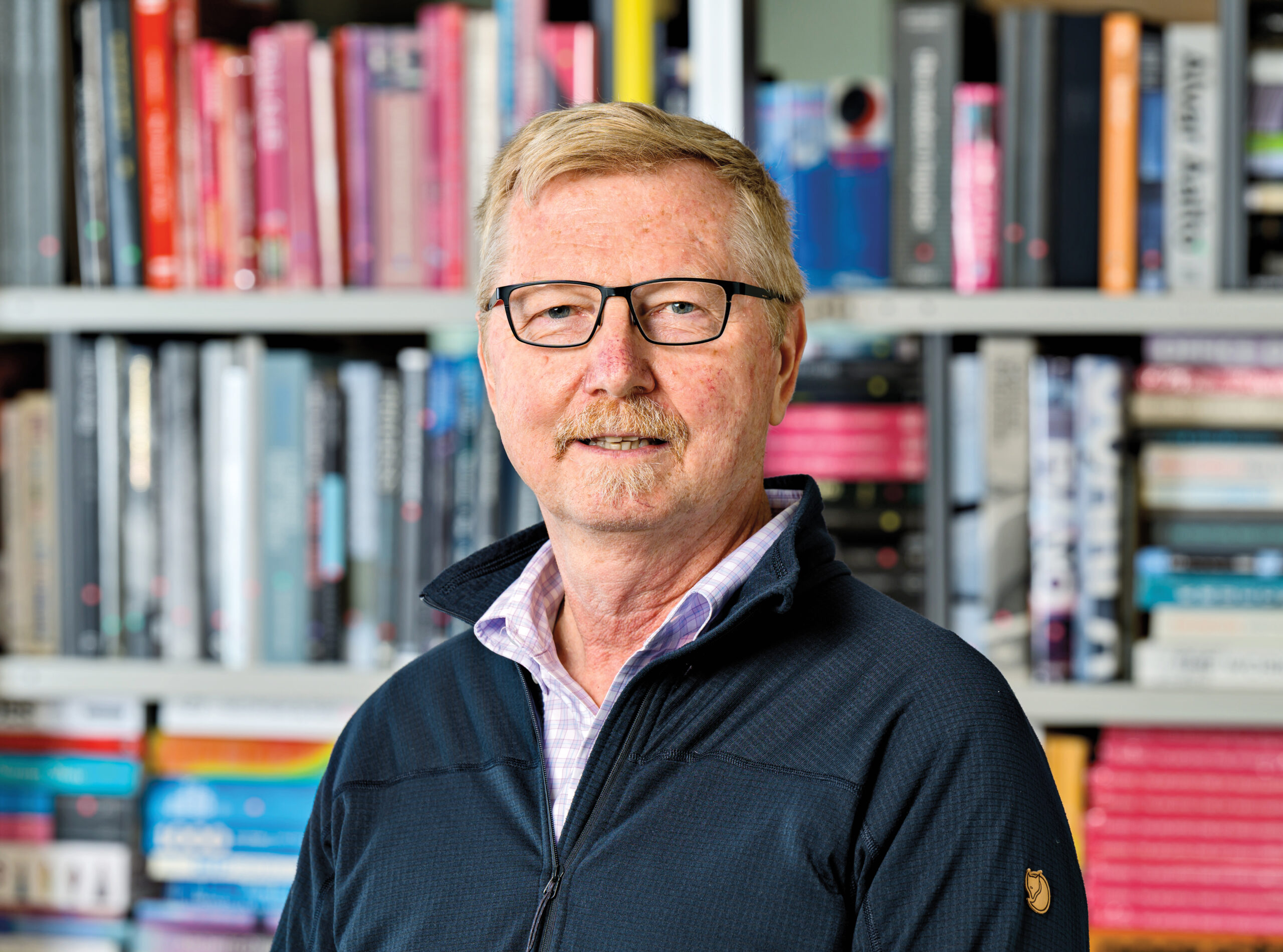
For more than two decades, Woolpert grew to become the third largest data-center-design firm in the U.S. METROPOLIS senior editor Francisco Brown talked to Woolpert’s mission critical market director, Neil Sheehan, about an increasingly essential piece of global infrastructure.
FB: Beyond scale and speed, what has changed most dramatically in the architecture of data centers?
NS: The technological change underway now, aside from the velocity and scale, is the change to liquid cooling of the computers. That may seem like a modest change, but it has implications for the entire configuration of the building and how you think about it.
We’re also seeing changes in backup power, particularly for AI applications that can be turned on and off, a difference from previous generations of data centers. Also, the computer industry buys an amazing amount of diesel generators. Nobody likes them. However, we are beginning to need fewer of them because we don’t necessarily need to maintain that full, 24/7 uptime for a lot of applications. For some projects as well, we’re able to substitute the generator—which comes in a big box—for that same big box filled with batteries.
FB: Just like previous revolutionary infrastructure changed cities, it also disrupted communities in the past. How can architects help address and mitigate the environmental and community impacts of data centers?
NS: There are engineering factors and then community and public factors. The engineering factors are actually very addressable. Take water. We don’t need to use water for cooling.
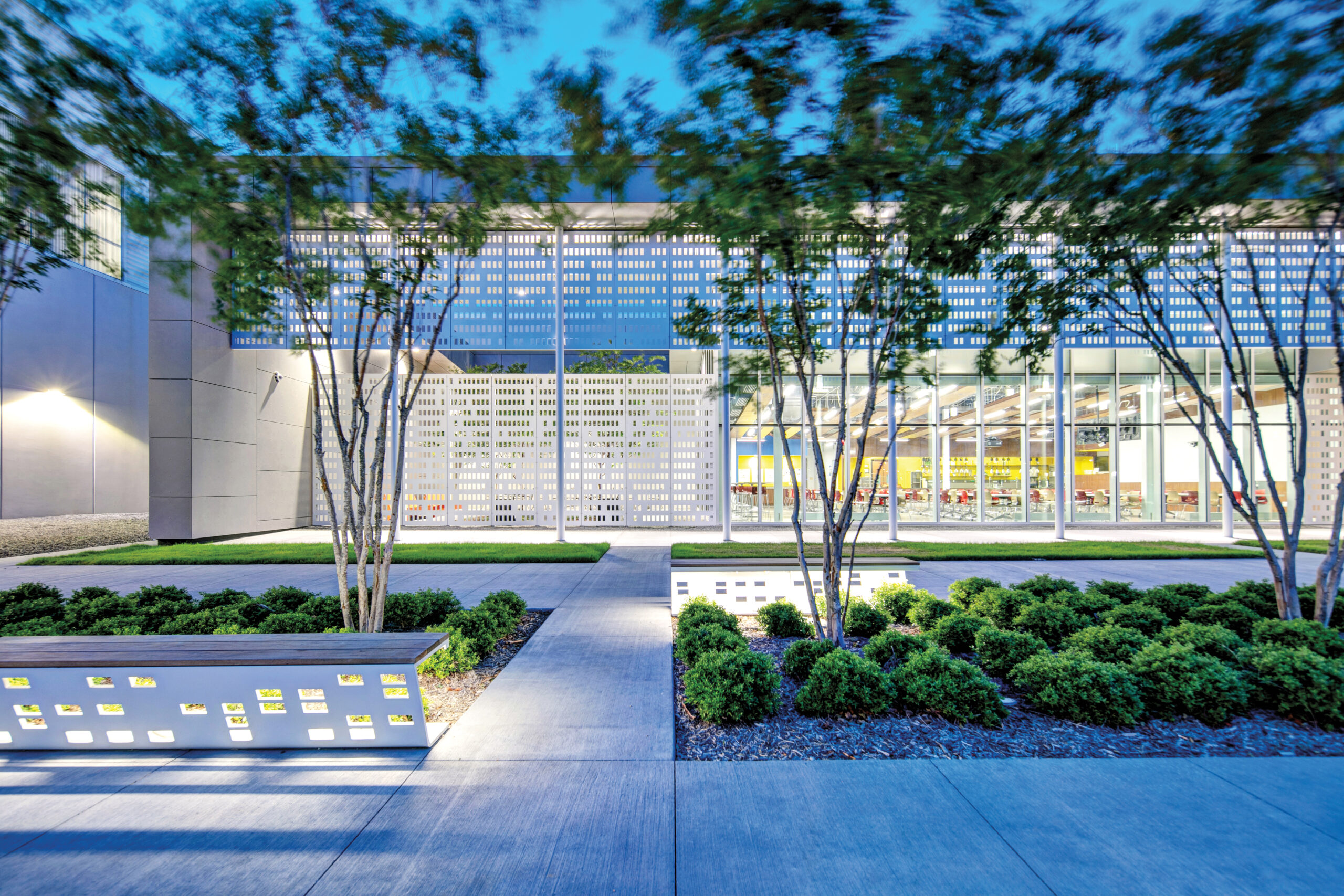
We’ve had clients expand water treatment facilities in communities or take water returning to a treatment plant and use that water for cooling instead.
One client worked with a municipality to evaluate its water system across the entire community, found all the leaks, and plugged them.
Electricity is another issue. There are instances where the added power demand of a data center can temporarily increase residential power rates. That’s a flaw in the system that sets rates, and the industry is working with those instances to restructure how rates are calculated. In many cases, data center companies are more than happy to pay for the utility upgrades necessary to support the facility, which makes the system around it more robust. In addition, particularly the biggest hyperscale clients we work with, they all have zero carbon commitments. They’ve done extensive solar and wind power purchase agreements across the country.
Noise is another issue we pay attention to more than just about any other because, as architects, we’re responsible for solving that one. Noise is manageable, and the site selection is critical. It’s best not to have homes nearby. Where noise is a severe problem, particularly in urban locations, it can become an architectural solution: Equipment can be placed inside, with acoustic louvers allowing airflow while controlling noise.
FB: What about the broader conversation with communities?
NS: As the industry has grown, we’ve fallen behind on this issue. Across the industry, everybody recognizes it. There’s a growing effort to communicate with communities in a very clear and honest way.
For example, a client of ours, QTS, has a fantastic website to communicate with the community about its plans, show them clearly, answer questions, and address matters as they arise. Community leaders want to be able to say yes to a data center because the revenues and tax advantages can be significant, but they also have to address citizen concerns.
We’re having more meetings with local communities about what can be addressed, what can’t be addressed, and what is ultimately up to the community to decide. Within Woolpert, we’re working to develop resources to support clients with community outreach, public communications, and evaluating the risks of a particular location.
FB: How are you approaching operational and embodied carbon?
NS: A couple of members of our team have been working with a client to evaluate heavy timber construction and stress-skin—essentially, all-wood construction.
What was interesting was that before we embarked on it, we looked at the U.S. supply chain. What we learned was that there wasn’t enough product available to serve the demand we were about to create. So, we started by working on the supply chain and then resolved that into design.
The other aspect is power. Our clients are committed to solar and wind and, to some degree, geothermal. But when they’re doing on-site generation, it’s almost always natural gas. Some clients use fuel cells, which are more carbon efficient than a single-stage turbine generator but less efficient than a dual-stage turbine generator with heat recovery. Those solutions are considered temporary, but there’s no denying that the industry is driving more power demand.
FB: Finally, what do architects need to learn to adapt to this rapidly changing typology?
NS: They’re the things that you learn as an engineer, and they’re based on physics.
We always have a saying in our office: “You can’t fool physics.” You can ask for something, but the physics is going to drive what you’re doing. And then there are the tools. We’ve put so much time, energy, and care into making sure we’re delivering the tools our clients need to have the building constructed.
Would you like to comment on this article? Send your thoughts to: [email protected]
Latest
Projects
UC San Diego Transforms a Facade into a Dynamic Display for Digital Art
With the help of Studio E Architects, The Mandeville Center for the Arts now showcases innovative art, inside and out.

Viewpoints
A Whole-Systems Approach to Design for Autism
This new ASD Design Matrix can help designers apply new scientific insights while designing spaces that consider autistic people’s experiences.