



April 6, 2026
What are the Implications of AI for Interior Design?
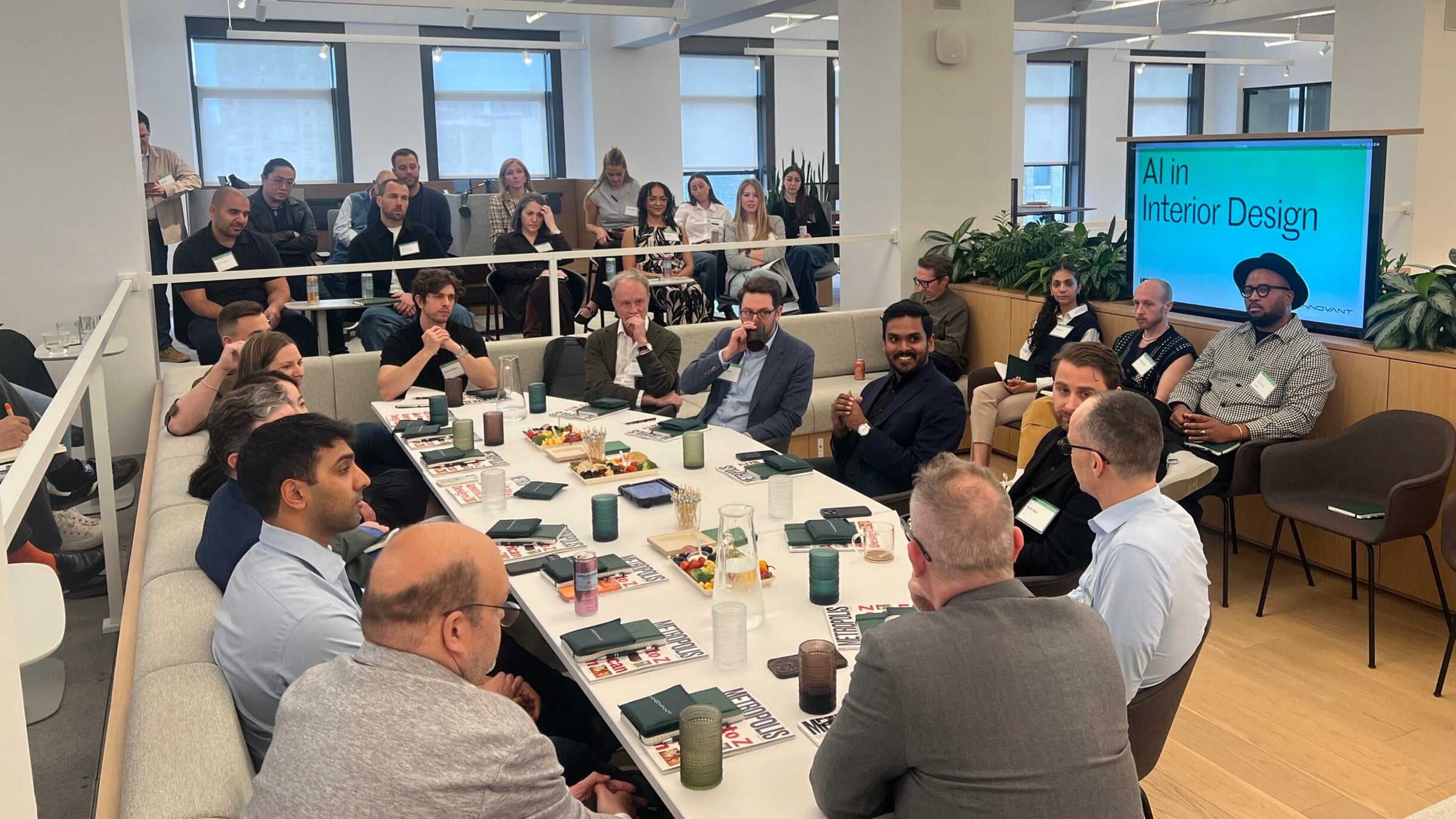
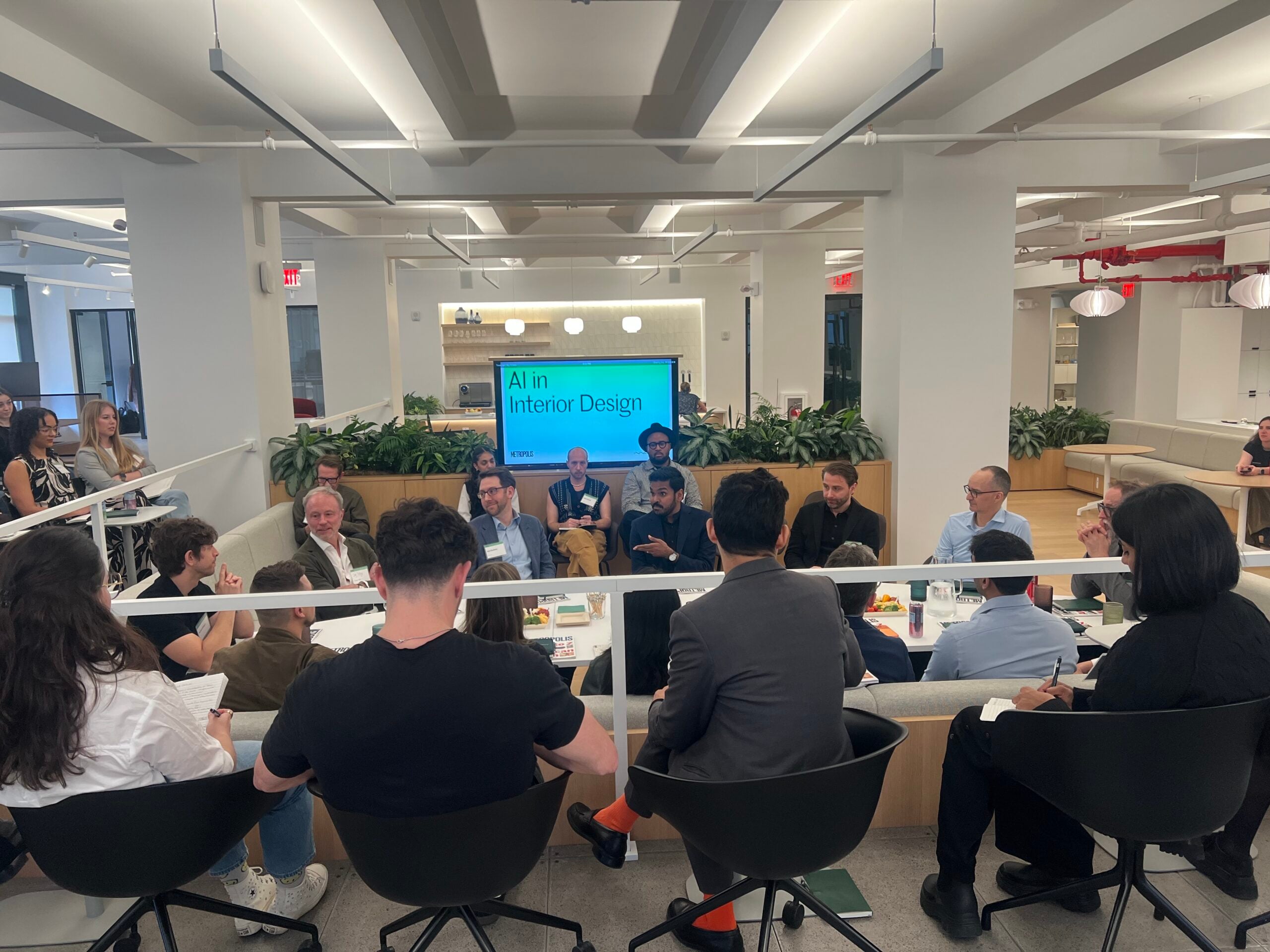
The promise—and anxieties—of Artificial Intelligence (AI) in interior design were the focus of a recent gathering convened by METROPOLIS at the Innovant Headquarters in New York, where 31 architects and interior design leaders from prominent firms across the Northeast met to assess how AI is shaping practice today. Moderated by Avinash Rajagopal, METROPOLIS’ editor in chief, the conversation was less a showcase of tools than a collective interrogation of authorship, mentorship, labor, and value.
Participants from firms including KPF, Perkins&Will, HKS, Elkus Manfredi, Workshop/APD, HWKN, HLW, Fogarty Finger, Gensler, Huntsman Architectural Group, IA Interior Architects, and Spector Group—spanning New York, Boston, and Philadelphia—brought a range of perspectives. Some described AI as already embedded in visualization pipelines, as an optional offering for clients; others praised it as a managerial and research tool, quietly restructuring workflows behind the scenes. Most design teams reported using AI in a very experimental way, and just a few were embedding these tools into their client-facing workflows. This lack of full transparency into AI use and its actual impact reflects how the industry is still on a learning curve.
Rajagopal opened with disarming clarity: “Are we using AI to design better—or just faster?” The question lingered throughout the session, surfacing a shared ambivalence. The high pace, several guests noted, risks flattening critical thinking, especially in interior environments where materials’ haptic characteristics, for example, shape human experience and resist easy automation. Yet others argued that AI’s ability to iterate rapidly can expand—not diminish—design intelligence, provided it is guided with intention.
Developing a Critical Voice
As in other creative industries, a recurring tension emerged around authorship. As Rajagopal pressed, “When a model produces hundreds of options in seconds, what does it mean to choose?” For many, the answer lay in critical curation as a new form of expertise. Designers position themselves as editors of possibility—selecting, refining, and imbuing outputs with cultural and technical specificity. In other words, a way to navigate and benefit from this new paradigm is by developing a critical and personal design voice.
This shift also raises questions about attribution, originality, and the erosion of junior roles traditionally tasked with producing iterations, which might not be a bad thing, and might invite the industry to rethink designers’ career paths after school entirely. On the same note, there was agreement, especially among more senior guests, that mentorship is crucial now not only for junior staff on ethics and design values, but also for senior members on AI capabilities and workflows.
Discussions of labor followed. While some see an opportunity to elevate staff toward more strategic and conceptual work, others warned of a hollowing-out effect, where foundational skills risk being bypassed. “What are we no longer learning,” Rajagopal asked, “because the machine learns it for us?”
If full consensus was elusive, a cautious agreement did emerge: AI is neither a silver bullet nor an existential threat, but a tool whose consequences will be determined by how deliberately and ethically the discipline engages it. Interior design, with its proximity to the human experience and craft, may be uniquely positioned to resist formulaic, data-driven solutions and insist on qualitative judgment.
In that sense, this expert roundtable was more like a necessary checkpoint. Though the technology is moving quickly, the culture around it is less so, especially in an industry with tight R&D budgets and very thin margins for testing new tools. The challenge ahead is not simply adopting AI, but defining the terms under which it participates in design—and, crucially, who gets to decide.
METROPOLIS x Innovant AI Roundtable
Brent Capron, Corgan
Jared de Jonge, Elkus Manfredi Architects
Brandon Mut, Fogarty Finger
Brooks Morelock, Gensler
Bonan Sun, Gensler
Brandon Smart, Gensler
Elisabeth Mejia, HKS
Rebecca Balanza, HKS
Agustin Mauro, HKS
Xinru Liu, HLW
Veronica Aziz, HLW
Damir Pozderac, Huntsman
Allison Brown, Huntsman
Julia Rubert, Huntsman
Dorin Baul, HWKN
Will Williamson, HWKN
MIchael Villegas, IA
Noshin Khan, IA
Darina Zlateva, KPF
Rachel Vilalta, KPF
Dag Folger, KPF
Anish Reedy, KPF
Dag Folger, Perkins & Will
Anish Reedy, Perkins & Will
Elif Unsal, Perkins & Will
Steven South, Spectorgroup
Mimi Li, Spectorgroup
Colin DaPonte, Spectorgroup
Alex Dunham, Workshop APD
Lisa Jasper, Workshop APD
Colin Murtaugh, Workshop APD
Abe Ahmad, Workshop APD
Would you like to comment on this article? Send your thoughts to: [email protected]
Latest

Viewpoints
Detroit Month of Design: A City’s Work in Progress
Now in its 16th year, the celebration offers insights into the Motor City’s ongoing accomplishments without glossing over its hurdles.
Projects
How a Hybrid Building Helped an Historic Manhattan Congregation Remain in Place
On Billionaire’s Row, FX Collaborative designed a new home for Calvary Baptist Church combined with an office tower.