



November 12, 2025
Redefining the Library as Community Hub—On a Massive Scale
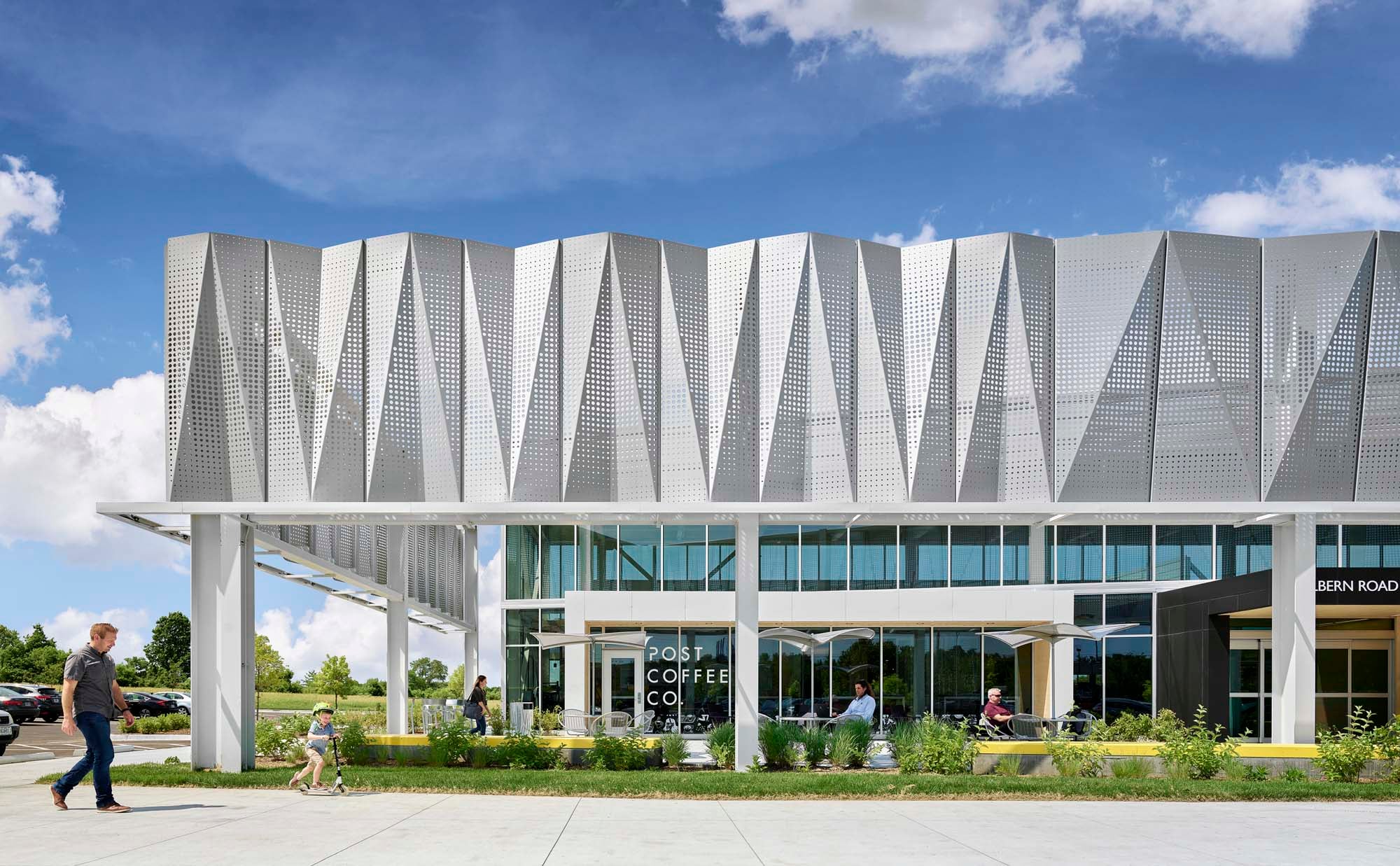
A rhythmic metal scrim folds around the facade of the Colbern Road Library in Lee’s Summit, Missouri, its angular patterns rippling like paper airplanes mid-launch. It’s the kind of move you’d expect from a contemporary art museum, not a suburban library. But that’s the point.
Over the past seven years, Kansas City–based Helix Architecture + Design has led one of the most ambitious public library overhauls in the country, building or modernizing 33 branches for the Mid-Continent Public Library (MCPL) system. The results—ranging from culinary centers and small business incubators to adaptive reuse transformations—redefine what a 21st-century library can be.
“It was about asking: What do our communities really need from a library now—and how can we design for that?” notes Erika Moody, Helix’s president and principal in charge.
The MCPL system spans the rural and suburban counties surrounding Kansas City, Missouri. With Kansas City proper already served by its own library network, MCPL focuses on outlying areas—places where access to public infrastructure can be limited and the library has long served as a vital third space.
Funded by a $113 million local ballot measure passed in 2016, the project was massive in both scope and ambition: eight new buildings and 25 renovations, serving more than 840,000 patrons across multiple counties. Helix partnered with architect of record Sapp Design Architects and general contractor JE Dunn to steer the process from early visioning through construction.
According to Steve Potter, who served as MCPL’s director throughout the planning and execution of the system-wide upgrade, the process began with rethinking the library’s role from the ground up. That meant a sweeping community needs assessment, national benchmarking trips, and hundreds of listening sessions with patrons and staff.
“We had to ask not just what libraries look like now, but what they’ll need to do ten, twenty years down the road,” Potter notes.
Each branch evolved from a standardized palette of materials and furnishings into its own story—shaped by site constraints, community input, and local character. “There’s a common DNA,” explains Helix lead interior designer Megan Penland, “but we didn’t want them to feel cloned. Every branch needed to reflect the community it served.”
Space, Light, and Community
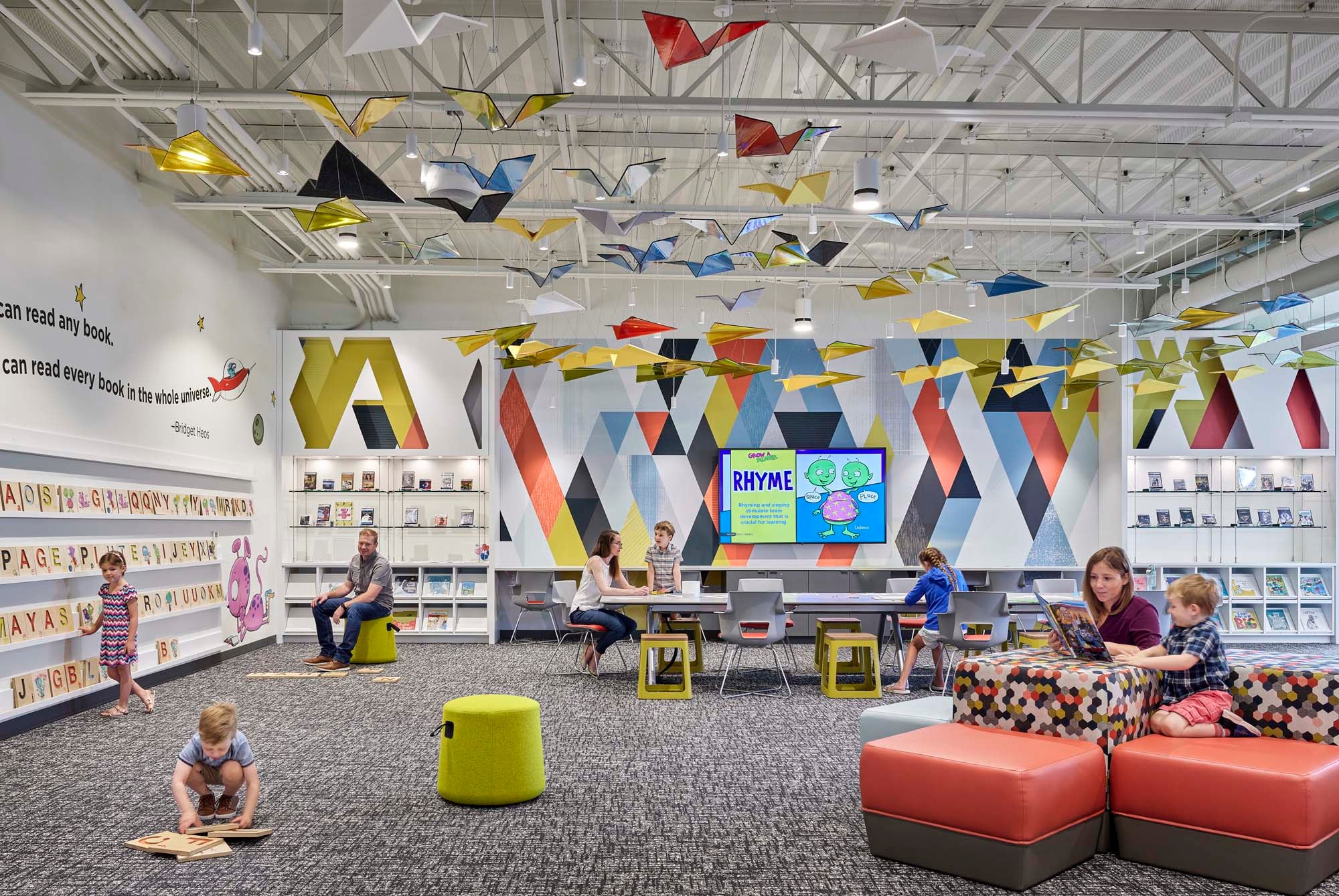
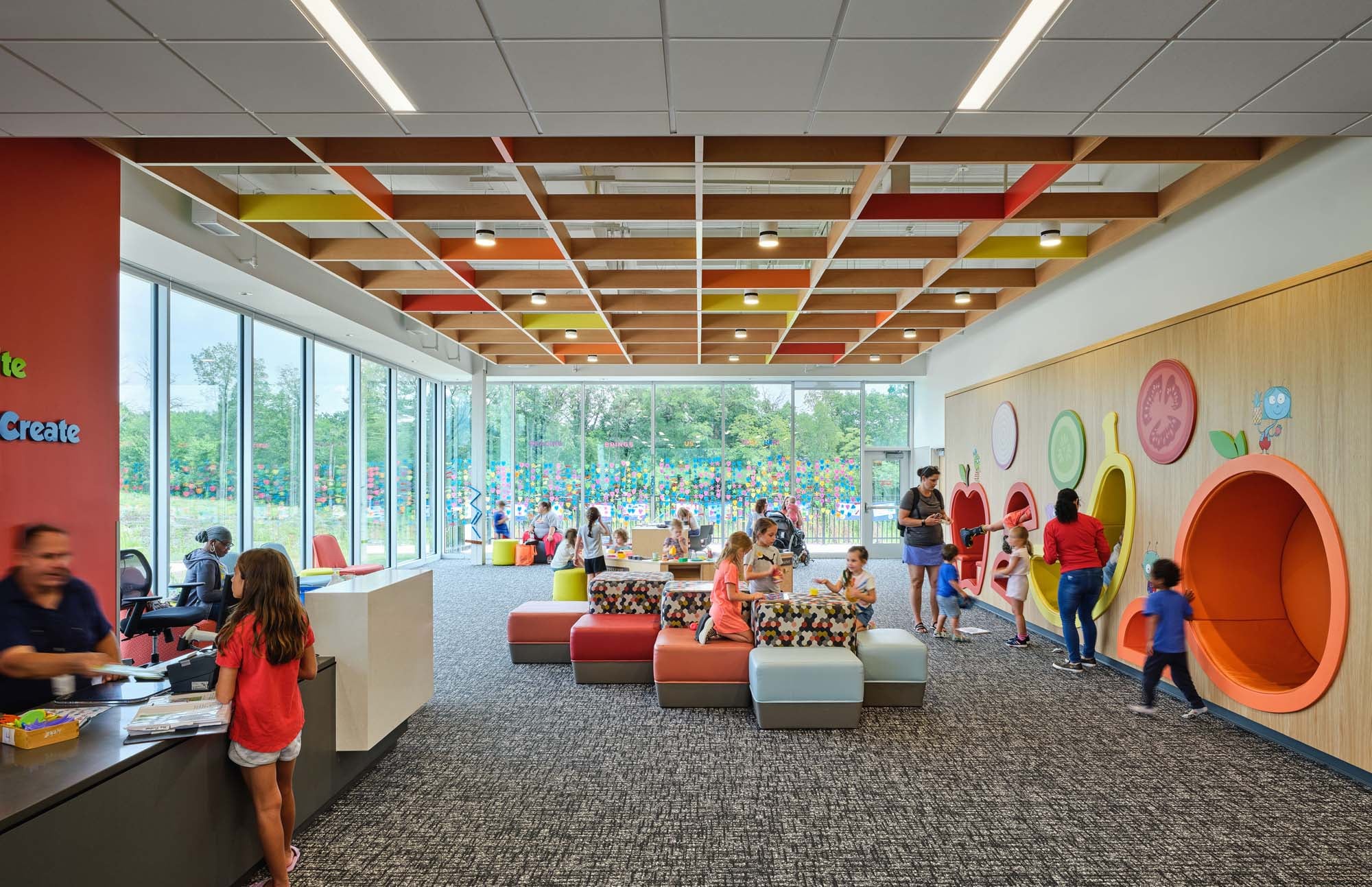
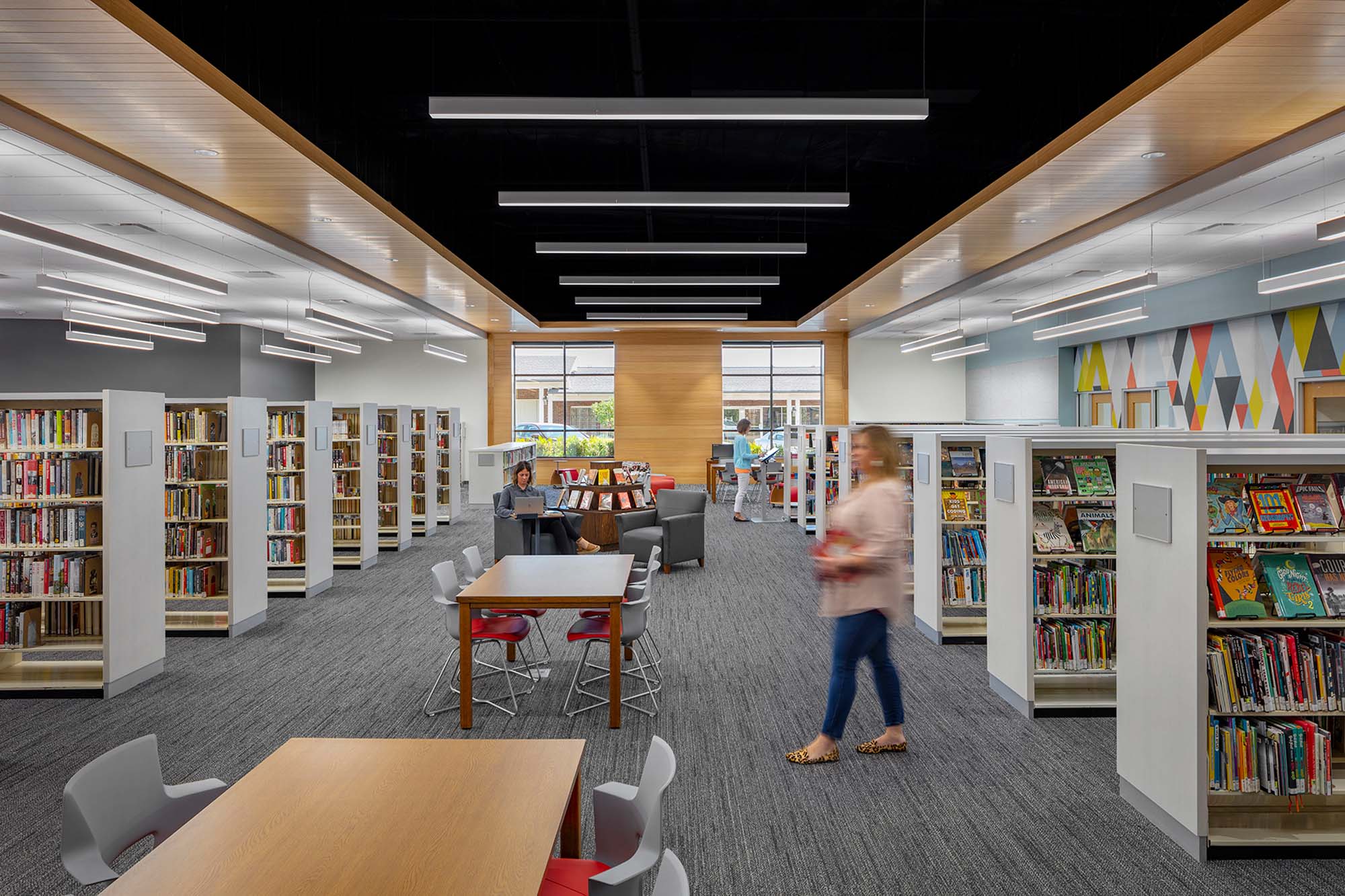
Throughout the system, Helix prioritized openness and daylight. High ceilings, generous glazing, and clear structural expression contribute to a calm, contemporary aesthetic. Most branches celebrate their programs—coworking lounges, culinary classes, reading nooks—as open, social elements within the larger space. Exposed steel, wood joists, and acoustic clouds turn construction into the driver of the architectural language.
The inclusion of elements like local coffee shops and coworking areas—services that are often privatized or locked behind paywalls—underscores the library’s evolving role as a civic platform, offering access to entrepreneurial and social infrastructure without cost or membership. And many branches feature oversized animal sculptures—snails, whales, owls—that double as playful landmarks and seating areas for children. Bright, tactile furnishings invite crawling, climbing, and lounging, while wall graphics turn reading corners into mini wonderlands.
Potter also emphasized the importance of blurring the line between interior and exterior. “Natural light, views to nature, and even physical access to outdoor patios or green spaces—it all helps break the old idea of a library as a closed box,” he says. Several branches include outdoor seating areas, reading gardens, and even walkable paths that tie the library into the surrounding community.
Destination Libraries
While all branches include staples like reading areas and meeting rooms, a handful of “destination branches” take things further. In Green Hills, a massive fork sculpture digs into the lawn, signaling the kitchen-centric mission inside. Patrons can sign up for free cooking classes, test commercial-grade equipment, and shop for goods produced by local food entrepreneurs. A chandelier made from hundreds of hanging coffee mugs, designed and installed by Penland herself, floats above the café.
Xander Ross, director of the Green Hills culinary kitchens, says the space fills a crucial gap in the community: “Most of the folks who come to us don’t have culinary or business experience, but they’ve got an idea—a family recipe, a passion for baking, a dream. We wanted to provide them with both the knowledge and the physical space to turn that dream into a real food business.”
The facility includes five kitchen spaces—two incubator kitchens, a shared kitchen, a prep kitchen, and a teaching kitchen—each geared toward launching entrepreneurs and enhancing culinary literacy. “There are a few libraries with teaching kitchens,” says Ross. “But as far as we know, no one else has a full-blown culinary incubator.”
At Colbern Road, the faceted metal screen, wrapping the upper volume of the building, creates the visual presence of a civic landmark while filtering natural light to the interior. Inside, open work areas and flexible meeting spaces cater to small business owners and freelancers, turning the library into a kind of startup incubator. A feature stair doubles as a casual hangout and presentation venue, while acoustic treatments and glass partitions strike a balance between openness and focus. The building’s design has made it a magnet for professional workshops, remote workers, and community events.
Renovation as Rebirth
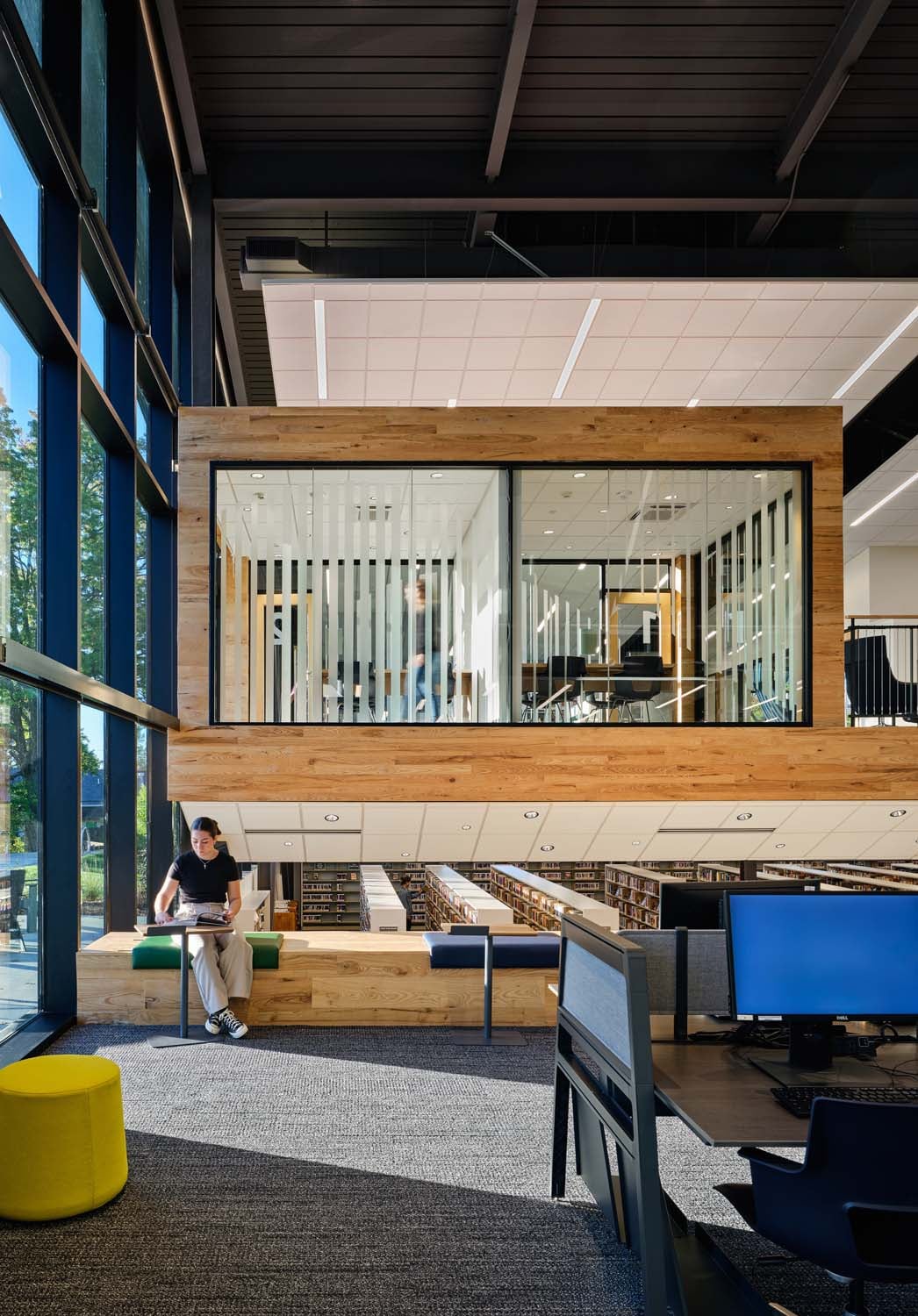
Some of the most inventive work came from transformations of existing buildings—like Red Bridge, a once-dilapidated bowling alley tucked into a strip mall. Helix repurposed the former lanes as an oak-clad reading stair that doubles as a community gathering space. Split levels and exposed structure give the interior a raw, loft-like quality. “You can still feel the ghost of the lanes,” Penland says.
Another example is North Oak, a compact branch fit into a tight, wooded site. Helix responded with a split-level plan—stacking volumes vertically to preserve the tree canopy and nodding to the site’s arboreal identity with branching rooflines and a treehouse-like reading room. “Every site had its quirks,” says Potter, “but we didn’t want to fight them. We wanted to turn them into assets.”
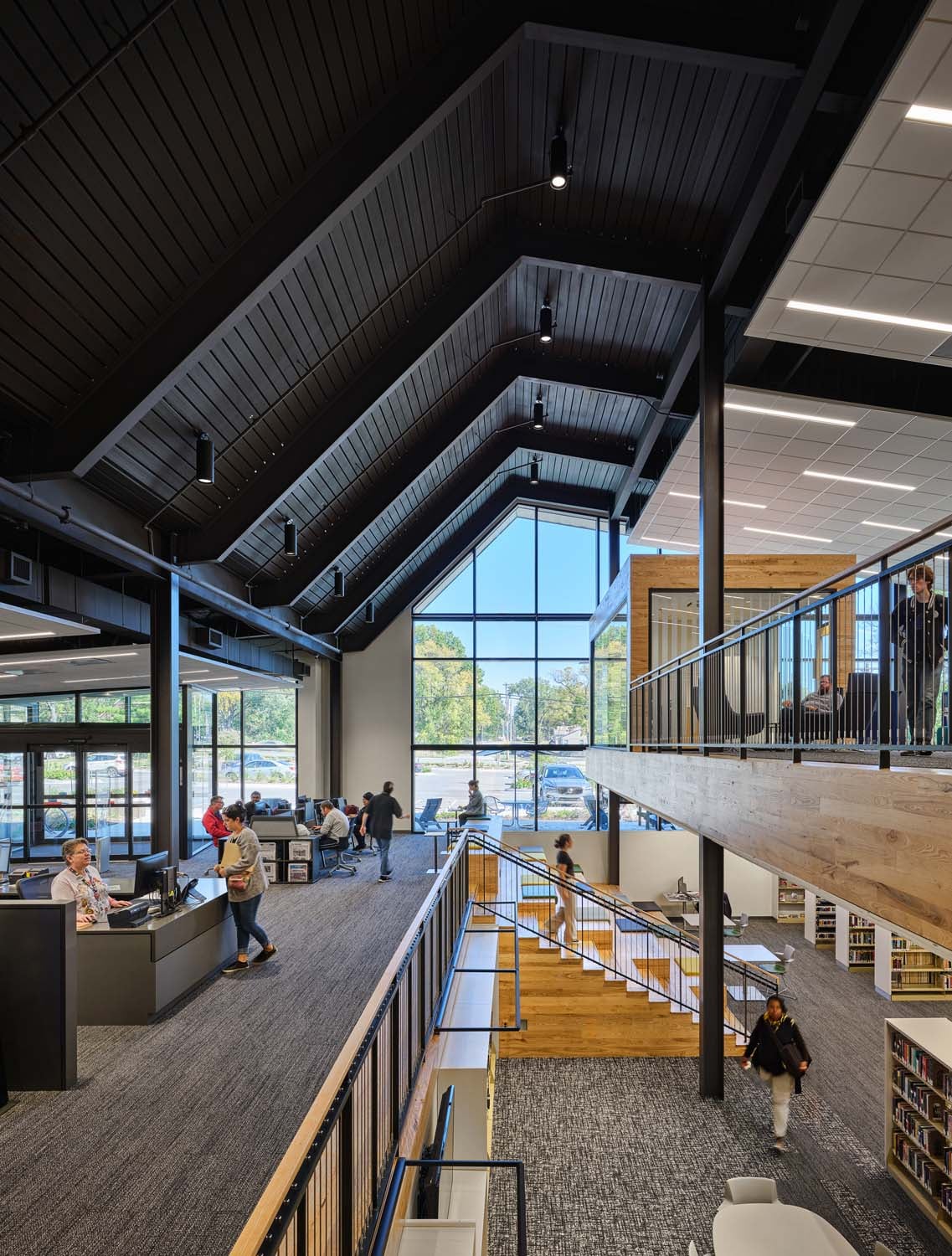
The Midwest Genealogy Center—an existing branch that Helix updated with a flexible auditorium—functions less like a library and more like a civic convention center. Modular acoustic partitions can divide the space into four event rooms or combine it into one large presentation hall.
“The reality is, most smaller branches will never need this scale,” says Moody. “But having one big venue in the system gives everyone access to that capacity.”
That emphasis on systemic thinking—balancing local customization with overall efficiency—runs through the program. Helix and Sapp developed standardized packages for furniture, finishes, hardware, lighting, plumbing fixtures, HVAC systems, exterior materials, roofing, and even site design and landscaping. Drive-throughs are now the norm. So are private meeting rooms, acoustic ceiling clouds, and those well-placed coffee shops.
Thinking Long Term
Despite the program’s polish, it was not without its bumps. Supply chain disruptions during the pandemic forced changes on the fly. Tight budgets demanded restraint and inventiveness.
“There’s always tension between ambition and practicality,” notes Moody. “But with the right team and trust from the client, you can still do great work.”
Lessons learned along the way were quickly applied to later phases. Successful prototypes, like acoustic separation strategies, were retroactively added to earlier branches. The design team is still fielding calls to update cushions, reconfigure layouts, or fine-tune millwork to meet evolving needs.
The public response has justified the investment. “In some locations, we saw a 200 percent increase in usage after reopening,” says Potter. “People were walking in not just to check out books, but to see the building, to use the space.”
In a moment when many public institutions are struggling to maintain relevance, MCPL’s branches are becoming essential destinations. “It’s about building trust, curiosity, opportunity,” says Moody. “Spaces that reflect who we are and who we want to be.”
Would you like to comment on this article? Send your thoughts to: [email protected]
Latest
Viewpoints
Detroit Month of Design: A City’s Work in Progress
Now in its 16th year, the celebration offers insights into the Motor City’s ongoing accomplishments without glossing over its hurdles.
Projects
How a Hybrid Building Helped an Historic Manhattan Congregation Remain in Place
On Billionaire’s Row, FX Collaborative designed a new home for Calvary Baptist Church combined with an office tower.