



April 28, 2026
From Transfer Machine to Front Door: Pittsburgh Reinvents Its Airport
After US Airways sharply reduced its operations at Pittsburgh International Airport in the early 2000s, the facility existed for years in a kind of architectural limbo. The terminal it inherited was designed specifically for high-volume transfers—moving tens of thousands of connecting passengers as quickly as possible. But now travelers overwhelmingly began and ended their journeys here. Leadership decided it had to dramatically pivot.
“We weren’t trying to go back to what we were,” Christina Cassotis, CEO of Pittsburgh International Airport, said of the airport’s post-hub reality. “We were trying to be who we are—and be really good at it.”
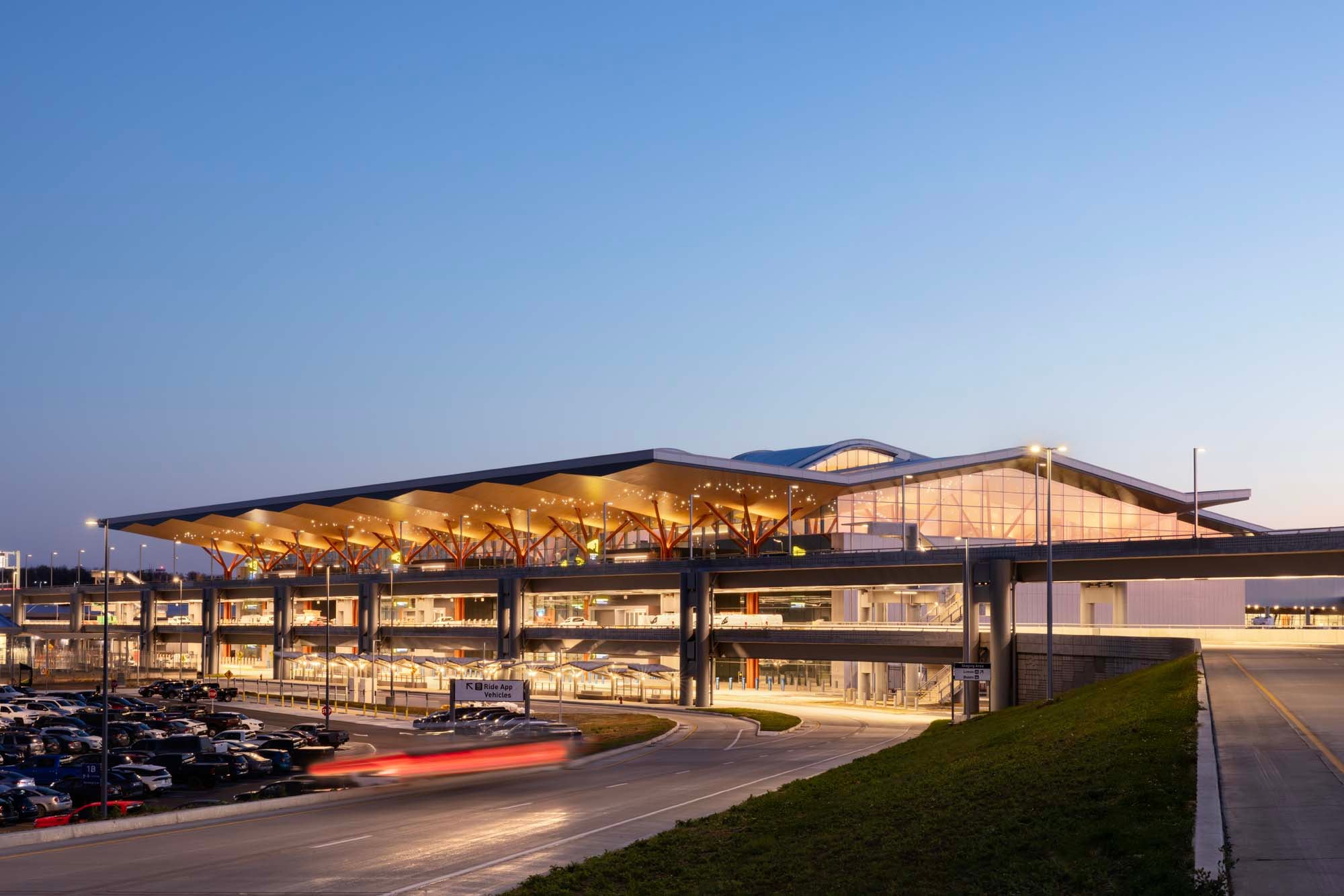
Their new $1.7-billion, 811,000-square-foot landside terminal, which opened late last year, focuses primarily on clarity, comfort, and civic presence—making it closer to a public building than a piece of airline infrastructure. Designed by Gensler and HDR in association with Luis Vidal + Architects (which also renovated the existing airside building with Michael Baker International), the terminal consolidates ticketing, security, baggage claim, international arrivals, and ground transportation into a single, three-level structure directly attached to the existing concourses—eliminating the old terminal and its half-mile people mover.
Designing for an Origin-and-Destination City
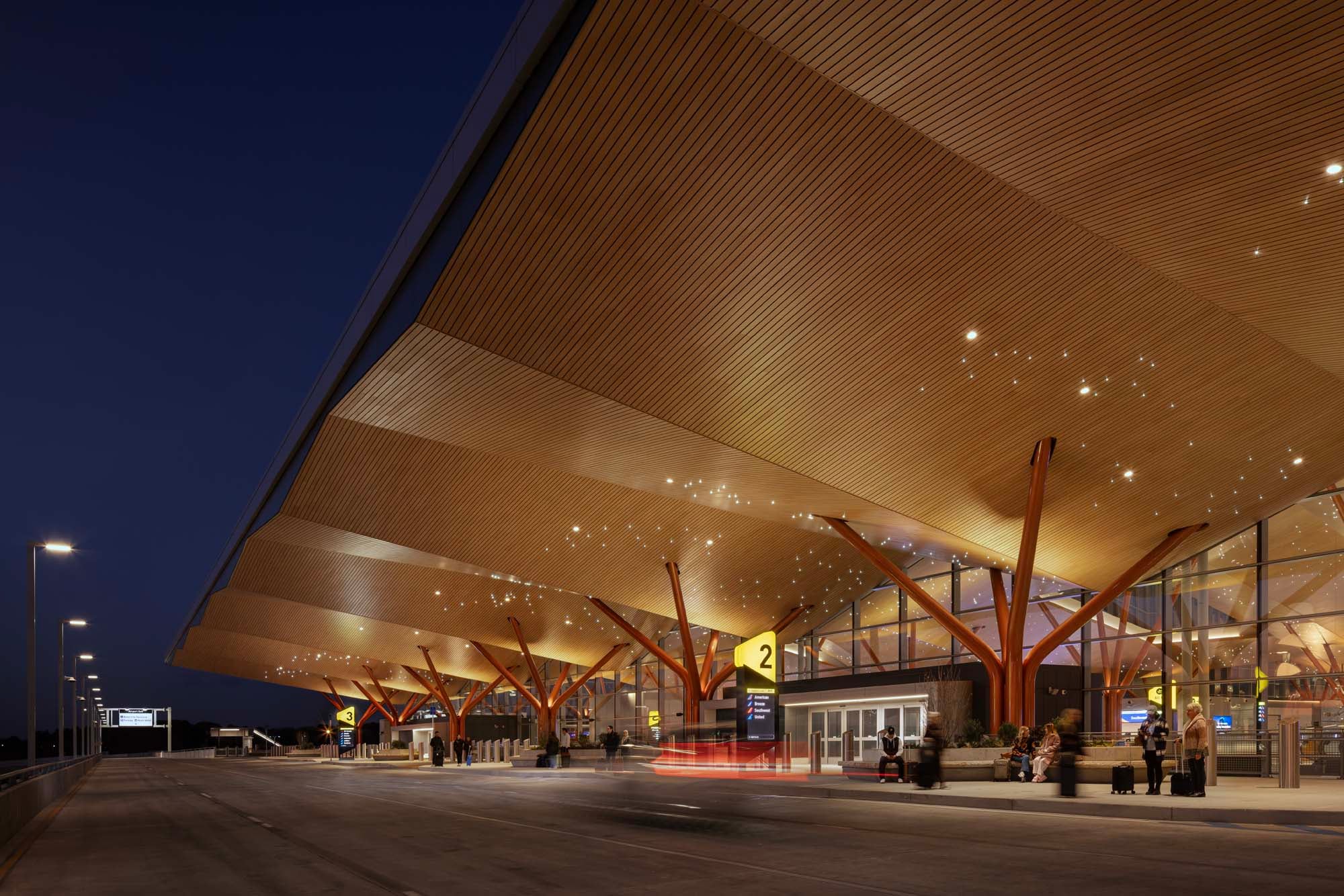
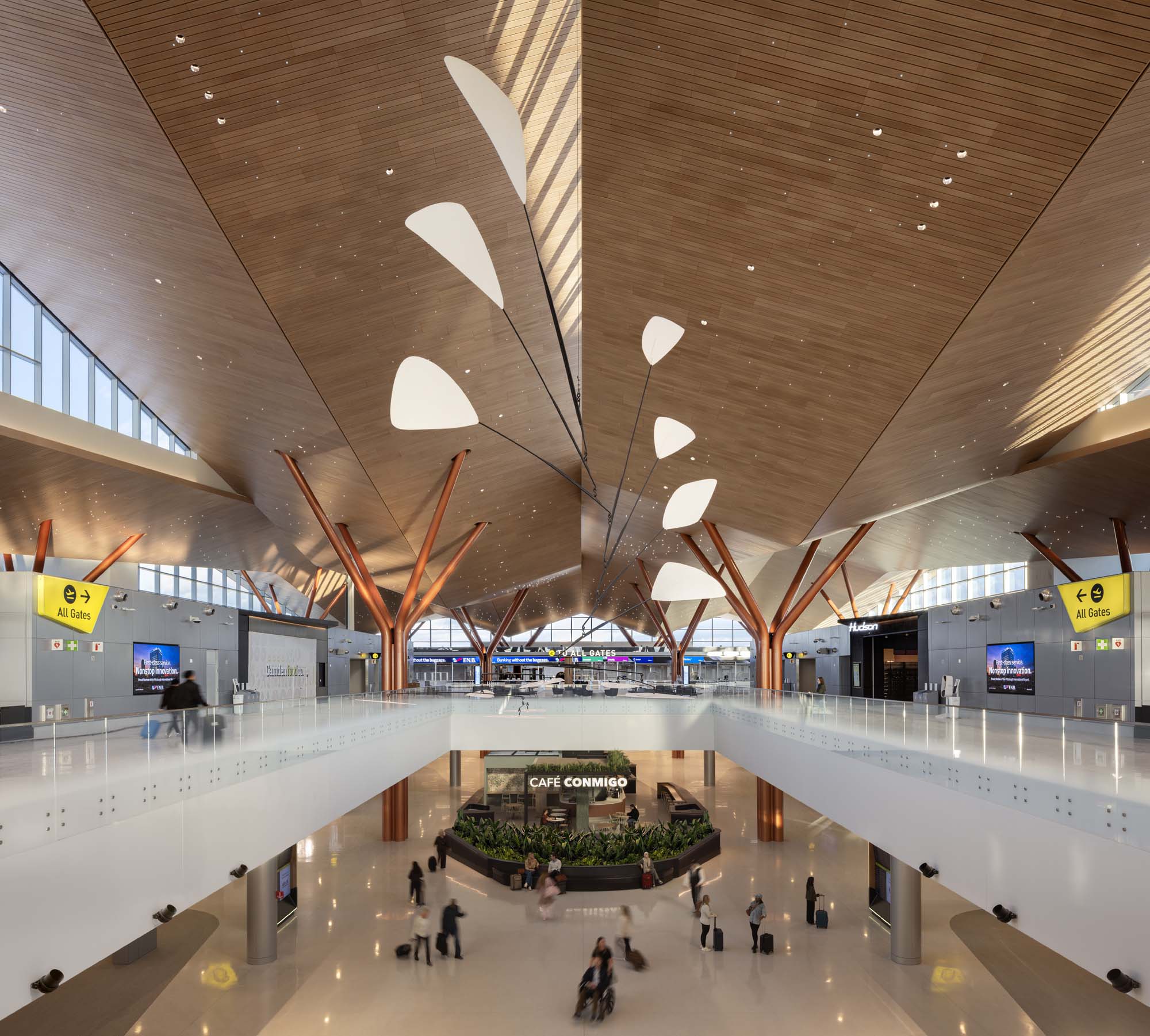
When travelers approach the new terminal they’re greeted by a sweeping, undulating roof that echoes the rolling hills and deep tree canopies of Western Pennsylvania. Rather than a monolithic gesture, it reads as a series of gentle folds—both expansive and human-scaled.
Vidal, a Spanish architect who recently led the modernization of Boston’s Logan Airport Terminal E, spent weeks in Pittsburgh prior to the airport competition to “understand what this region was about.” He remembers being especially moved by those hills, “and the quality of the natural light and the sunset.”
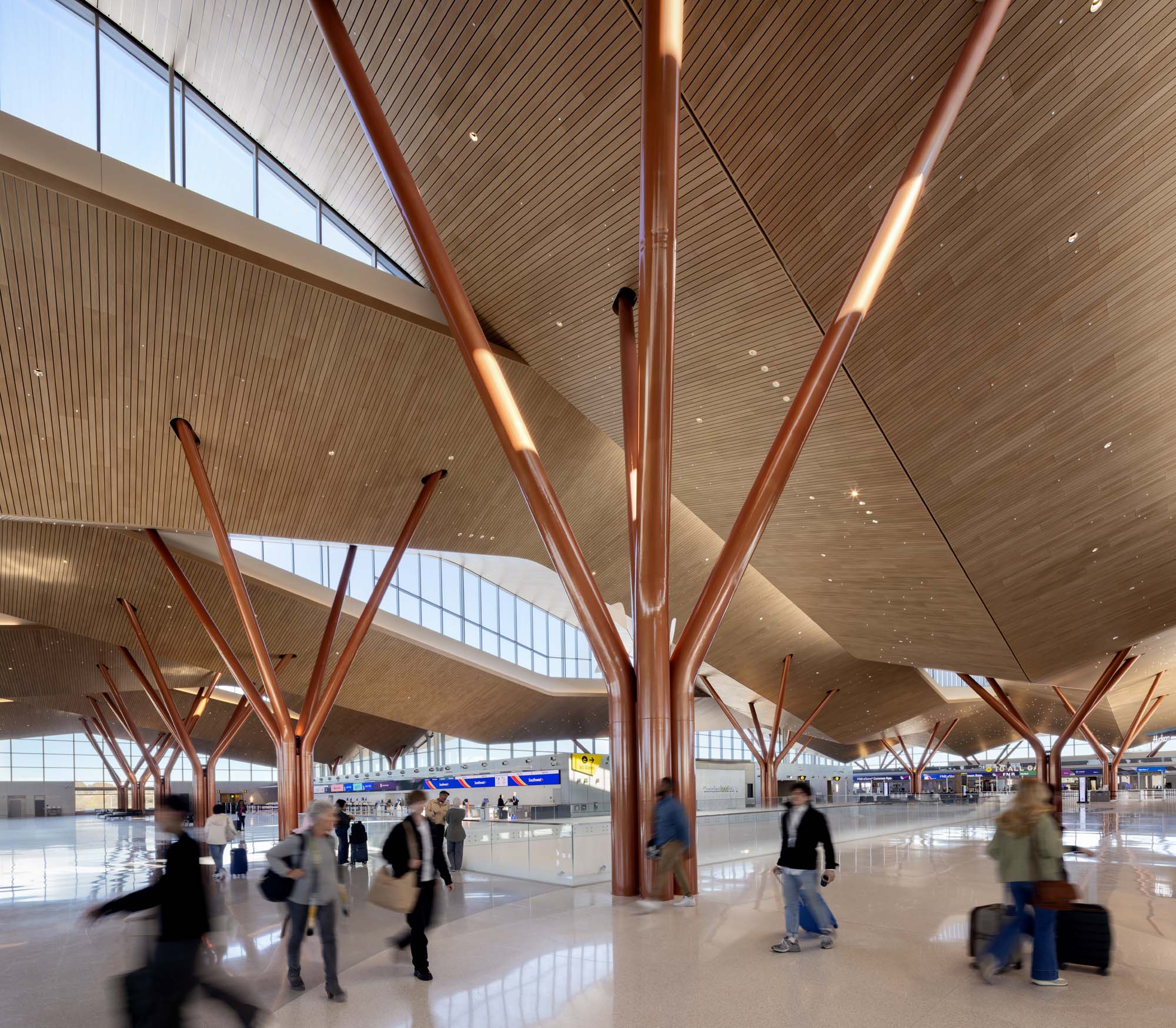
Inside, the terminal’s roof is supported by 38 exposed steel columns—steel is, of course, the historic economic engine of Pittsburgh—that branch and taper like trees, their copper-toned finish recalling the region’s autumn forests. (The columns were pumped with concrete for increased structural strength.) No two columns are identical. Some branch lower, others higher. The ceiling above—aluminum panels printed and finished to resemble wood—was originally conceived in timber but rethought for durability, maintenance, and climate control.
Clerestory glazing and strategically placed skylights flood circulation areas with natural light while avoiding glare at ticketing counters and security lanes. At night, constellation-like lighting embedded in the ceiling references the region’s dark skies.
“When you’re inside it feels like you’re outside,” says Vidal. “It’s like a fantastic floating roof supported by the trees.”
The Petal Tunnel
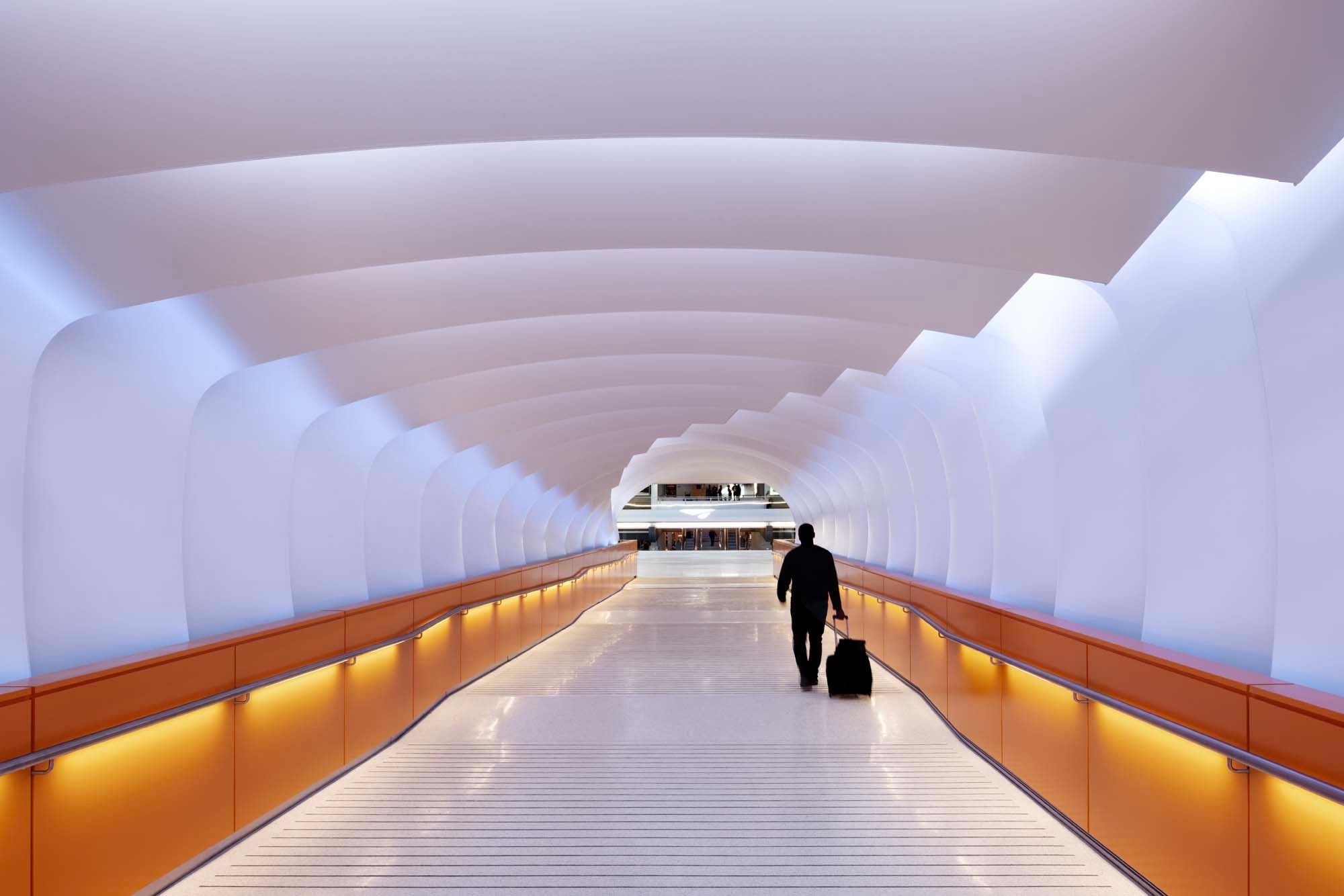
One of the project’s most distinctive spaces, designed by Vidal, is the “Petal Tunnel,” connecting the landside terminal to the renovated airside core. Inspired simultaneously by Pittsburgh’s Fort Pitt Tunnel, with its dramatic reveal of the city skyline, and the petal-like forms of the nearby Phipps Conservatory, the passage is lined with sculptural ribs that change length and color as passengers move through. Integrated lighting responds to daylight conditions, shifting from cool whites to warm ambers and violets.
Emerging from the compressed tunnel, passengers arrive at a balcony overlooking the expansive, revitalized airside core, with its new concessions and improved amenities, from family facilities to nursing lounges. Its roof has been lightened and unified via white fabric and white painted steel trusses. Immediately, notes Vidal, you understand—and can navigate— the entire space intuitively, with one quick look.
An Airport That Acts Like a City Building
That sense of the local outdoors is in some cases literal. Four outdoor terraces—two pre-security and two post-security—are still growing in. Once complete they will be filled with species native to Western Pennsylvania, offering travelers fresh air and respite without leaving the complex. Public art appears throughout, from terrazzo inlays referencing local leaves to a massive Alexander Calder mobile, “Pittsburgh,” which has been relocated to the new main hall.
“People would walk below it every day, but there was so much visual clutter nobody ever really saw it,” notes Carolyn Sponza, a studio director in Gensler’s Pittsburgh office. Sponza adds that the airport is “reflective of the Pittsburgh community and all its wonderful quirks.” For instance, Monmade, a platform that supports area craftspeople, supplied a range of elements, from colorful tiles to abstract sculptures.
The terminal formalizes what the airport describes as its culture of “meeters and greeters,” with generous landside waiting areas, direct terrace access, and a Welcome Point designed for gathering, lingering, and reunion.
It also incorporates a number of sustainability measures, including rainwater harvesting systems and locally sourced materials, and is pursuing LEED Gold certification. (Not easy for any airport.) These strategies complement Pittsburgh International Airport’s on-site microgrid, which allows the airport to operate independently from the regional grid.
While its spirit is less utilitarian, the new terminal’s consolidation of functions has transformed the airport’s efficiency. International arrivals, once awkwardly routed through secure areas designed for connecting passengers, are now handled landside. A new baggage system cuts conveyor length roughly in half, and a single consolidated security checkpoint replaces a patchwork of add-ons.
Instead of chasing spectacle, high-speed transfers, or retail maximalism, the new design focuses on the airport being what Cassotis calls “the front door to the region,” the first and last impression many visitors have of Pittsburgh.
Best of all, Cassotis adds, is getting to a place designed to improve visitors’ wellbeing. “People come to an airport at level 10 because they just don’t know what might go wrong,” she says. “The more that you can assure them that we’re set up to take care of them, the better.”
Would you like to comment on this article? Send your thoughts to: [email protected]
Latest

Profiles
Beyond Symbolism: Farshid Moussavi on the Ismaili Center in Houston
The cultural building and community center reinterprets Islamic design philosophy through geometry, climate-responsive design, and generous civic spaces.

Projects
Art Stages Built Into A Hillside & An Old School
PS21 and The Campus Upstate are reimagining cultural infrastructure from within.