



November 26, 2025
How Designtex Integrates Biophilia Into Every Surface
For more than a decade, Designtex has been exploring how the built environment can meaningfully support human well-being. What began as a curiosity about biophilia has evolved into a research-led design practice that blends neuroscience, material science, and nature-inspired patterning. In this conversation, METROPOLIS speaks with Designtex’s Deidre Hoguet, senior director of sustainability and applied research, and Sara Balderi, executive director of design, about how biophilia informs their day-to-day design decisions, how insights from neuroaesthetics shape new materials, and why walls, textiles, and textures play a pivotal role in creating environments that calm, restore, and uplift.
Metropolis Magazine: Biophilia is integral to the Designtex design process. How did that philosophy first take root within the company?
Deidre Hoguet: Around a decade ago, several members of Designtex became fascinated with the concept of biophilia and started sharing resources with each other. We had read the Terrapin/Bill Browning report “The 14 Patterns of Biophilic Design,” which kickstarted some of our conversations. Within our wide-format digital printing business, we had already worked on numerous projects that used local plant and landscape imagery as subject matter (even when abstracted) to embed points of interest into various types of commercial interiors. As we started to dig in further on biophilic patterns, colors, and visual complexity/order, we realized that biophilic design principles could be applied to all kinds of products, including wallcovering, textiles, and custom imaging.
MM: What does embedding biophilia into the design process look like day to day? How does it influence the way you approach new materials or collections?
Sara Balderi: For us, biophilia isn’t a last step layer; it’s a starting lens. Day to day, that means that when we begin exploring a new material or collection, we’re asking: What kinds of stress, focus, and emotional rhythms will people experience in this space, and how can nature-informed cues support that?
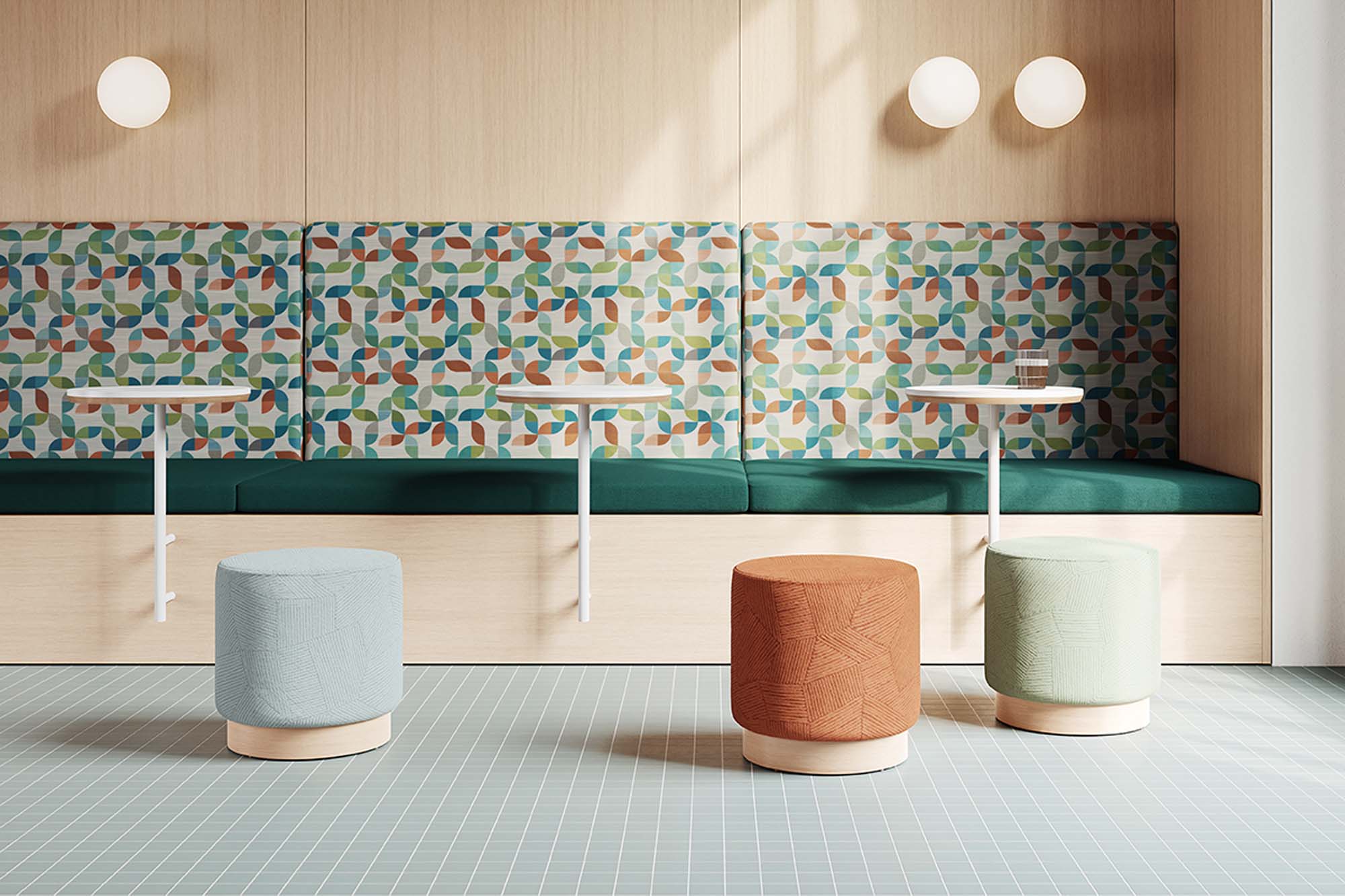
Practically, that shows up in our color work, our pattern logic, and our haptics. We build patterns around nature-inspired hues that support regulation, and tones that calm the nervous system or restore focus.
On the pattern side, our biophilic-inspired designs are developed from close observation of natural geometries—branching, layering, gradual shifts in density—rather than just literal scenic prints. We use those principles to choreograph how the eye moves across a surface, keeping complexity in that “calm but alive” range that helps reduce visual fatigue.

MM: Biophilic design is often associated with adding natural imagery or plants to a space. How does Designtex go beyond that to integrate deeper principles of biophilia into your surfaces and patterns?
SB: We love plants, but if biophilia stops at potted greenery and a leaf print, you’re missing a huge opportunity. Our goal is to encode principles of biophilia—how our brains respond to natural patterns—into the surfaces themselves.
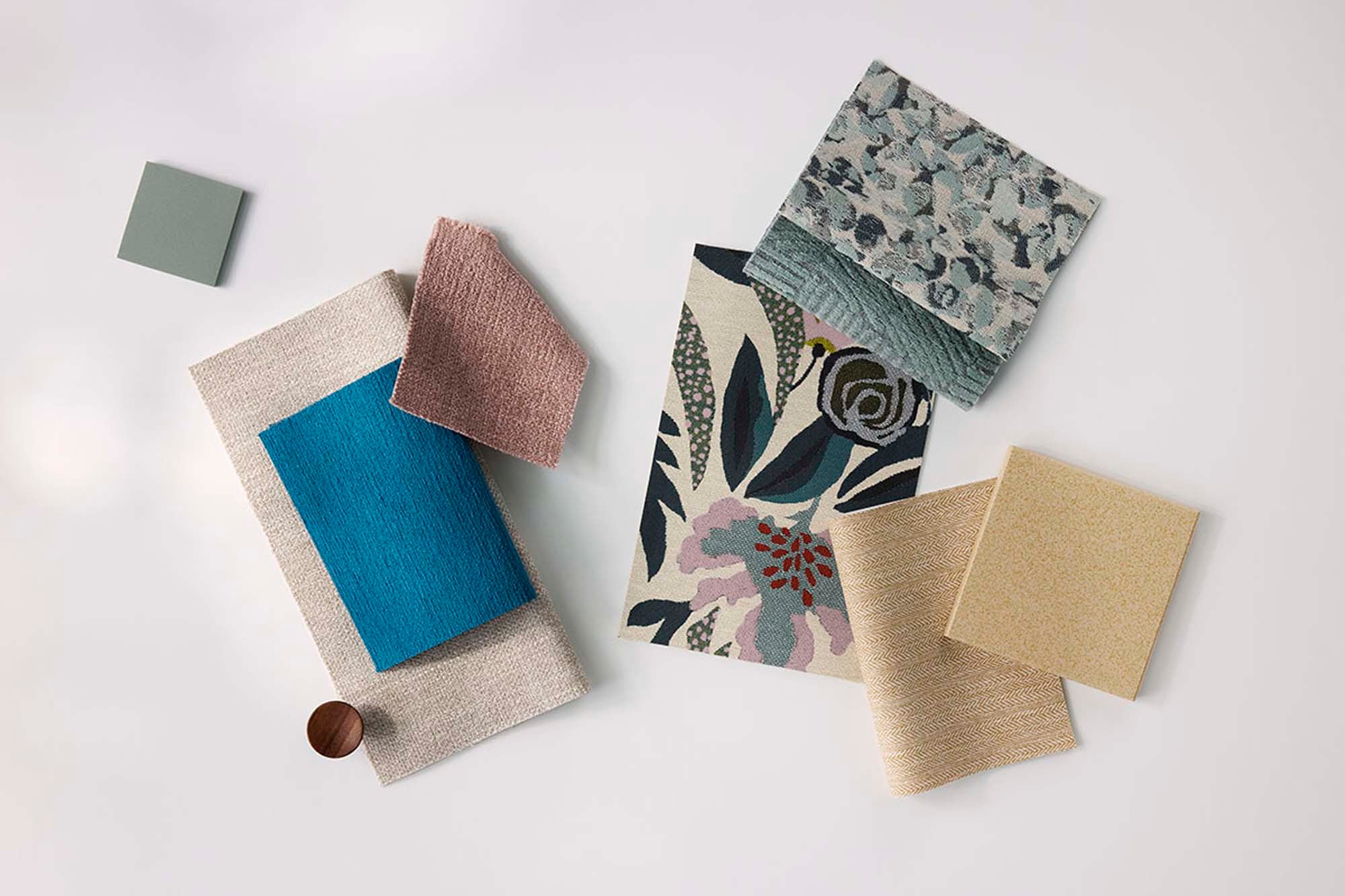
Many of our textiles are designed with quiet, organic textures that echo natural materials, support sensory comfort, and contribute to acoustic softness. The result is a multilayered experience: surfaces that don’t just look like nature in a decorative way, but behave like nature in how they calm, ground, and restore people in everyday use.
DH: Because surface materials are the part of an interior that an occupant interacts with through touch, we consider the tactility of different weaves, fibers, and natural materials. For woven textiles, we talk about the “hand” of the material and consider what the user will experience. For our alternative-to-vinyl wallcovering substrate DNA, (which is made of 50 percent sustainably forested wood pulp), the natural material can be felt in the “hand” of the wallcovering, and people are drawn to run their hand over the surface to experience it.
MM: Your approach to biophilia is grounded in research from neuroscience and neuroaesthetics. How have findings from those fields shaped the way you design materials that connect people to nature?
DH: Many studies demonstrate that the way an environment looks and feels can impact an occupant’s mood. We often take an interesting piece of neuroaesthetics data as a jumping-off point to explore how it might inform our product design.
For example, we have taken the concept of positive distraction (known to support well-being) as an intended action that our products may be able to elicit. Our digitally imaged wall installations are meant to engage the viewer—whether through quiet reflection when contemplating a calming nature scene, or with an exciting, complex pattern intended to spark curiosity, even briefly in a corridor. An often-cited concept in neuroaesthetics is that humans prefer harmonious patterns that are easily (or fluently) processed by our visual systems. However, Thomas Albright, a vision researcher at the Salk Institute, gave us an interesting insight when he stated that the optimal visual environment has varying degrees of familiarity and novelty.
This contrast between subtle, harmonious patterns and novel, curious, or complex patterns is something we can embed into our products, delivering many options to interior designers who can then play with these varying pattern types in their space design.
In our pattern work, we use density, collinearity, and moderated complexity so the eye can “solve” the surface quickly, freeing up attentional resources for learning, healing, or working. That was central to our collaboration with Dr. Tom Albright at the Salk Institute, where the preferred visual patterns of the cortex directly informed a palm-frond-inspired wallcovering for a 6th grade math classroom.
On the tactile side, we lean into textures and fibers that support sensory comfort and what we might call “positive distraction” and “gentle engagement” for the nervous system. Instead of thinking of color, pattern, and texture as purely aesthetic choices, we treat them as tools to influence stress, focus, and emotional tone in measurable ways.

MM: The Green Street Academy classroom project is a powerful example of research in action. What role did Designtex play in that study, and what were some of the most meaningful outcomes?
SB: Green Street Academy was a chance to ask a big question in a very real context: Can a biophilic learning environment measurably improve student stress and performance in an under-resourced, high-stress urban school?
Our primary contribution was a custom wallcovering—a biomorphic palm frond pattern in a natural green palette—developed in collaboration with Dr. Tom Albright. We tuned everything: the density of the pattern, the spacing, and the radial curves so that at classroom viewing distances the wall felt ordered and calm, with enough visual life to feel engaging but not add to the cognitive load. The wall was conceived as part of a larger system, coordinated with nature-referencing carpet, window treatments, and ceiling elements.
Students in the biophilic classroom reported feeling calmer and more positive about the space; biometric indicators showed greater stress reduction; and math scores improved at more than three times the rate of the control classroom, even though both groups started from similar baselines.
MM: How do you translate insights from projects like Green Street Academy into scalable solutions that can be specified across different types of spaces?
SB: One of our priorities with Green Street Academy was to design an intervention that was both research-led and repeatable. Choosing a wallcovering as a core element was deliberate: it’s a specifiable, scalable surface that can be rolled out across classrooms, schools, and even different building typologies without re-engineering the entire design system.
From there, we abstract the lessons into design frameworks: pattern density thresholds that keep complexity in a “calm but alive” range; preferred color families for restoration and focus; and texture strategies that support acoustics and sensory regulation. Those frameworks then inform new patterns, textiles, and colorways that designers can deploy in healthcare, workplace, or hospitality environments as easily as in education.
We also talk about materials being the “connective tissue” of an ecosystem. We’re using surfaces to create micro-moments of restoration: walls that quiet the mind, textiles that soften the soundscape, colors that signal psychological safety. Once those principles are embedded in the product line, they can be tuned to different spaces while still carrying the underlying biophilic and neuroaesthetic intent.
MM: When you’re developing a new biophilic material, how do you balance the aesthetic—color, texture, pattern—with the scientific and emotional goals of the design?
SB: We usually start with a feeling, not a form: How should this material make someone feel in their body and mind? Rested? Focused? Energized? Then we cross-check that emotional brief against the science—what we know about color and stress, about curves versus angles, about sensory sensitivities and positive distraction.
From there, it becomes an iterative dance. We push aesthetics—more saturation, more texture, more rhythm—and then pull back if the pattern starts to feel busy or fatiguing. We prototype and view the material at real scale, in real lighting conditions, asking whether it’s truly supporting regulation or just performing “biophilic style.” In sectors like healthcare or education, that often means favoring subtle, nature-inspired patterning and soft, tactile weaves that can hold up to rigorous cleaning while still feeling approachable.
The goal is never beauty versus science; it’s beauty in service of well-being. If we’ve done our job, the research is embedded in the material, but the experience for the user is simple: “I feel better in this space, and I may not even know why.”
MM: Looking ahead, how is Designtex continuing to evolve its understanding of biophilia and neuroaesthetics?
DH: On the material side, we’re especially excited about pairing neuroaesthetic principles with biobased and low-impact chemistries. Our DNA wallcovering substrate, for example, uses cellulose and latex rather than PVC, offering a different haptic and emotional quality while still competing on durability.
We’re also deepening our focus on inclusive and neurodiverse design, thinking about how color, pattern, and texture land for occupants with sensory sensitivities and different processing styles, and how spaces can help educators, students, patients, and workers regulate through incredibly demanding days.
Looking ahead five to ten years, we hope to see more data-informed environments, where wearable tech and post-occupancy research offer real-time insights into how spaces affect stress, focus, and mood. Our role is to turn that knowledge into “emotional infrastructure”—materials that make well-being a tangible part of the built environment rather than an abstract aspiration.
Would you like to comment on this article? Send your thoughts to: [email protected]
Latest
Viewpoints
Detroit Month of Design: A City’s Work in Progress
Now in its 16th year, the celebration offers insights into the Motor City’s ongoing accomplishments without glossing over its hurdles.
Projects
How a Hybrid Building Helped an Historic Manhattan Congregation Remain in Place
On Billionaire’s Row, FX Collaborative designed a new home for Calvary Baptist Church combined with an office tower.