



July 14, 2025
How Architectural Sculpture in the U.S. Reimagines Public Space
On September 21, the long-anticipated Calder Gardens will open along Philadelphia’s Parkway. It’s a museum devoted to the work of Alexander Calder—a pioneering artist who forever altered the space between sculpture and architecture, creating monumental pieces that integrated his smaller experiments (like bent and twisted metal mobiles, which he essentially invented) while employing construction-grade materials like bolted sheet steel, metal wire, aluminum panels, and reused industrial remnants.
As the lines between these disciplines continue to dissolve, a new generation of architectural sculpture in the U.S. is carrying Calder’s legacy in strikingly contemporary ways. Each merges structure, storytelling, and innovative engineering—testaments to a new era of public projects that, like Calder’s, transcend form to become experiences that reinvigorate their settings—and their fields.
Merica May Jensen, Arenaria, Atlanta, Georgia
Suspended above Georgia Tech’s central pedestrian thoroughfare, known as Tech Walkway, Merica May Jensen’s Arenaria (also known as the Georgia Tech Women’s Pavilion or the Pathway of Progress) is composed of nearly 3,000 mirrored stainless steel tile pairs stretching over 260 feet. Commissioned by alumna Andrea Laliberte, a scientist specializing in geospatial analysis, it marks the 73rd year of women at Georgia Tech and commemorates women alumnae and faculty who have made deep impacts.
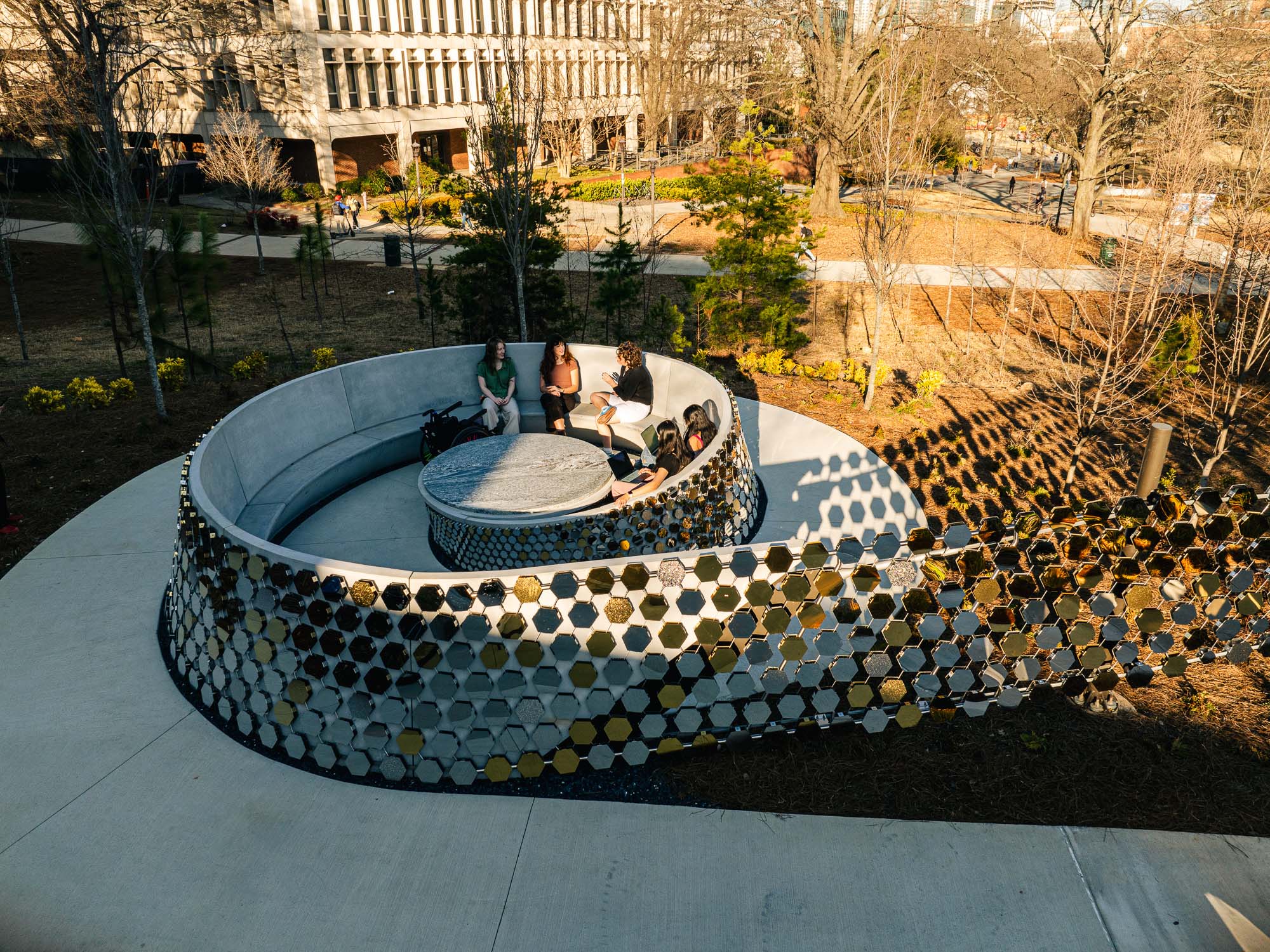
Originally conceived as a series of benches, the design evolved following dialogue with students, faculty, and historians. It now consists of a high-tension cable-net canopy supported by carbon steel columns. Mirrored tiles, embossed with names and stories, are attached via clamps. Some are polished silver, some gold-coated titanium, and some textured for light diffusion.
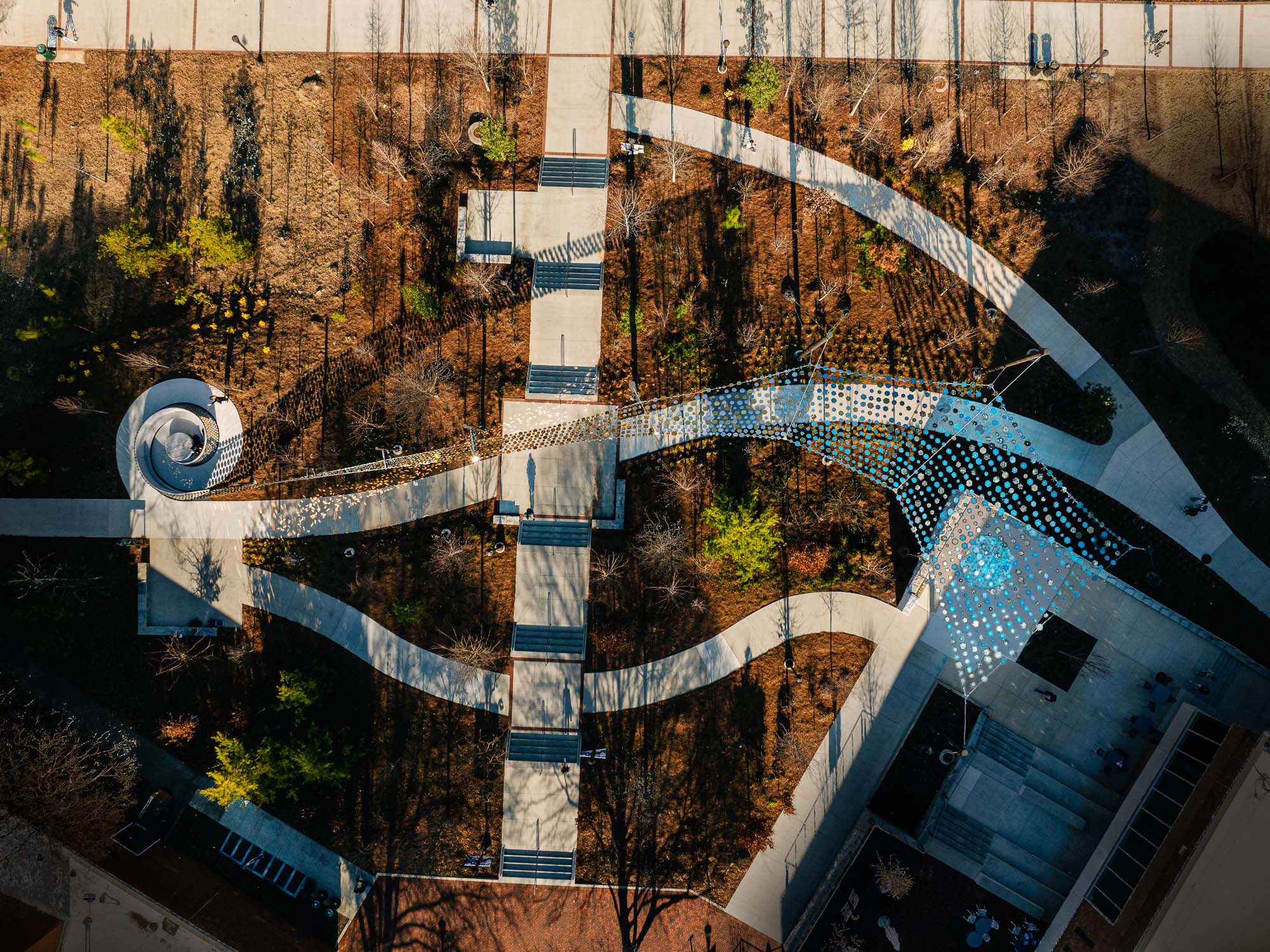
The piece is divided into three zones: a spiraling bench (made of ultra-high-performance concrete) for reflection, a midsection highlighting achievements, and a canopy of mostly not-yet-finished tiles, pointing toward the future. A digital twin deepens the narrative with biographies, historical timelines, and an interactive network builder.
As of now the piece includes 168 inscribed tiles. Among those recognized are Elizabeth Herndon and Diane Michael Clark, the first two women to enroll full-time at Georgia Tech; Dorothy Crosland, the school’s first female librarian; and alumna Robyn Gatens, who was the first woman to serve as NASA’s Director of the International Space Station.
Jensen, a dancer-turned-architect and a Georgia Tech architecture graduate, brought a kinetic sensibility to the design. “It was important she envelope the body. Both support and shelter,” Jensen says of the installation. “I hope she feels like an accompaniment—to the site, to the passerby. I hope she reads like a snake and a canopy. A swarm of light. An apparition. A memory.”
Trahan Architects, Floating Pavilion at Luther George Park, Springfield, Arkansas
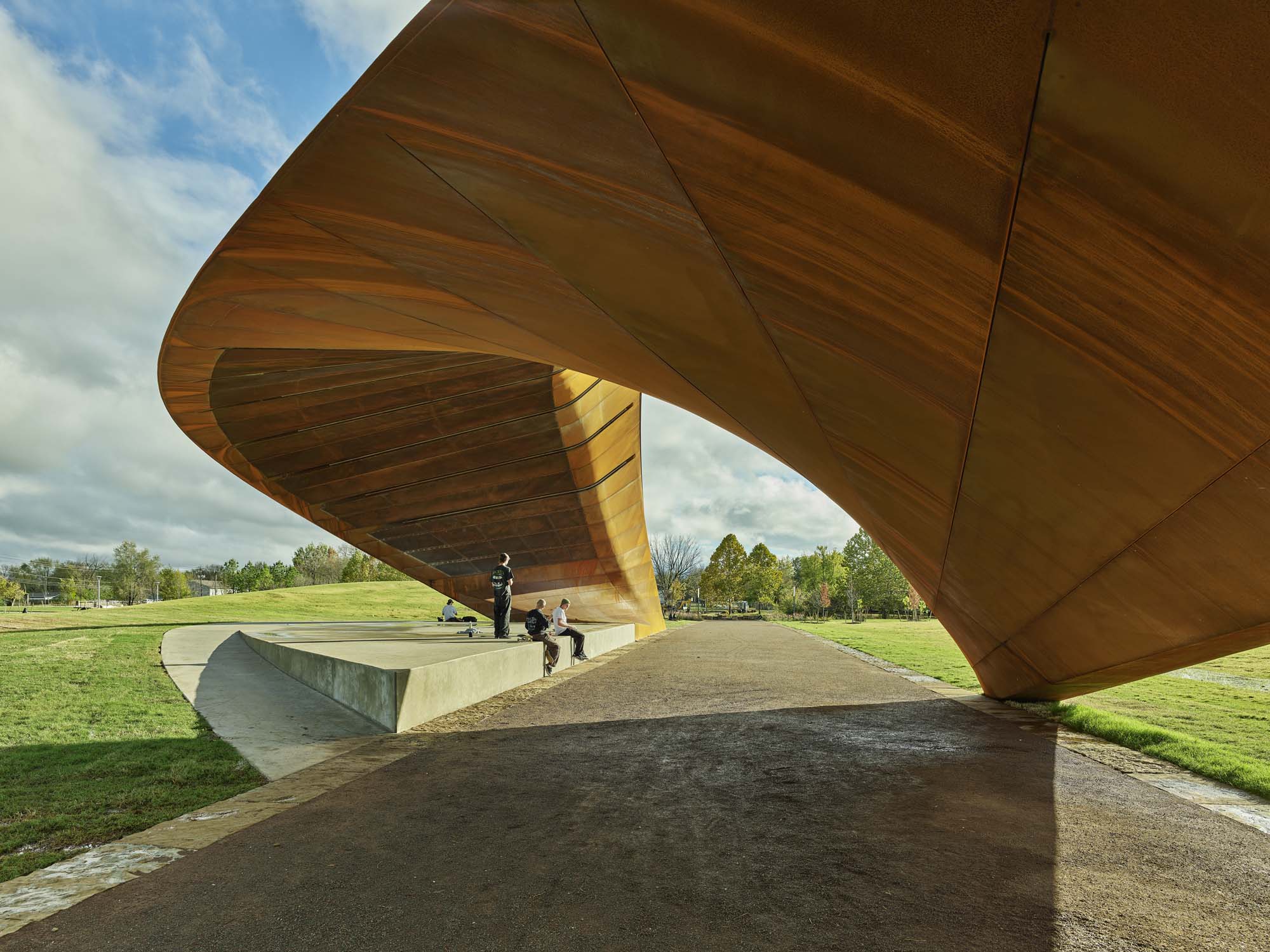
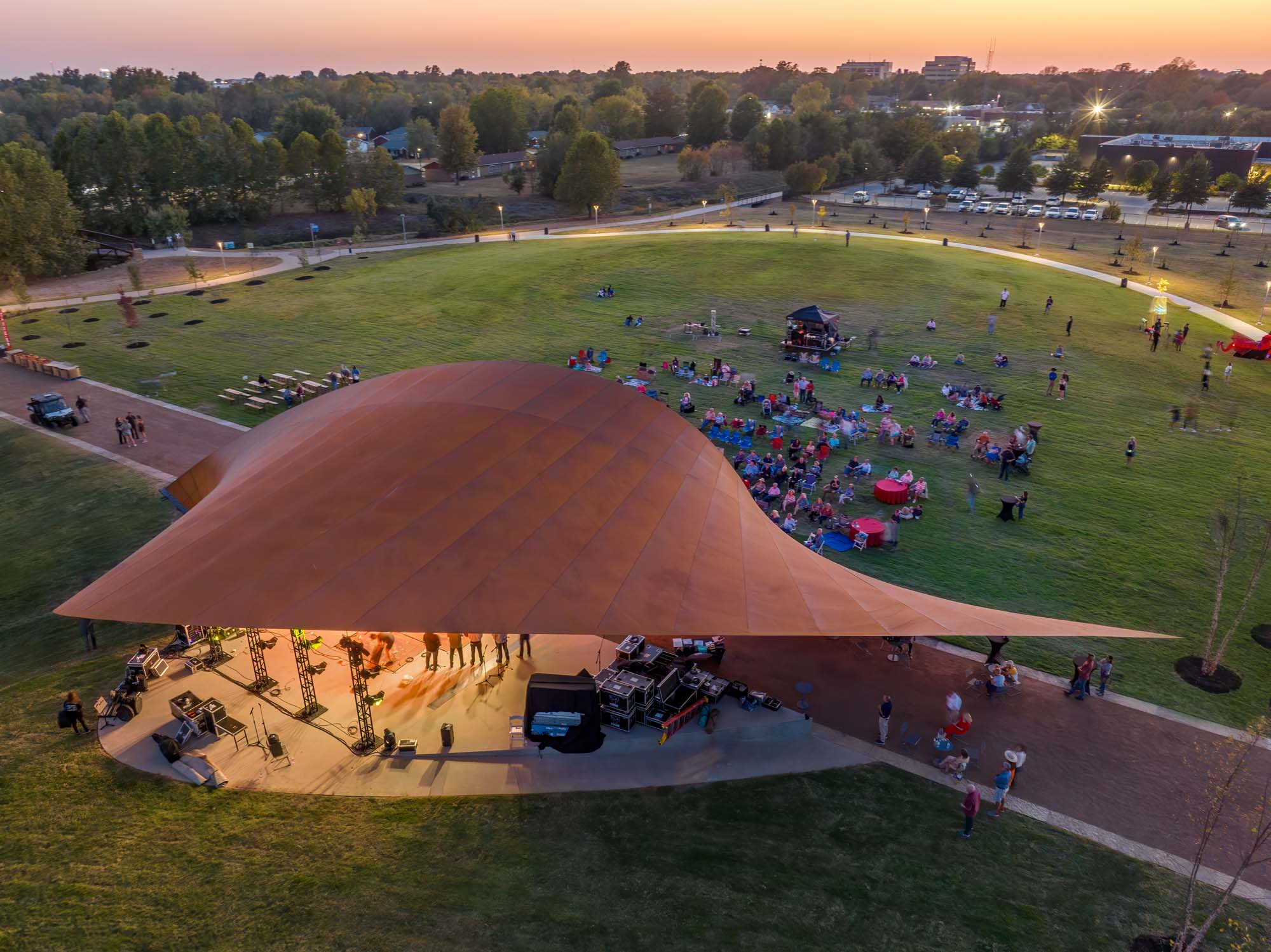
At the heart of Luther George Park in Springdale, Arkansas, Trahan Architects has crafted a pavilion that seems to defy gravity—an elegantly torqued canopy bringing together sculpture, infrastructure, and landscape. Conceived as stage, shade, and beacon, the 150-foot-long weathering steel structure touches the earth only twice.
“Could we peel a single sheet of steel up from the ground and let it float?” was one of the studio’s earliest questions, according to firm founder Trey Trahan. Drawing inspiration from the curves of Calder and the monumentality of Serra, the team collaborated with Dutch fabricator CIG—known for artistic partnerships with Anish Kapoor and Frank Stella—to realize the pavilion using advanced shipbuilding techniques. The shell, supported underground by concrete footings and drilled piers, is a monocoque system: a self-supporting skin made from weathering steel, a material that mirrors the iron-oxidized soils of the Ozarks and will change character over time.
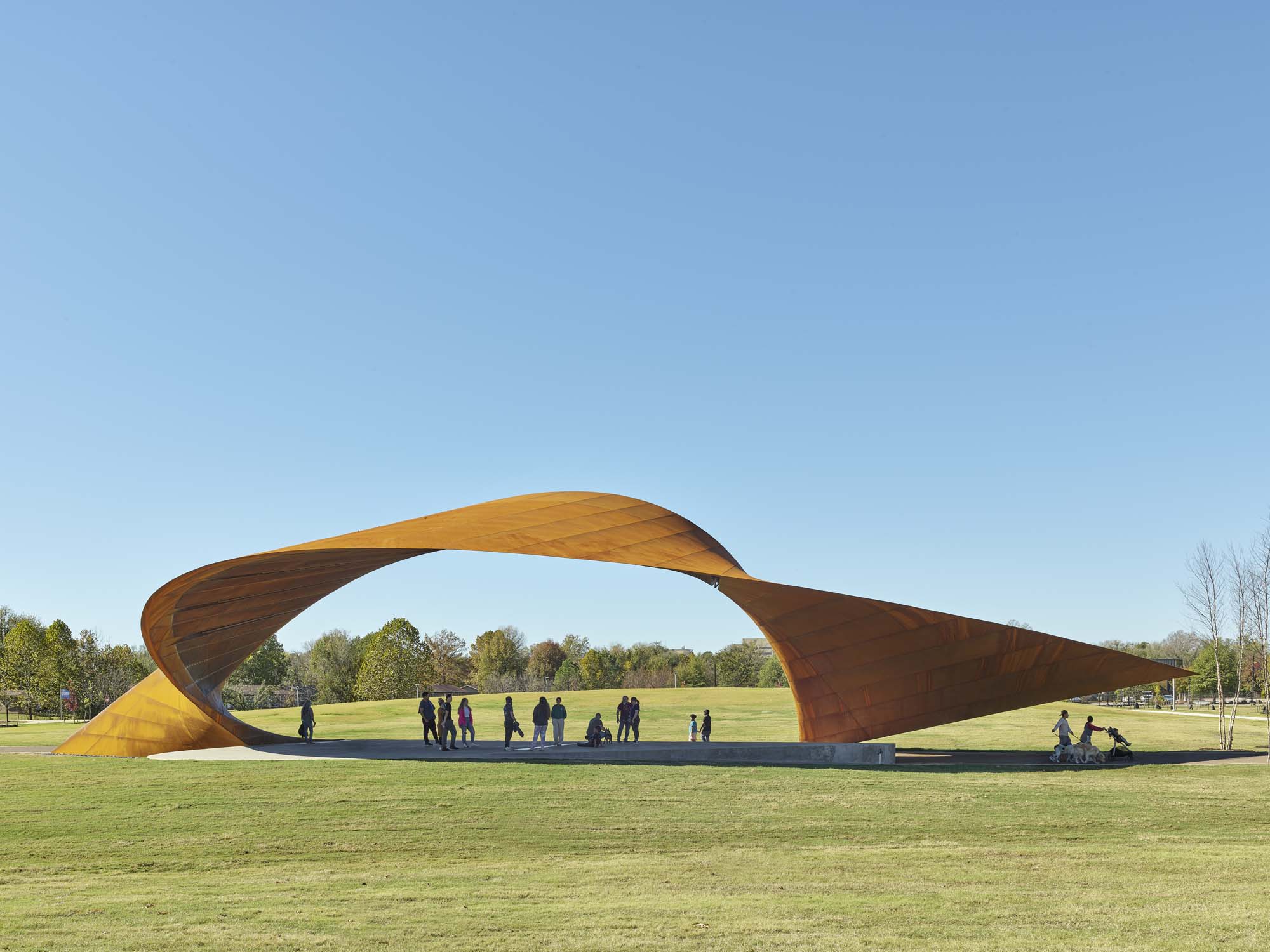
Beyond its mind-bending form, the pavilion is quite functional. It houses a full theatrical rigging system and acoustically engineered surfaces, enabling performances for up to 3,000 people. Designed together with landscape firm SMM, the park’s new groundscape is a choreography of berms, lawns, and native plantings that frame the structure and enhance movement around it. Berms near the pavilion enhance acoustics, while slightly sloped lawns offer optimal sightlines while remaining usable for everyday activities. The surrounding native vegetation changes with the seasons.
Nestled between downtown Springdale and the Razorback Greenway—a 40-mile regional trail system that links the major cities of Northwest Arkansas—the pavilion also acts as a portal, directing cyclists and pedestrians to the town’s active main street, Emma Avenue.
It now serves as an anchor for a town that often gets overlooked in favor of nearby Bentonville and Fayetteville. “It’s not just about looking beautiful,” says Trahan Architects’ design director Robbie Eleazer. “It’s about offering dignity to the community.”
Ronald Rael, “Adobe Oasis” at Desert X
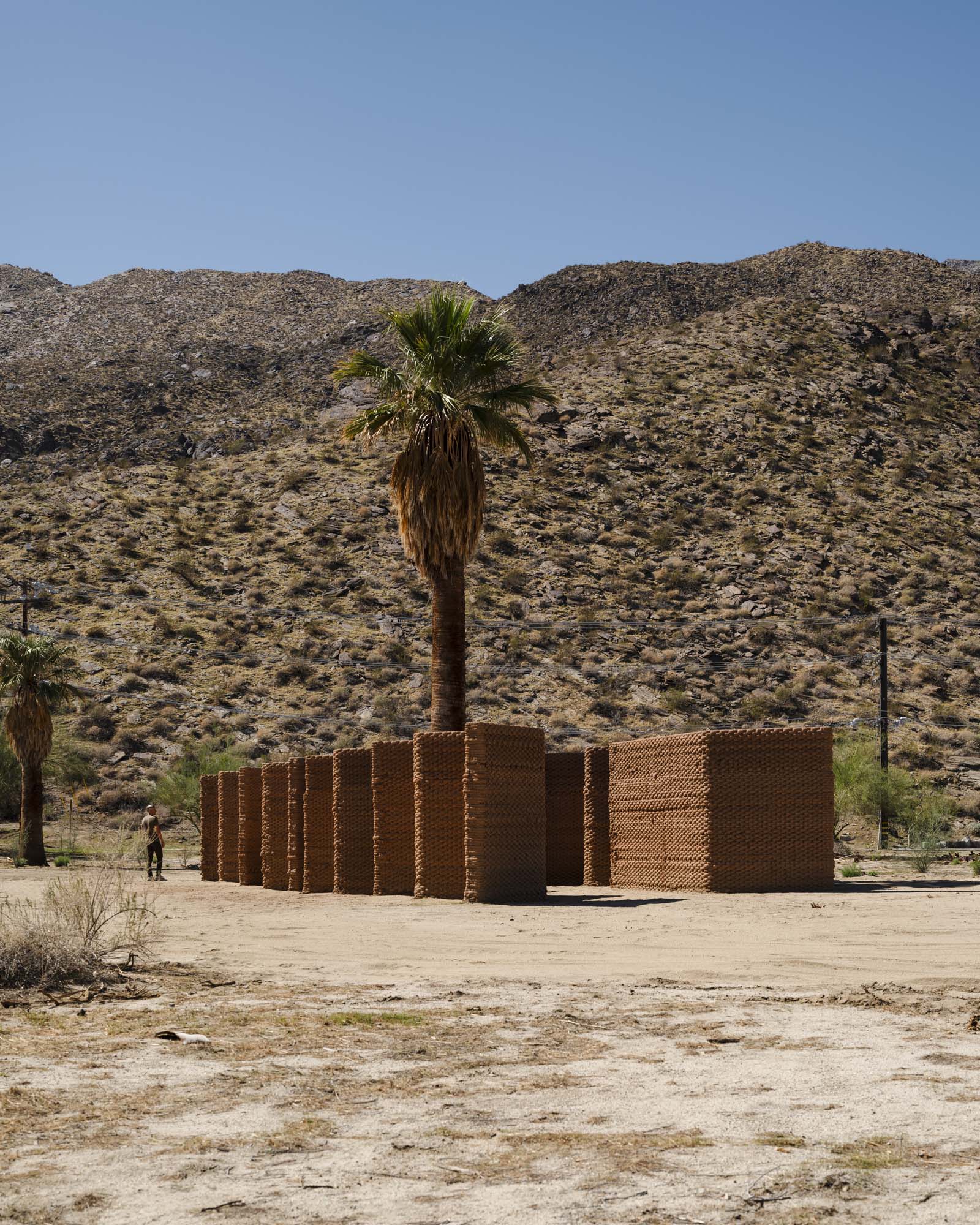
At this year’s Desert X, architect and artist Ronald Rael unveiled Adobe Oasis, a site-specific installation that merges ancient earth-building traditions with advanced robotics. Built entirely from 3D-printed adobe mud, it’s both a structural feat and a challenge to the systems that dominate architecture.
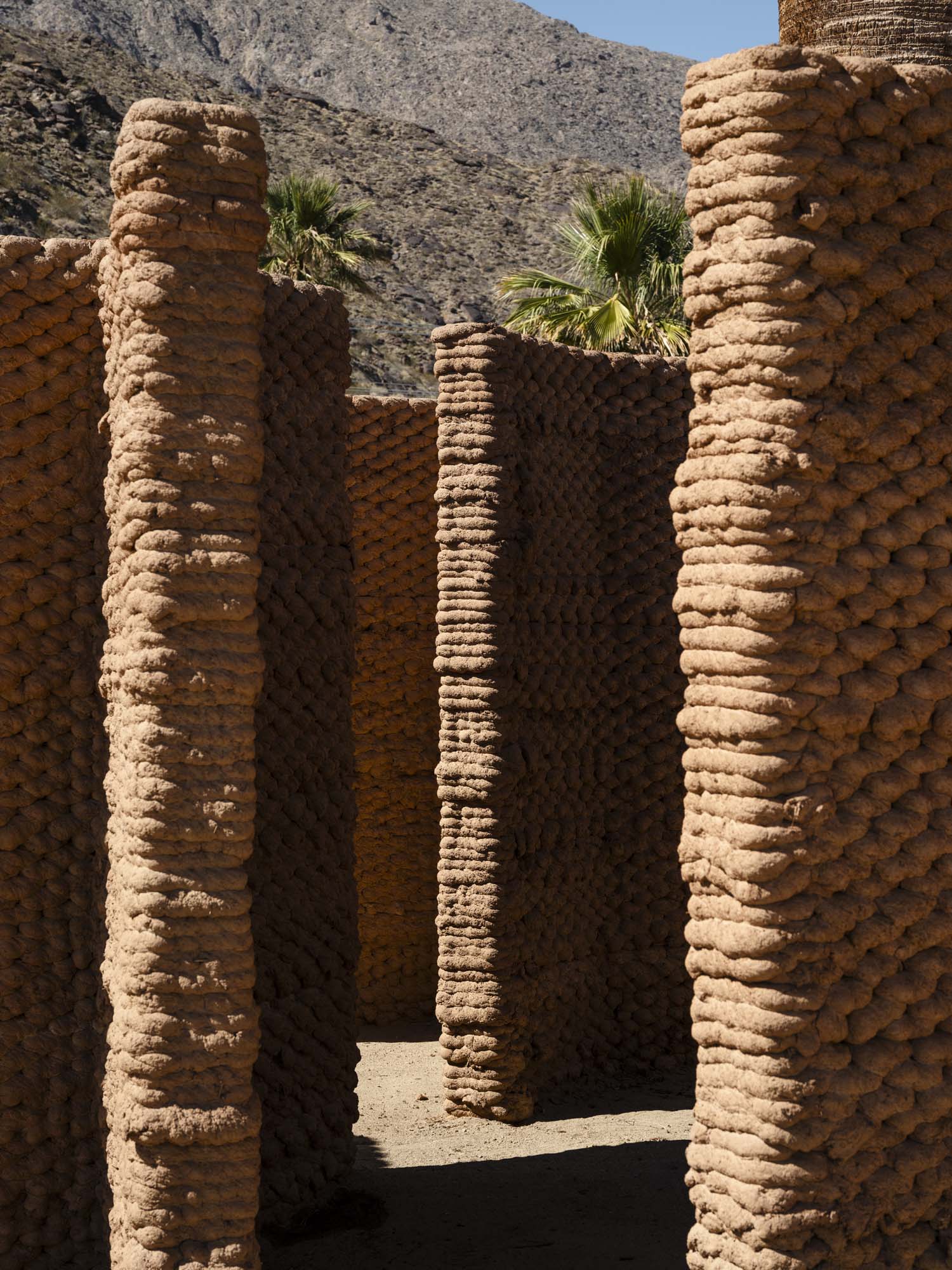
Rael, who comes from a lineage of adobe builders in Colorado’s San Luis Valley, has long questioned the abandonment of earthen construction. “What if,” he asks, “the future of building wasn’t steel or concrete, but a return to the earth—just with new tools?” Using a robotic arm to extrude corrugated ribbons of Riverside County clay, Rael evokes the textures of palm bark and the flowing contours of Coachella Valley foothills and other local geological formations.
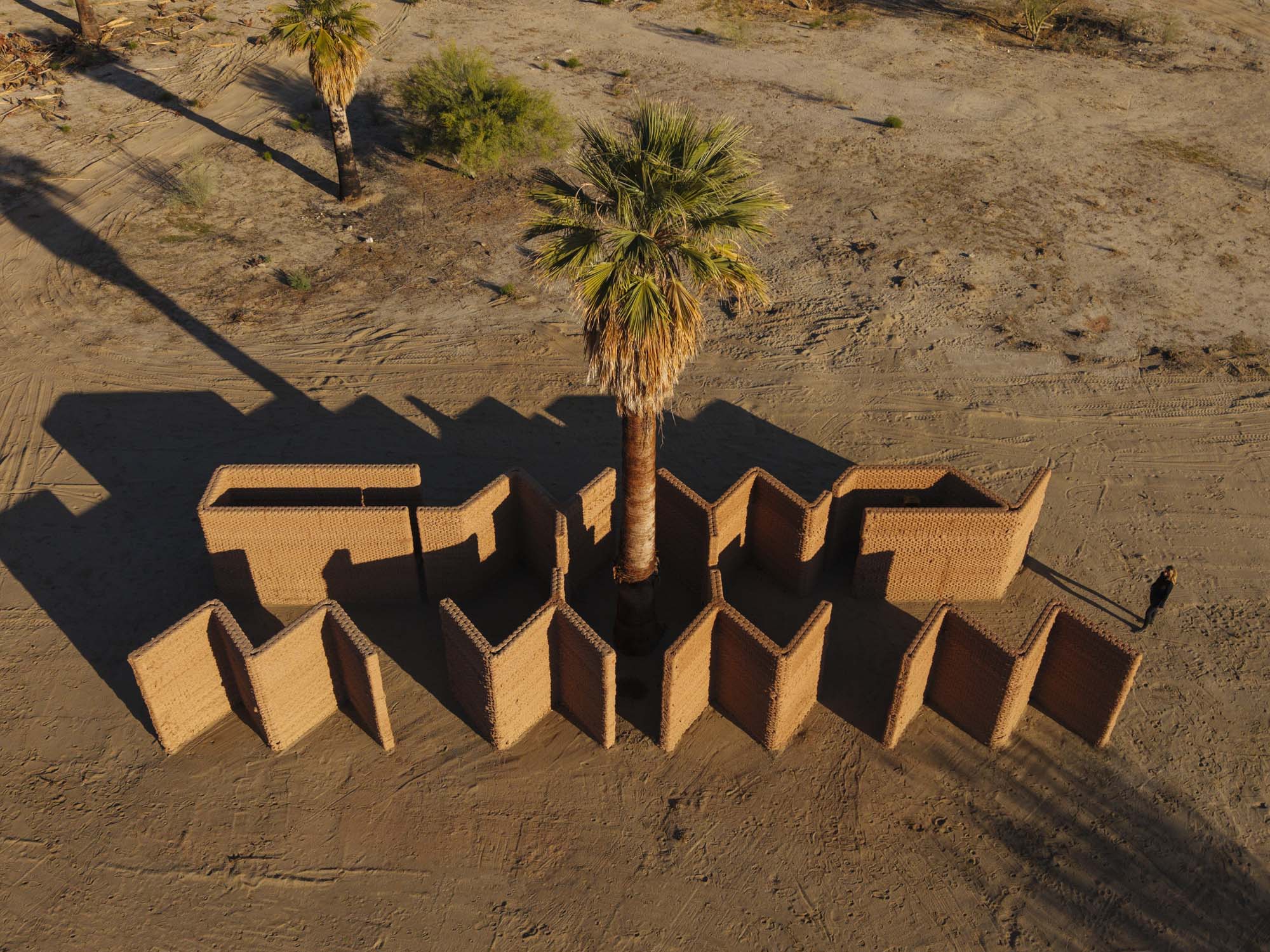
The installation’s walls, some 12 feet tall and just three inches thick, stand strong thanks to their rippling form. Rael tested not just material mixes and structural angles but also the choreography between man and machine. “It’s like dancing with a collaborator,” he notes, describing the intimate physicality of guiding the robot, often by touch.
Beyond its visual drama, Adobe Oasis is a test case for how locally sourced, recyclable materials can reenter the architectural mainstream. As Rael sees it, the most advanced construction system may be the one humanity mastered 10,000 years ago. “It’s a structure, but also a memory, a possibility—and maybe even a necessity,” he says.
Would you like to comment on this article? Send your thoughts to: [email protected]
Latest
Viewpoints
Drawing Collective Housing Back Into a Common Language
Felipe Correa’s Collective Living and the Architectural Imaginary, and why this survey of a century of collective housing was built to argue a point, not cover the field.
Profiles
The Architect Designing Sacred Spaces for the Every Day
RIBA Gold Medal winner Níall McLaughlin strives to design not just buildings but the rituals that unfold within them.