



October 29, 2025
Jeanne Gang on Harvard’s New Rubenstein Treehouse
A tesseract shaped by its context
LINDA JUST: Let’s start by spotlighting aesthetics and form generation. How did your team created the form of the building in response to its site conditions?
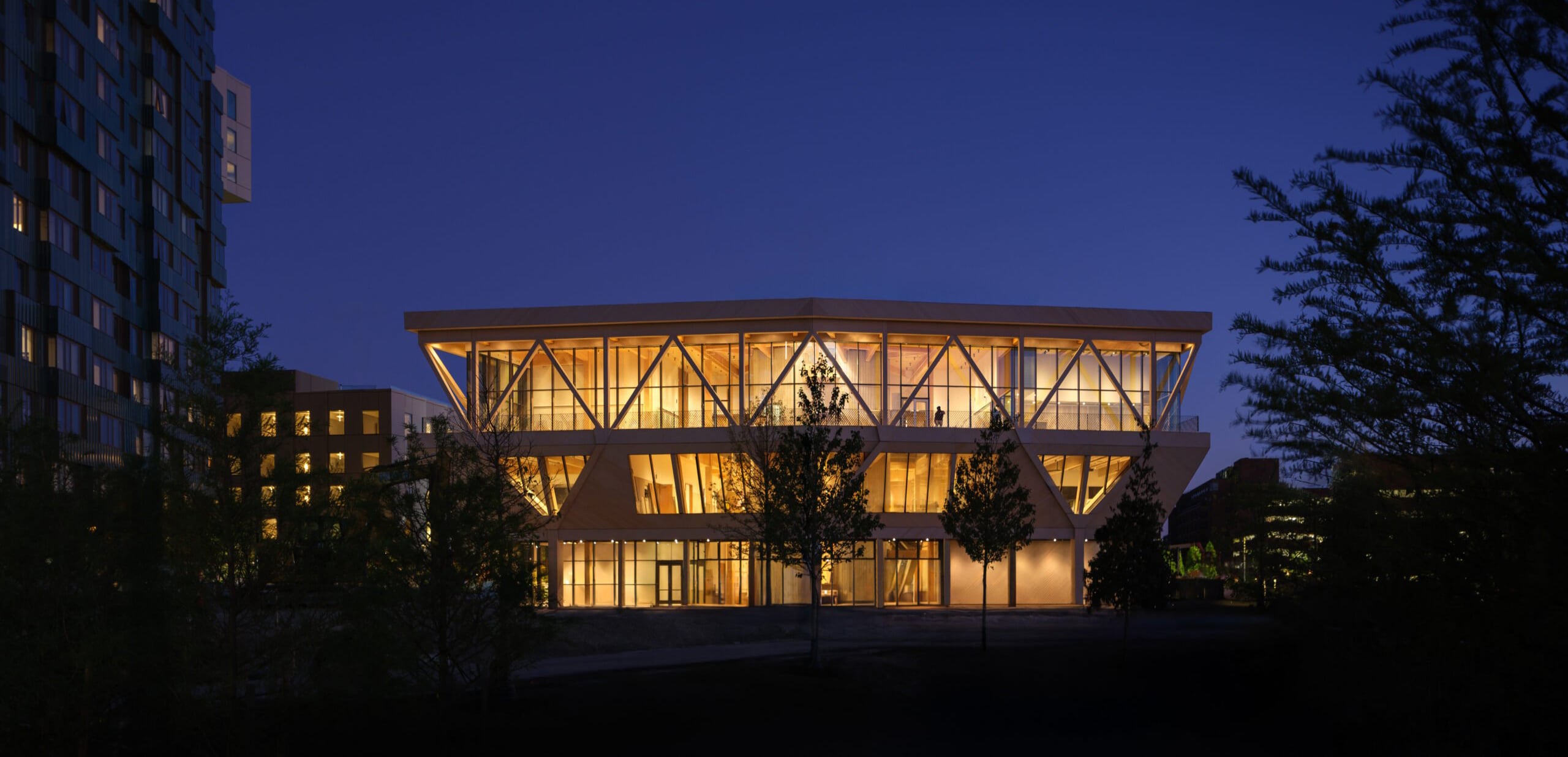
JEANNE GANG: When we were in early design During the COVID-19 era, we were envisioning spaces where people could hang out. We put the core in the center and arranged casual spaces around it to encourage people to circle around and gather.
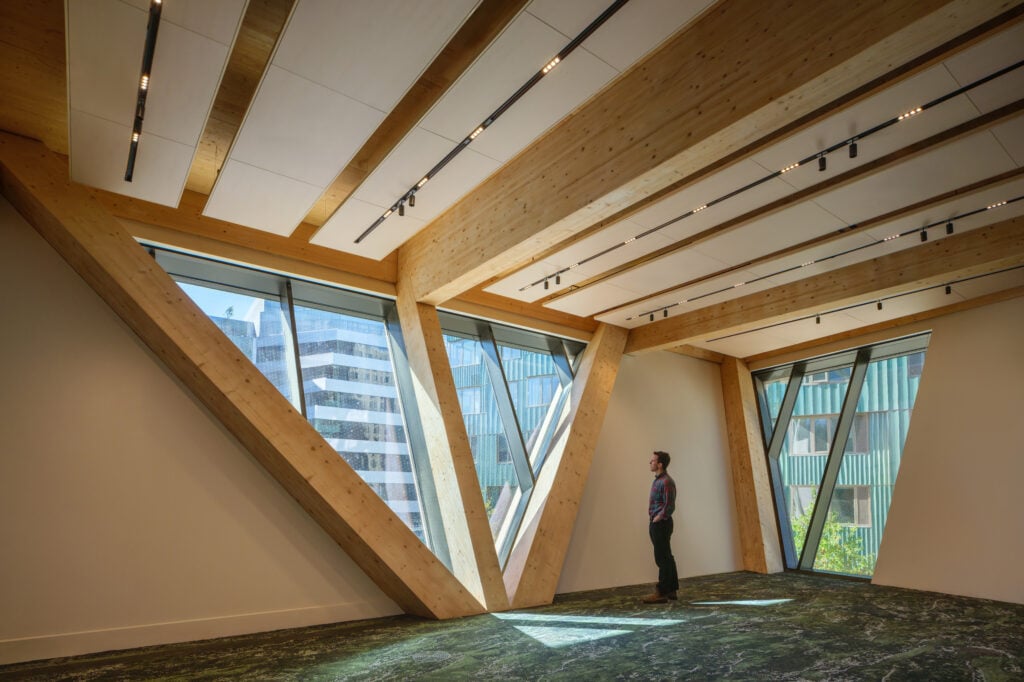
At the top level, there are expansive views of the campus and city framed by the building’s timber columns. On the north side is the Canopy Hall, the main gathering space, and then a terrace along the south façade. There’s also a pre-function area with other breakout spaces around it. We thought carefully about where to put that main space, and we landed at the top so that visitors could have the feeling of being “up in the canopy.”
Were you actively collaborating with the landscape team at SCAPE to achieve a highly integrated design? There’s an impression of seamless interweaving in the relationship of paving textures.
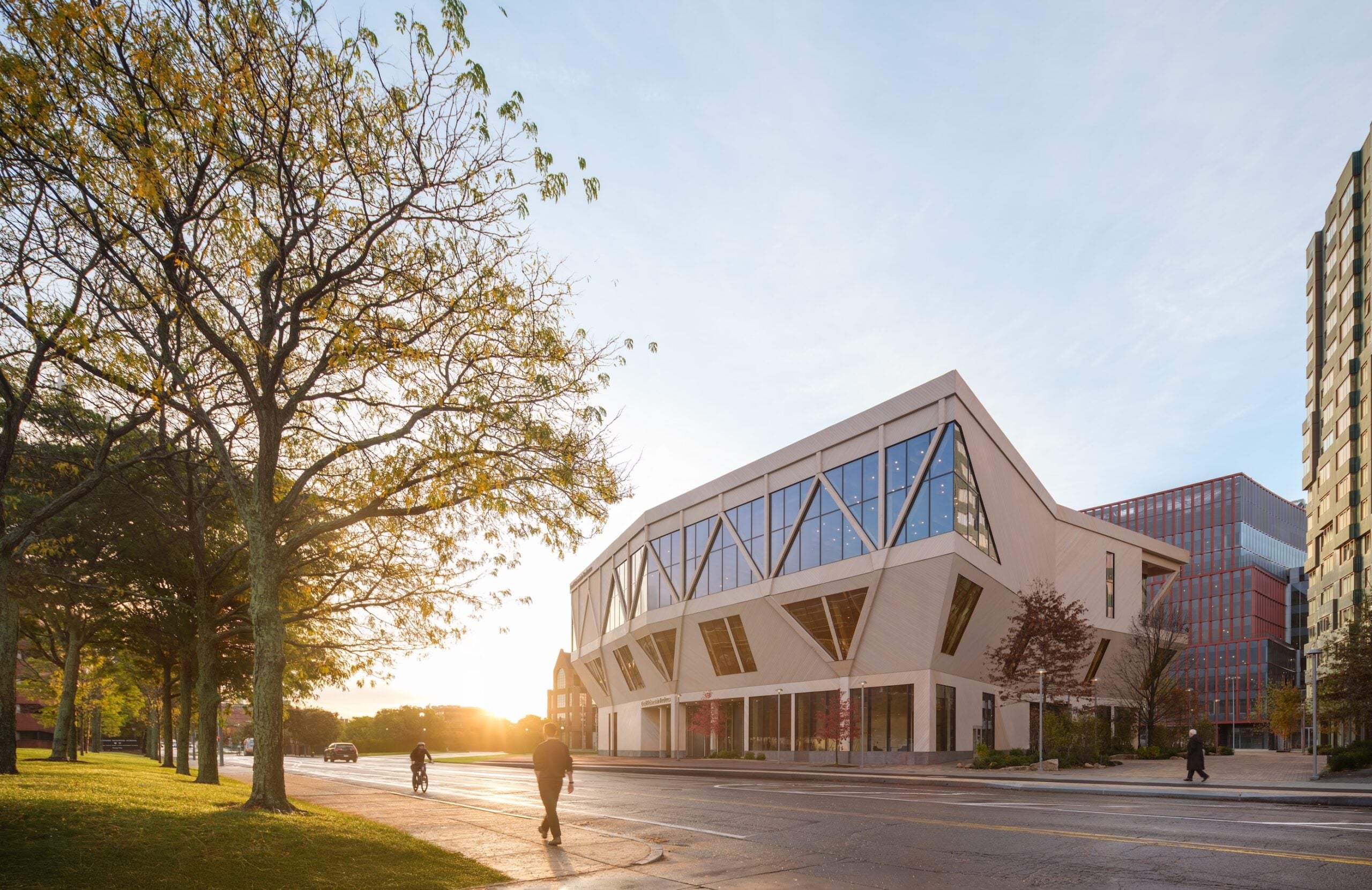
We were really thinking about the ground floor as an extension of the urban space around it. The lobby is designed as a space that people can easily move through and reach other parts of the neighborhood, like the Greenway. We also inflected each face of the building to help extend the public realm in different ways. For example, the north and south sides inflect outward to draw people into and through the building, while the western side inflects inward to create more space for the Laneway.
Our main site goal was to make a pedestrian area inflection around what resembles a champion level tree amidst a forest clearing: with a laneway that is human-scaled and connected; a covered walkway; and an upper level balcony facing south
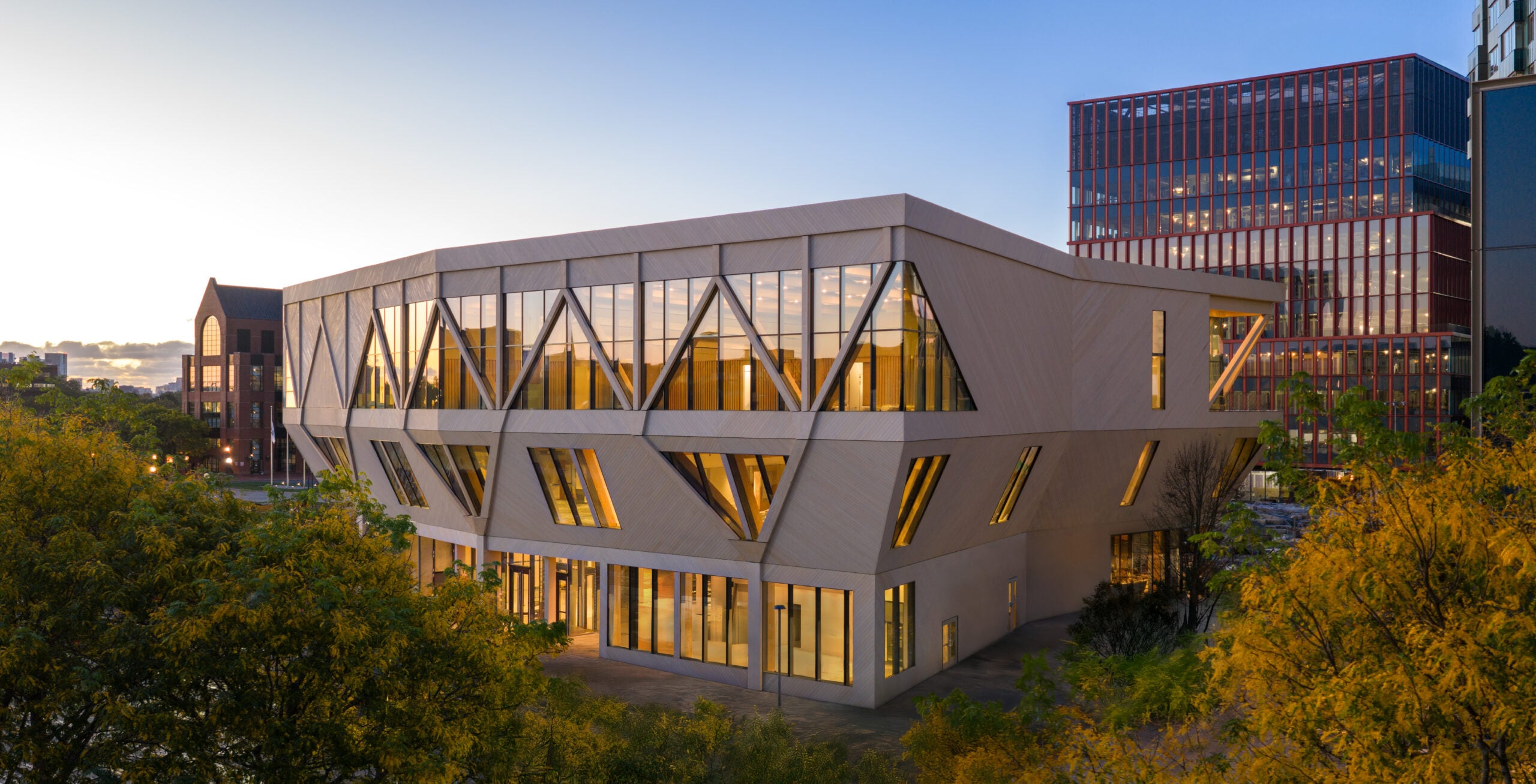
If you look at the building in the site view, it’s a lot smaller than the other buildings. That helps people enter at multiple points drawing them into the park at the site’s center. The resulting little bowtie shape at the ground plane connects and activates ground floors by allowing you to see in.
If I remember correctly, you have a space in your Chicago office that you sometimes fondly refer to as the Treehouse, that’s kind of delicately poised over a more enclosed central stair. This is of course different ,but experientially what you’re describing seems to have some relationship to your own lived experience.
Yes, good memory.
And yes, I’ve always been fascinated with trees, and liked treehouses.
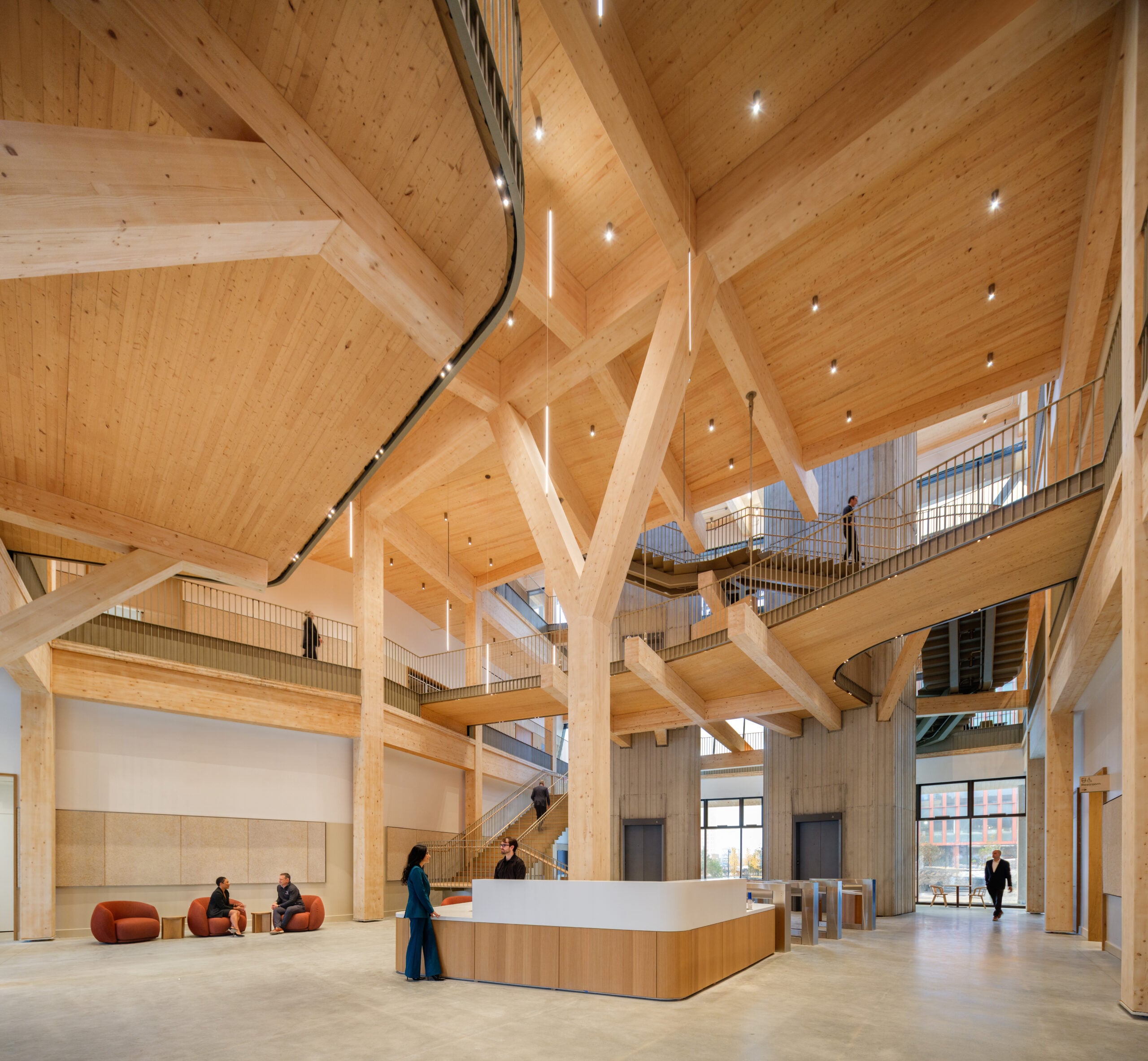
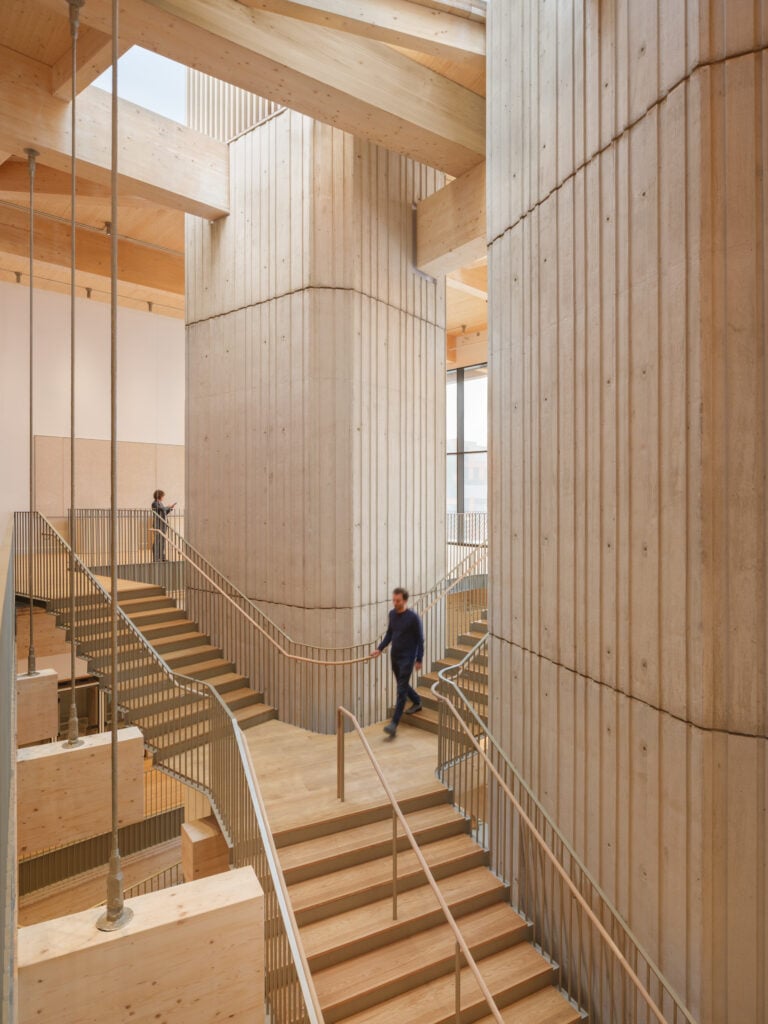
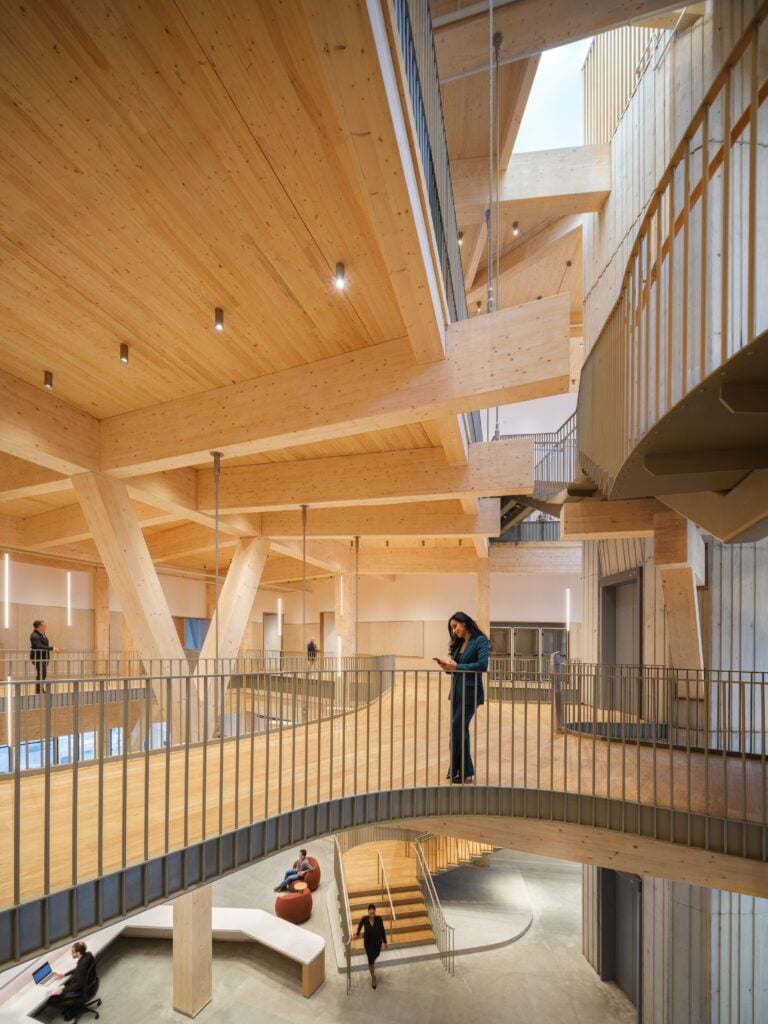
In Chicago, there are many spaces on the second floor, just above street level, that were once gathering places and ballrooms. The result is this common experience of looking up from the outside and catching a glimpse of an interesting ceiling. So, the idea of articulating the ceiling at the top of the Canopy Hall, visible from the street, was appealing to us. We separated the core into two volumes, so light can get through and around it. The mass timber columns in a Y shape evoke this feeling of being in a forest. The building really is tree-like, from its structure to the experience of navigating and being in the space.
I think you have long been a champion of wood as a material, whether we’re talking about the Arcus Center for Social Justice Leadership in Michigan or the Writers Theatre in Glencoe, which has such an intricate façade that presents structural elements as visual expression. Are there areas you have experimented with in this project as one of Studio Gang’s newest forays in mass timber?
From a sustainability standpoint, the building is designed to perform very well, especially when compared to similar buildings using traditional materials. Our use of mass timber is a large part of this, along with the use of low-carbon concrete below grade and for the elevator cores. The concrete mix uses ground glass pozzolan, a low-carbon cement replacement made from post-consumer glass containers.
We were able to use mass timber throughout, but we also thought about how to innovate with it. A lot of people think that mass timber only lends itself to boxier forms, but we wanted to create a new shape that could expand beyond those.
We also had to produce a high-performance envelope. We needed cladding to waterproof this wood structure, and that’s where these interesting diagonal panels on the façade came into the design. We also had to clad the structure, since it cannot be exposed, so we let it express itself through its branched form.
Flexible design requires a lot of integration
It’s an exercise of topology, reconciling a skin around a more complex shape. And it’s interesting because the distinction between tissue and bone structure beneath registers quite clearly to first glance, through color. Is the anticipation that the facade changes with time? Or are the sealers going to keep the wood that rich, dawn-like pink tone.
It’s been a similar process each time we have done a wooden structure.
We work with clients to figure out their comfort with the aging and silvering of wood. I think it’s beautiful, but some clients worry that it looks like it’s not being properly cared for.
Harvard was open to some weathering of the wood. So, we used a sealer on light-colored wood that will allow it to lightly silver without going to extremes or darkening with time.
Because the Rubenstein Treehouse effectively serves as a gathering space. Did you have any particularly defined parameters for what was meant to go inside, or was it more open to interpretation?
This was a fun and exciting program because Harvard has so many different types of gatherings, from academic lectures and conferences, to social events for celebrating or fundraising.
It was important to think about how to help people connect in a space like this. One way we did that was by creating visual connections across levels. People can see each other and the activity happening in the building, which encourages them to climb up and explore further. The ground level is open to the public, so you can study there, grab a coffee from the café, or simply cut through the building to get to the Greenway. The idea is that no matter what’s happening at the Rubenstein Treehouse, everyone feels welcomed there.
Designing a building with flexibility requires integrating a lot of different elements that make this possible. For example, we had to make sure there was storage space for different equipment and moveable walls to adjust the size of gathering spaces.

The studio is now working in a lot of different places. Are there common points of entry into your research that allow you to do that? And what would you say was the entry point for this particular project?
Well, unlike a lot of projects where you might never have been there before embarking on the task at hand, I was more familiar with this site. Allston is a neighborhood I know well—first as a student living in Cambridge, and then as a faculty member at the Harvard Graduate School of Design.
As a co-leader of the ERC masterplan, we had to think about how to make this feel like an active neighborhood on day one. That included thinking about how to make it feel welcoming to people that live in the surrounding neighborhood, who may not be affiliated with Harvard. All the buildings have spaces at the ground level, like cafes, restaurants, and retail, that anyone can visit. These, along the Laneway and Greenway, really open up the ERC and will make it a lively place when the first phase completes.
With the Greenway, it’s going to be amazing to have a connection all the way to the Charles River from Allston.
Would you like to comment on this article? Send your thoughts to: [email protected]
Latest
Viewpoints
Detroit Month of Design: A City’s Work in Progress
Now in its 16th year, the celebration offers insights into the Motor City’s ongoing accomplishments without glossing over its hurdles.
Projects
How a Hybrid Building Helped an Historic Manhattan Congregation Remain in Place
On Billionaire’s Row, FX Collaborative designed a new home for Calvary Baptist Church combined with an office tower.