



March 12, 2026
Organic Architecture Continues to Bloom in Portland
How did we get here? Oshatz, who was born in 1945 in Los Angeles, had an early start in his career, working half-days during high school for an architect practicing near his home. He then attended Arizona State University and had two summers of considerably better-than-average summer work, for Lloyd Wright. “I just walked into his studio with my portfolio and asked for a summer job. He took a quick look through my portfolio and simply said ‘go hand.’ Oshatz worked on drawings for Wright at his studio in West Hollywood, such as the landscape plan for his landmark Bird of Paradise (Bowler House) in Rancho Palos Verdes.
“I remember how sharp his mind was in terms of what he was designing. He knew exactly where he wanted every plant,” Oshatz notes. “I would drive him to job sites, and he would talk about his father and Louis Sullivan and all of the people he knew. [That’s how] I learned the history of modern architecture.”
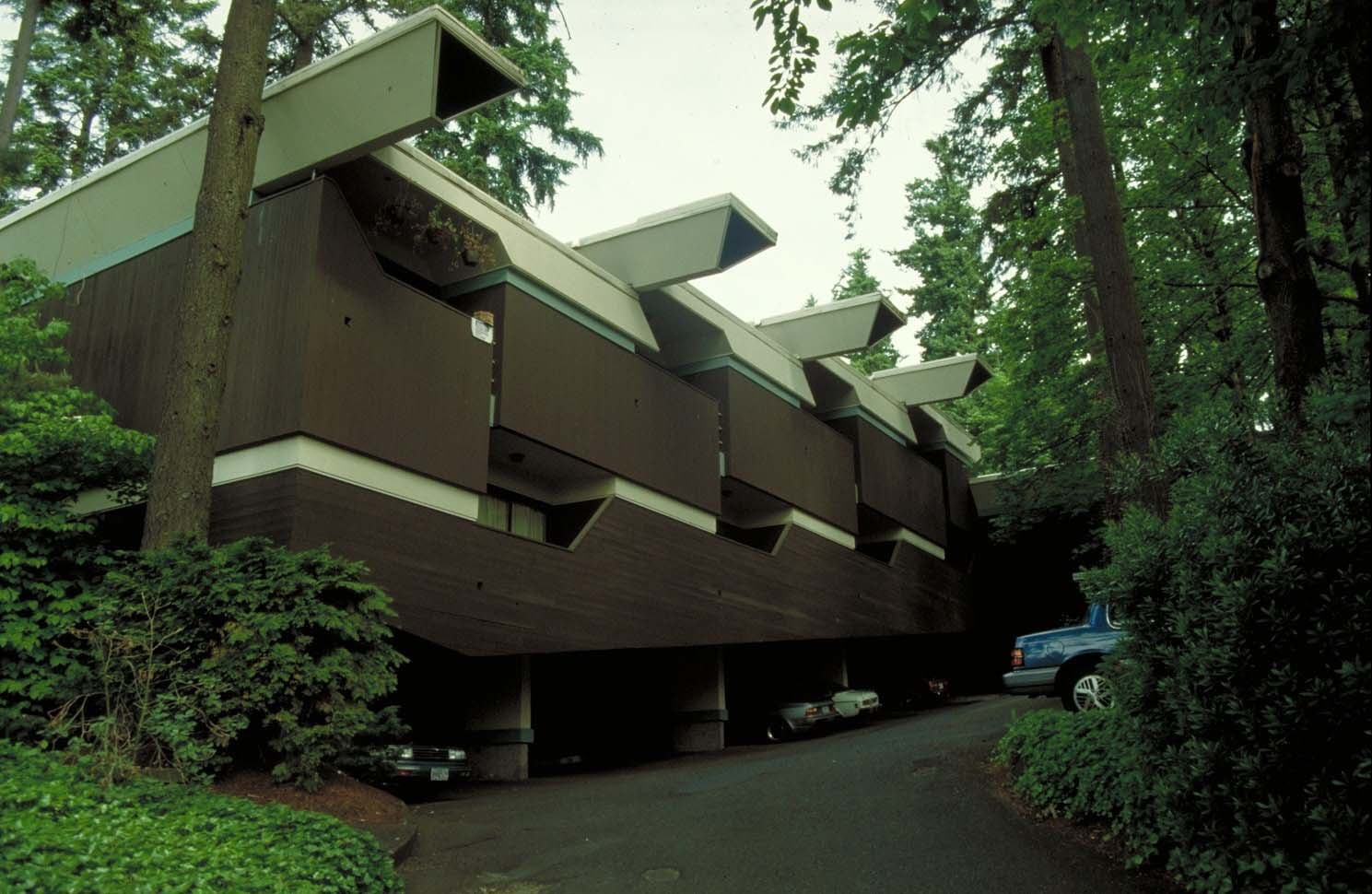

Oshatz graduated in 1968 and obtained early work for a civil engineering firm working on residential subdivisions. He began working on plans for an apartment complex and when the firm dropped out of the project, he built it himself. This, the 1972 Raleigh Woods Apartments in Portland, is deftly articulated and assertively corniced. Oshatz recalls, “It made a big stir because it was so different from what they were building as apartment complexes.”
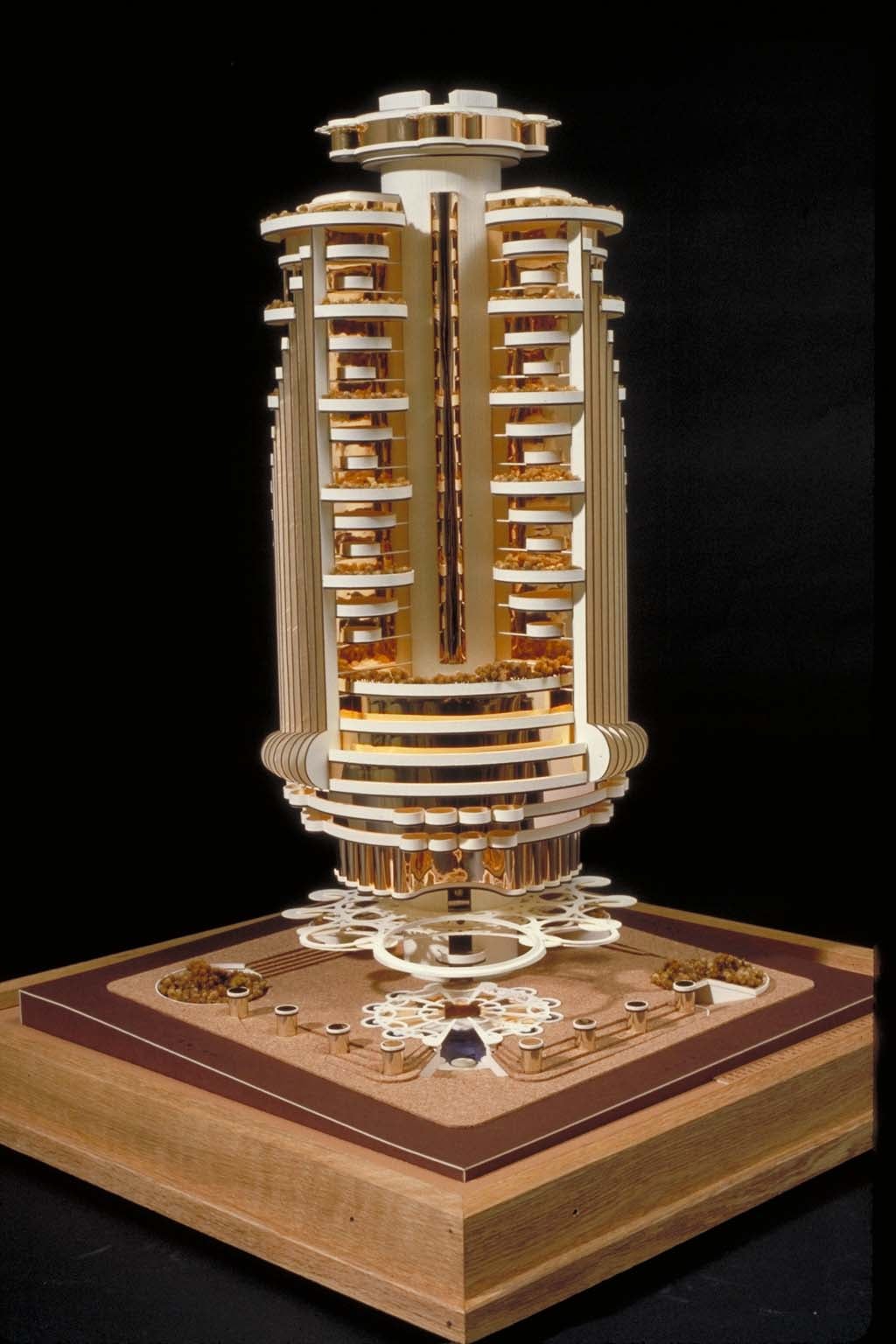
Oshatz went on to build a great variety of work in the Portland area and afar. These have included a few commercial buildings and a great variety of single family residences. A number of dazzling projects were near-misses, prominent among them The C.A. Bright Tower, one of the great might-have-been organic skyscrapers.
Work has continued to crop up. He explains, “I’m basically a dinosaur because I wait for the phone to ring which isn’t the way you get work in this day and age, but so far, I get enough phone calls to make a living.” He is currently working on a cottage in British Columbia, and houses in San Jose, Malibu, and Japan.
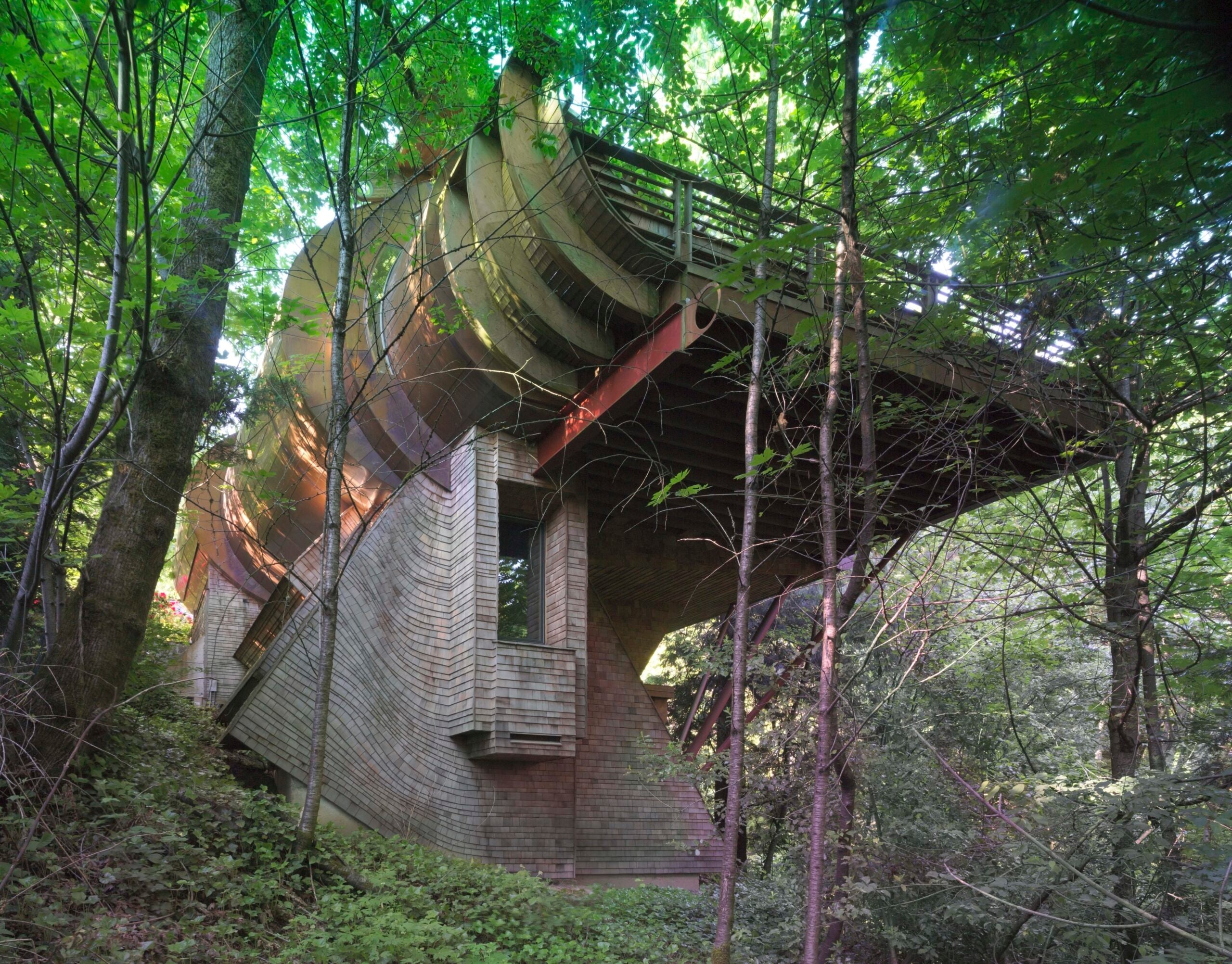

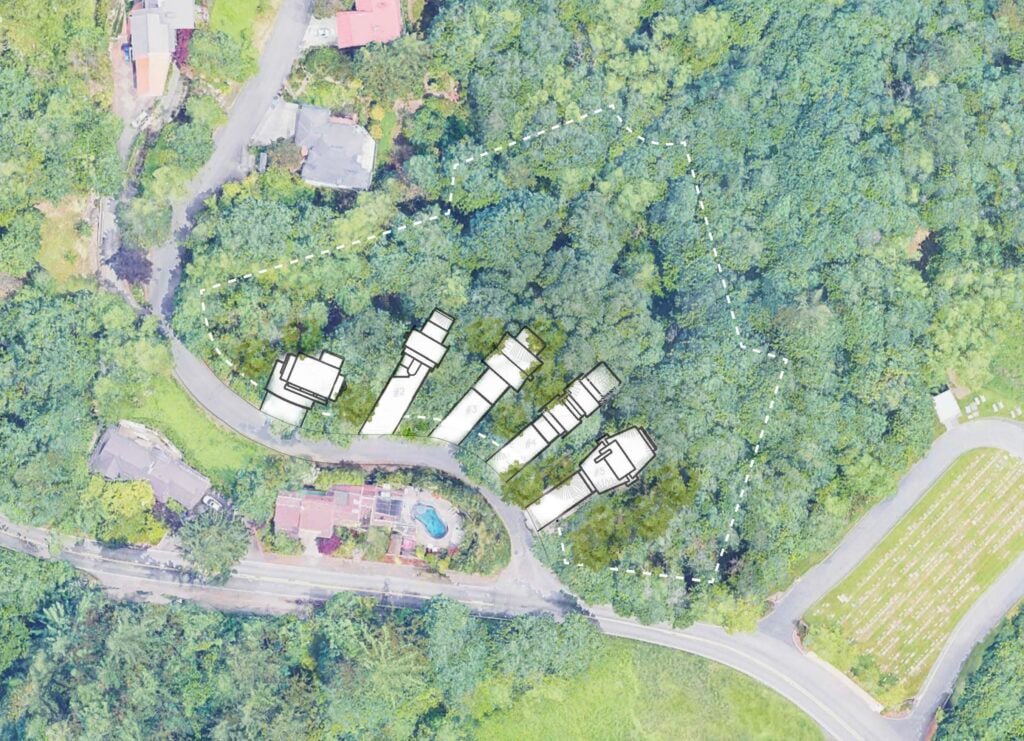
He saw an opportunity for an ensemble with the Royal Five site. A client had suggested that Oshatz build him a house and two others on what became the Royal Five site, but backed out. He bought the land—about 100,000 square feet—in 2003 for “a ridiculously low offer.”
When exploring the zoning on the site he discovered it was actually possible to build five houses but Oshatz wanted to make the slightest imprint on the forest in any case. The topography—of 30 to 40 degree slopes—was difficult, to put it mildly, and its location in a special environmental zone limited the buildable area to five 2,000 square foot lots.
Sustainability had always been his watchword, even before the term was in vogue. “All of my projects were energy efficient and so forth,” he says. “I always thought that sustainability was just good design.”
Oshatz actively prefers working with a client in designing houses. “I really strongly believe that someone shouldn’t have to adapt to an existing structure, but the structure should be adapted to the way they want to live.” Clients are helpful for other reasons “my clients have better budgets than I do,” he laughed. In this case, he had to forge ahead on his own dime.
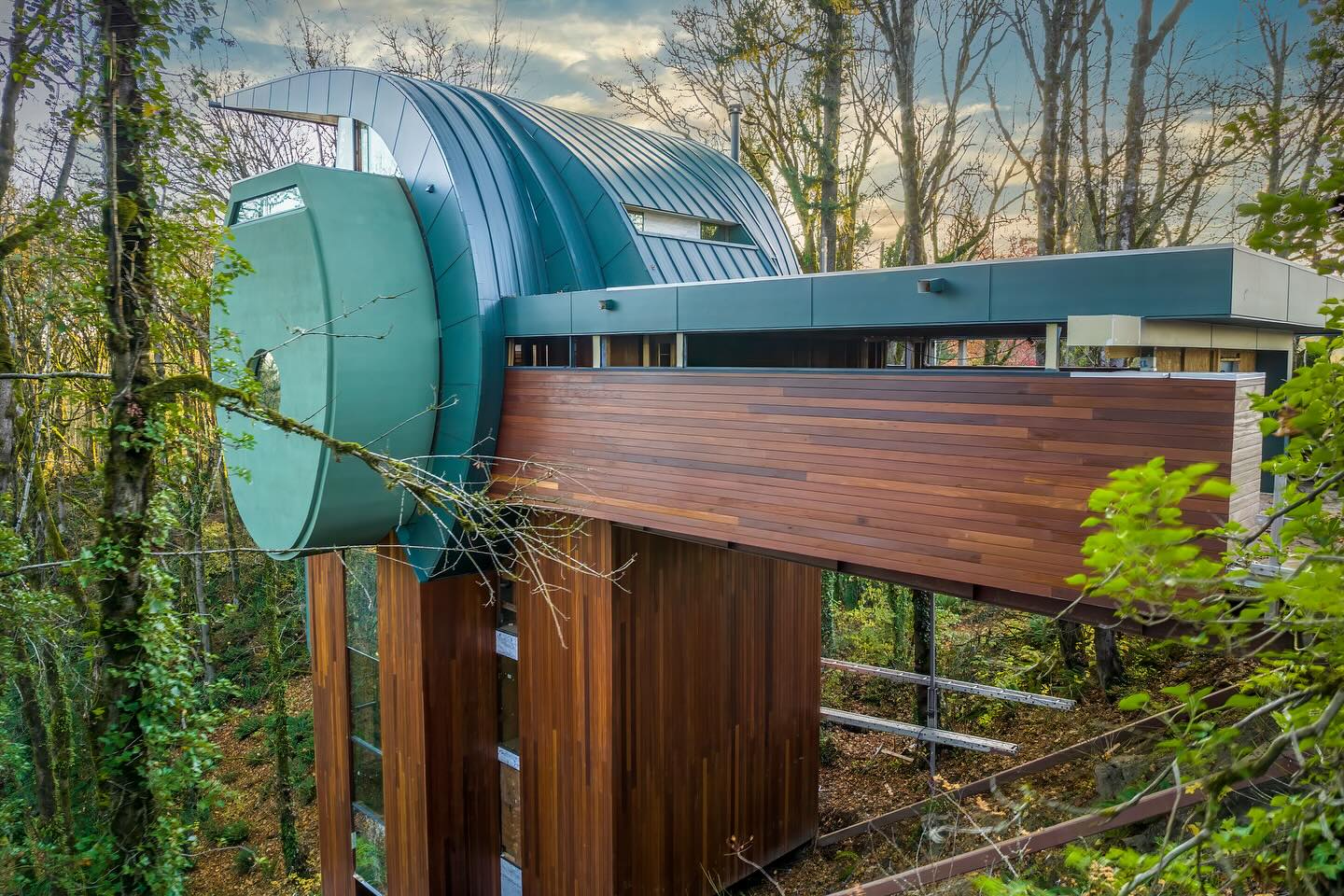
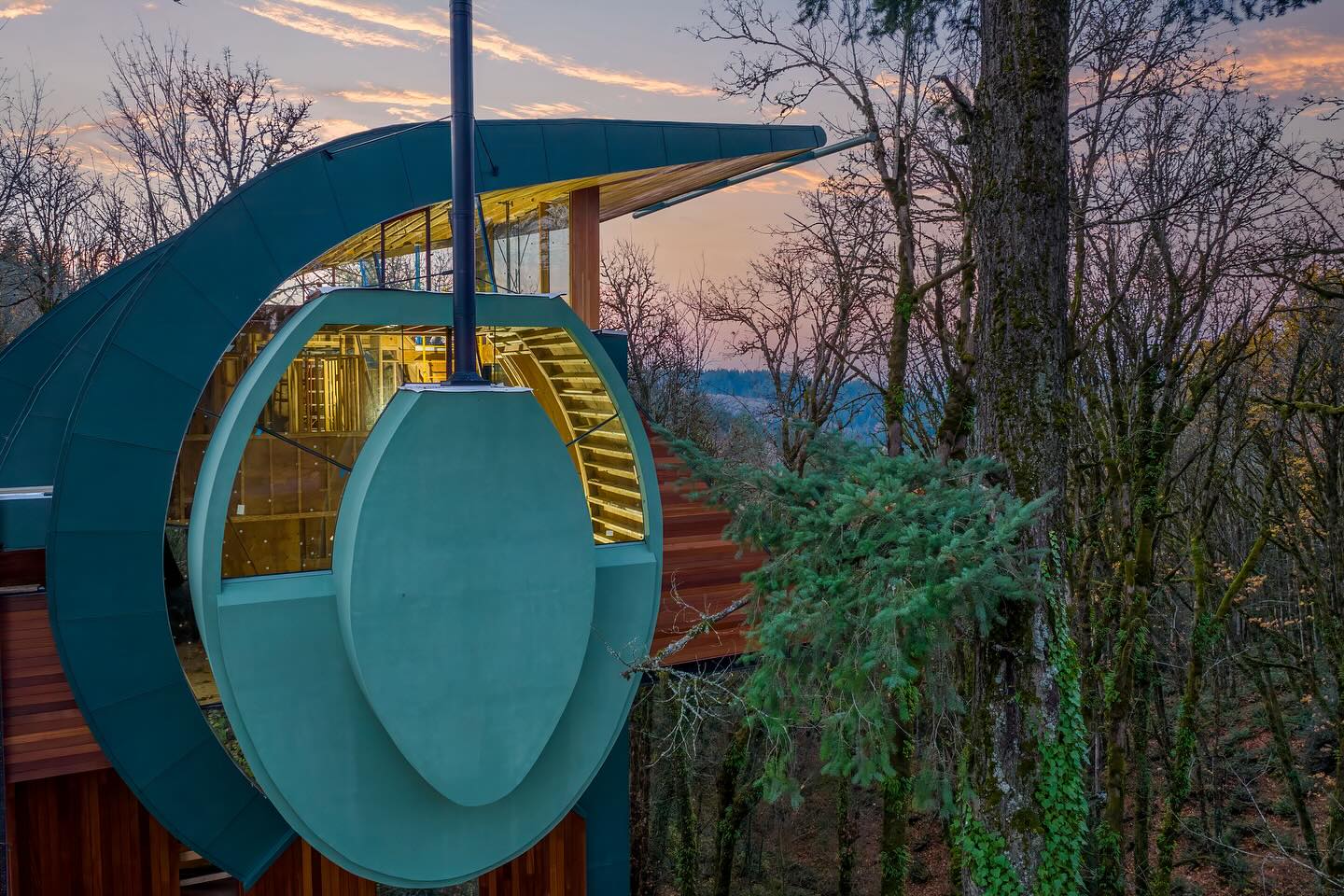
In the Royal Five home, he chose to directly emulate the foliage on site, for reasons both practical and expressionistic. Oshatz explains, “I started with a stem that relates to the vertical trunks of the trees to support the structure. Then when you get up in the air it opens up and blossoms like a flower.”
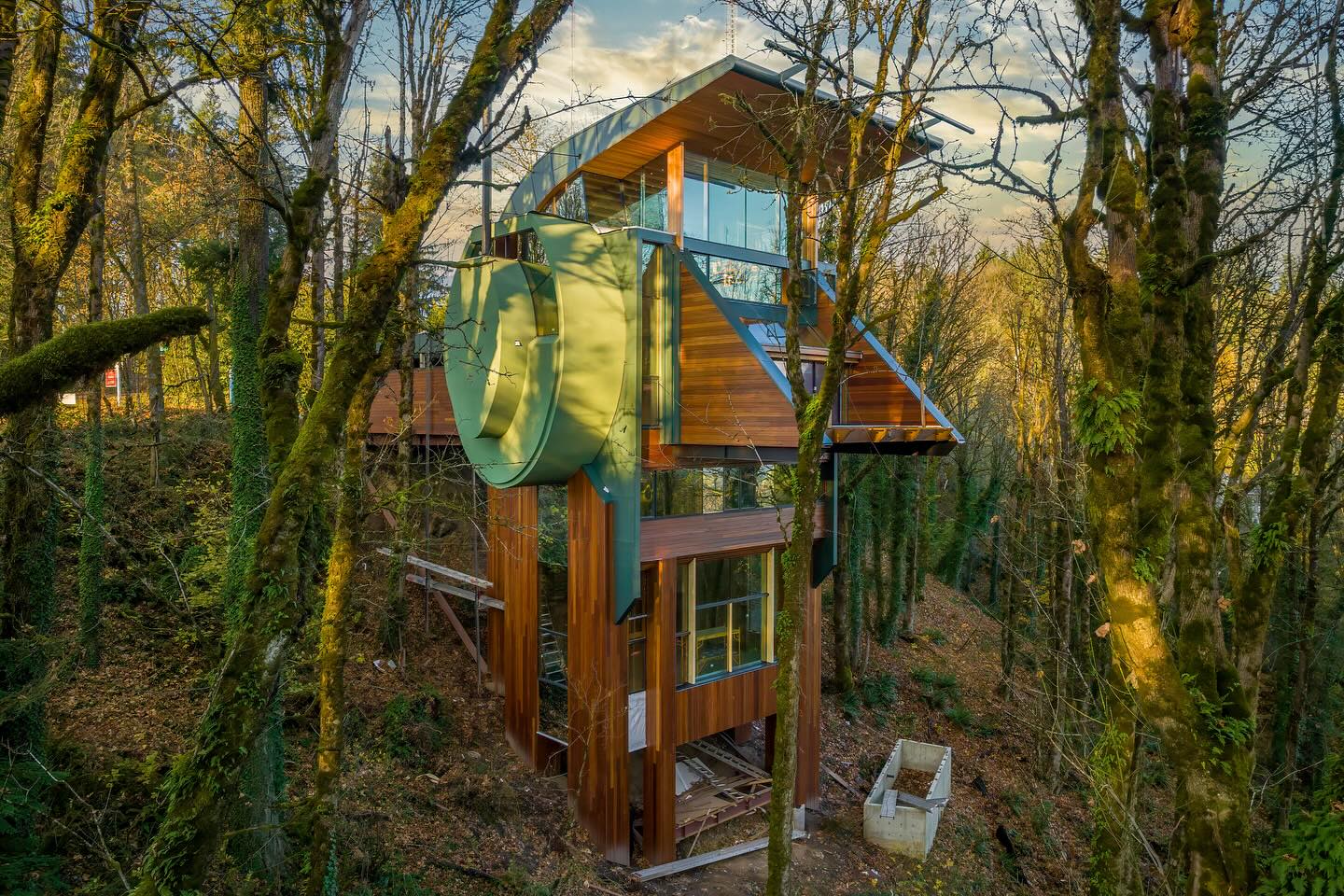
The house consists of a steel frame, a few cement panels, and some stucco portions. Most is constructed out of Indonesian Balau wood. “The colors and forms you see on the outside, you also see on the inside. It ties you to the forest outside. The whole idea is that the structures feel at peace within the environment and people feel at peace within the structure.”
It made sense to place the primary social spaces—living room, dining room, and kitchen—on the floor adjoining a bridge to the road. This floor cantilevers out in a diagonal volume to the front providing additional angles for light and a deck. “When you’re in the forest, you need to be very careful to get ample sunlight coming into a structure. So there’s a lot of glass in the two-story volume on the top.”
Oshatz has long been demonstrating that excellent residential design is possible in a market where it’s not much in demand. He reflects, “Most people are not educated to understand what an architect does. They think you buy a house like you buy a car. You can ask for a bigger window or an added room or a different fabric but that’s it. Our culture is geared to mass-marketing. You remember what Lloyd Wright would say when he saw subdivisions, the same thing over and over, ‘Give me more of the same, oh Lord. I deserve no more.’”
Oshatz has plans drawn up for the remainder of his Royal Five, but he may well alter them as he goes along. “If I was a painter, I wouldn’t want to do the same painting twice. I prefer to try something new each time.”
Would you like to comment on this article? Send your thoughts to: [email protected]
- No tags selected
Latest
Projects
UC Berkeley’s Newest Building Is All About Human Interactions
The Barbara and Gerson Bakar Gateway—home to the university’s College of Computing, Data Science, and Society—gently reminds data scientists and AI researchers of what’s really important.
Projects
ZD+A Brings a Modernist Mexico City House in Line with its Context
Architect Yuri Zagoin Alazraki reorganized the speculative house to respond to its site and create unique spaces for contemplation.