



March 23, 2026
The New New Museum: A Pair, Not an Addition
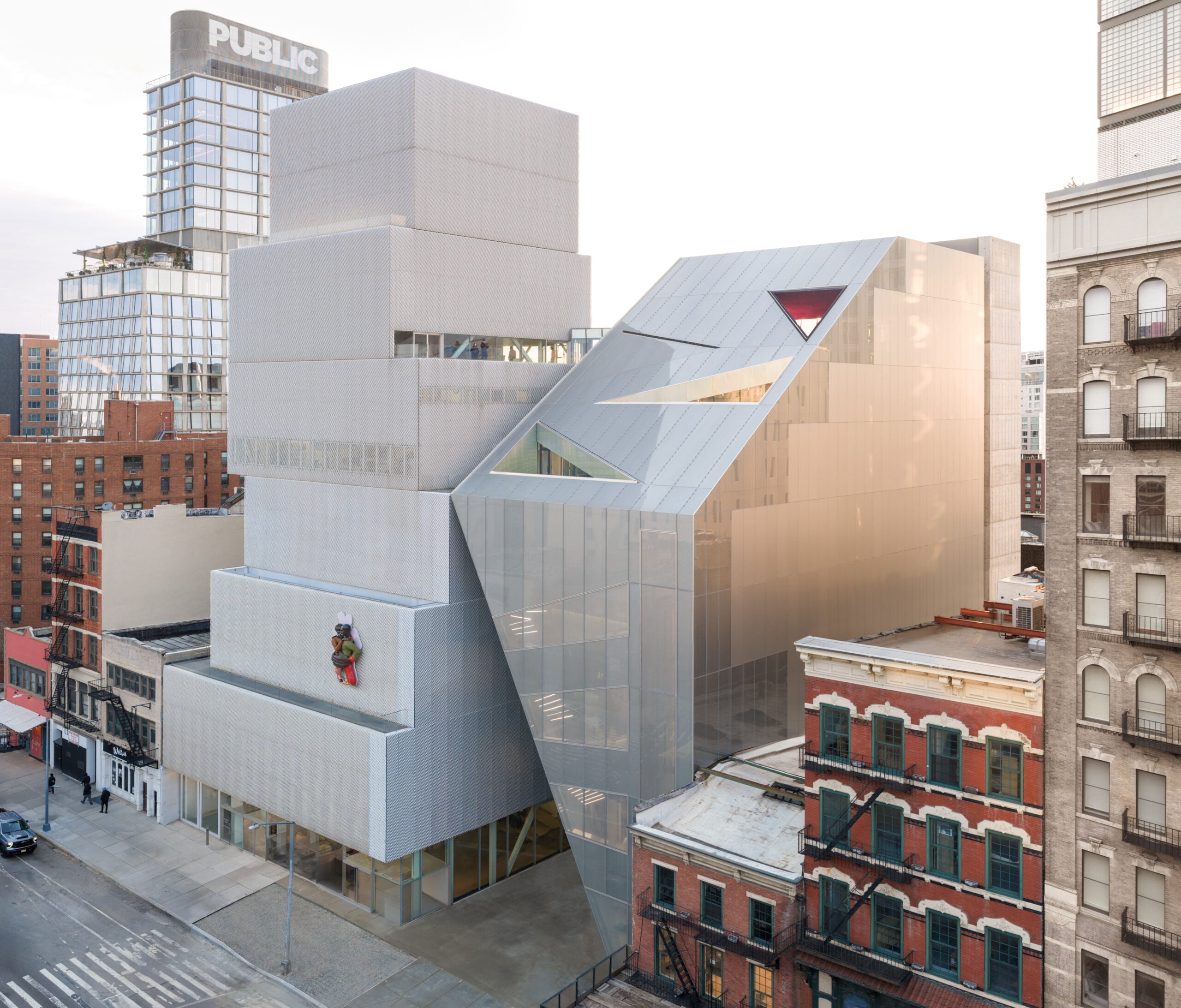
Here it is: the New New Museum. Not an extension, not quite an expansion, but something more deliberate—a second body. A counterpart. A pairing.
Paraphrasing both of its architects, Shohei Shigematsu, partner at OMA New York, and Rem Koolhaas, OMA’s founding partner—who addressed the opening via a prerecorded message due to a site injury—the project was conceived not as an extension but as a relationship. “A new pair,” as it was framed, with all the complexity that implies.
At the opening, museum director Lisa Phillips recalled the final selection process of the design team and the clarity of the proposal: a “thoughtful response to our brief,” she noted, one that demonstrated a deep understanding of the museum, its ethics, and its relationship to the city. Crucially, the building was never meant to be a wing. “It’s not an extension,” she emphasized. “It’s a new building.”
That distinction seems to matter to them. Maybe because museum expansions are often trapped in a series of dichotomies—old versus new, dominant versus subordinate, icon versus infrastructure. These binaries can flatten the potential of the project into a hierarchy. Here, OMA and Cooper Robertson (now Corgan), the architect of record, attempt something more ambiguous: two entities that are distinct yet reciprocal, independent yet in constant dialogue. However, while it looks like a new pair from the outside, the new extension feels like a seamless, logical museum completion inside.
Between Icon and Infrastructure
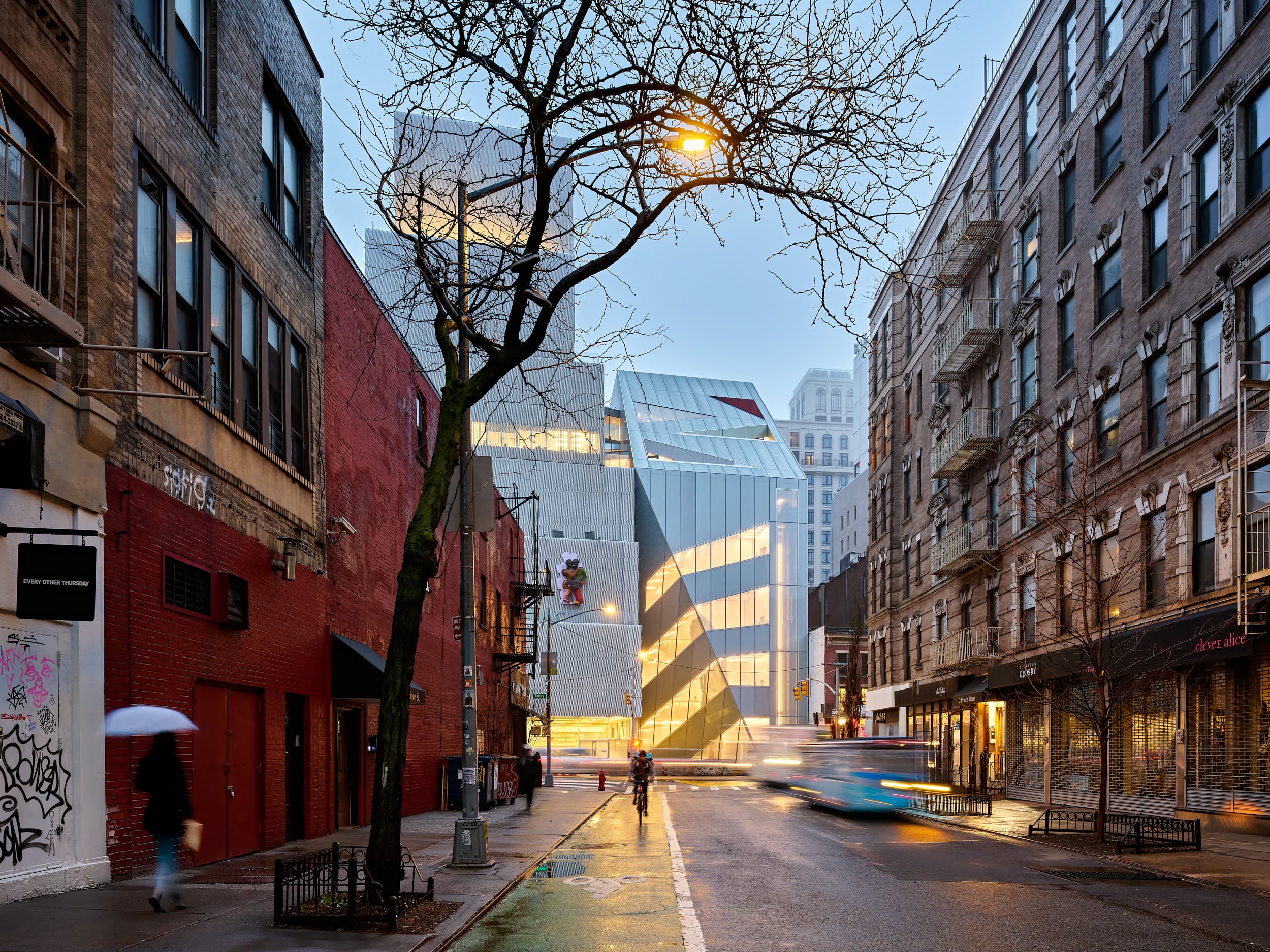
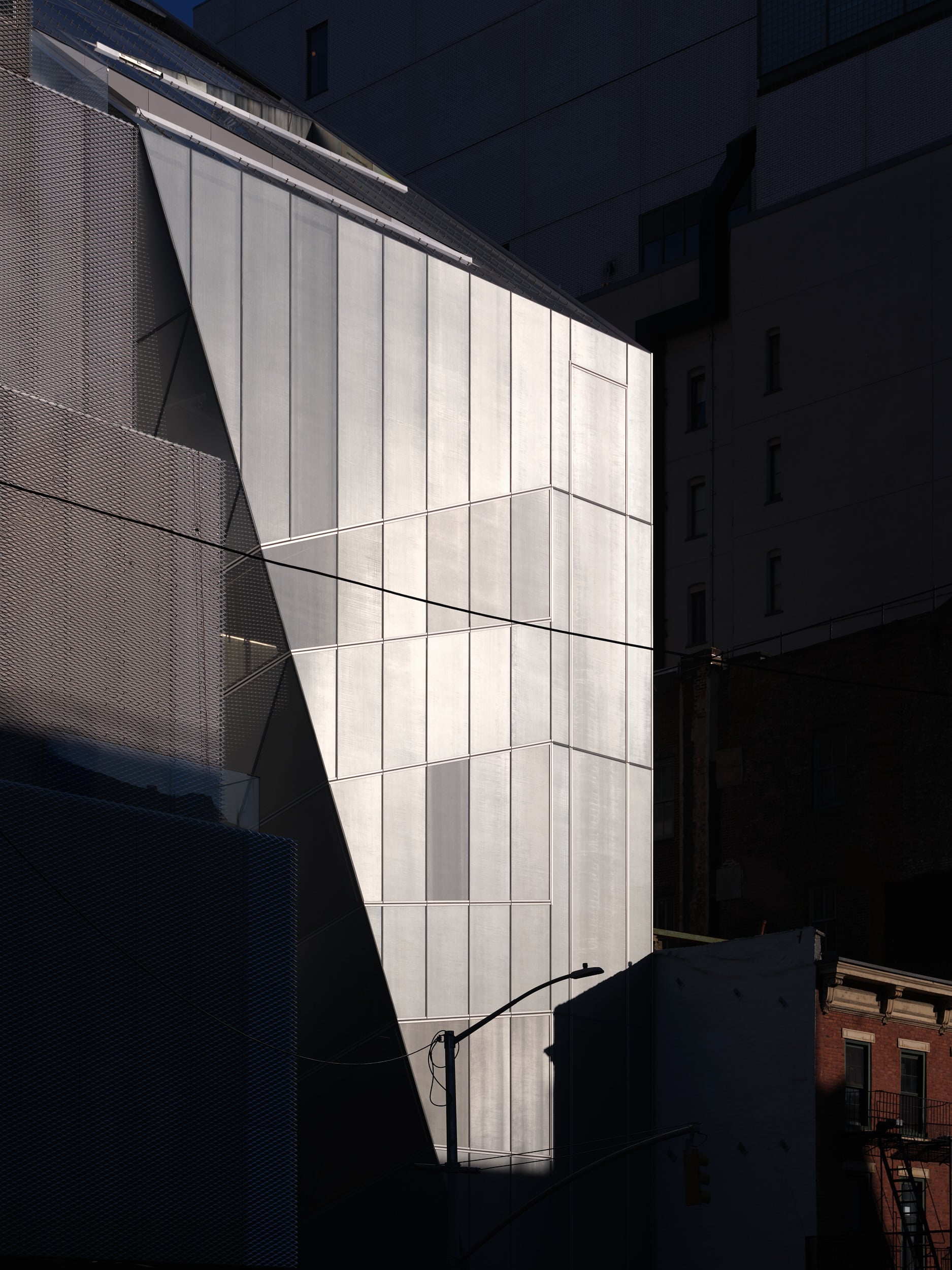
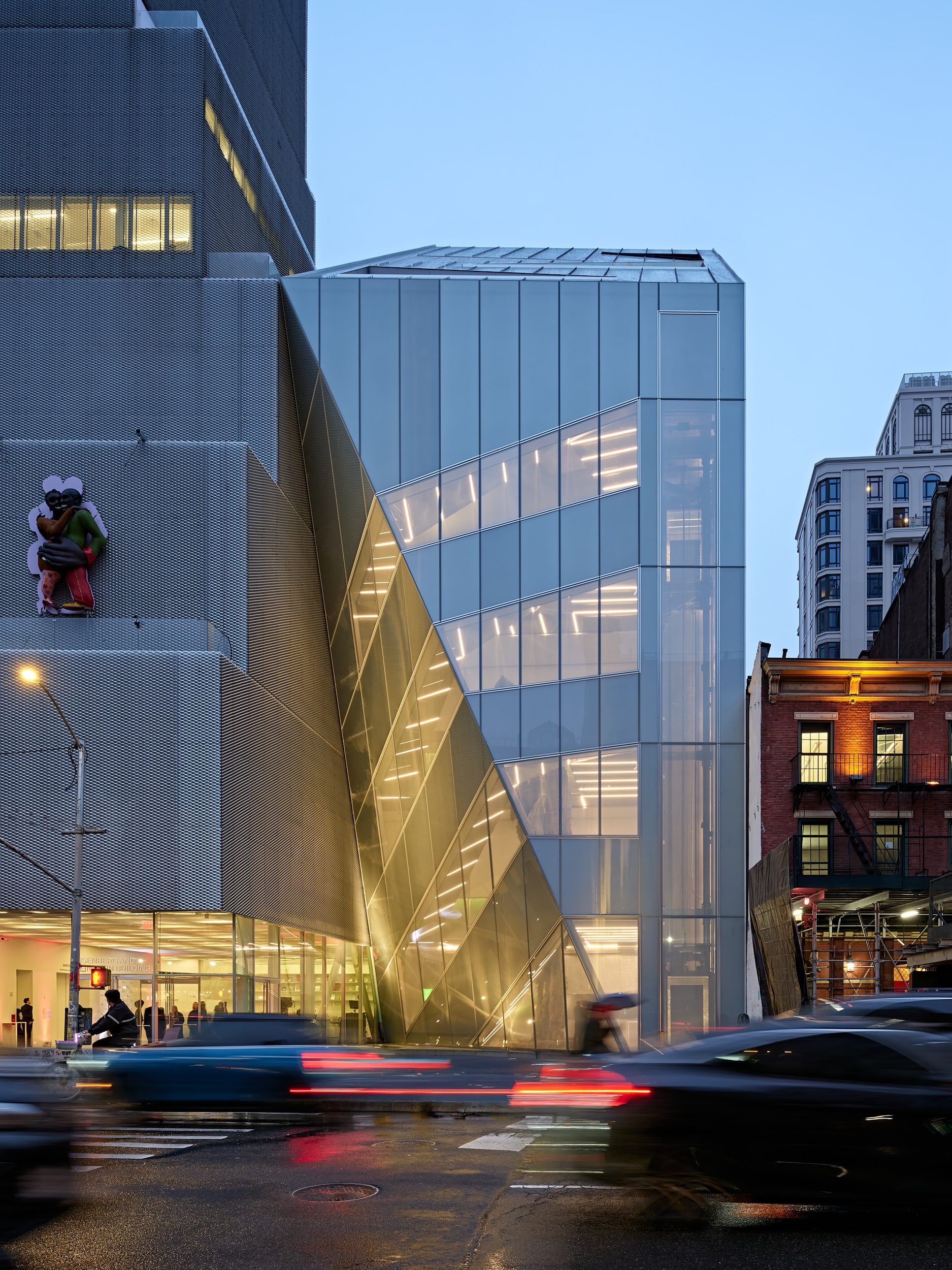
Formally and materially, the new building positions itself in contrast to its predecessor. OMA’s new addition is gleaming, reflective, and layered. The facade—a complex assembly of laminated glass, metal mesh, and integrated photovoltaics in some areas—reads as both surface and system. During the day, it wants to maintain a certain metallic continuity with SANAA’s cladding, though its highly reflective and sharp geometries make this connection hard to read. At night, the reflective front transforms, revealing the building’s interior life in a luminous display of activity. Like movie theaters and department stores, it adopts a commercial language that fits Prince Street’s retail character, though with a starker contrast on Bowery’s more mixed-use facades.
“It’s metallic during the day,” Shigematsu noted, “kind of synergistic with the existing facade, but during the night it shows a contrast.” The result is a structure that reflects the Bowery by day and broadcasts the museum’s program by night—aiming for a dual performance of opacity and exposure. Together with the glass elevator and other design tropes, the building really wants to be seen in the neighborhood.
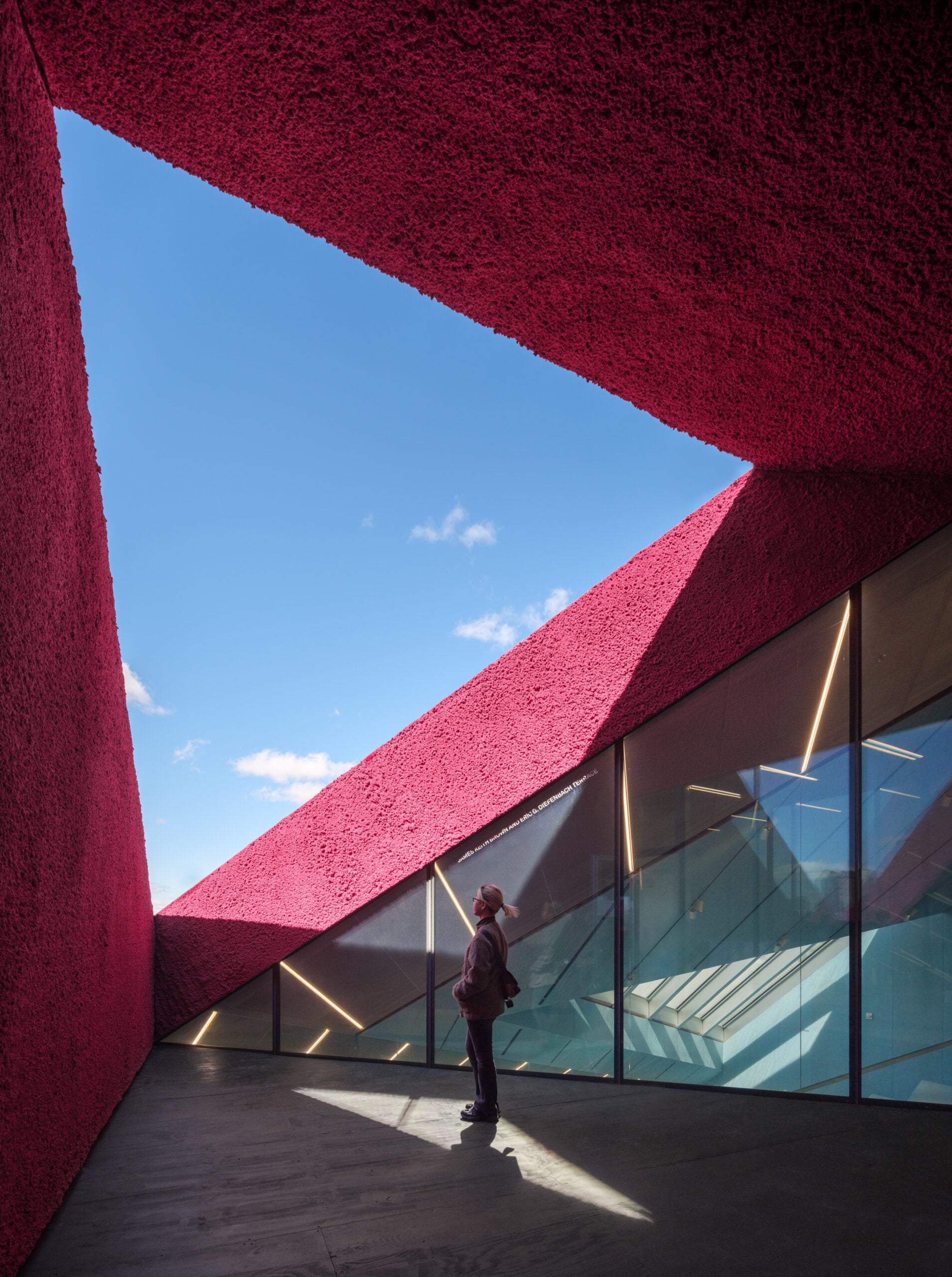
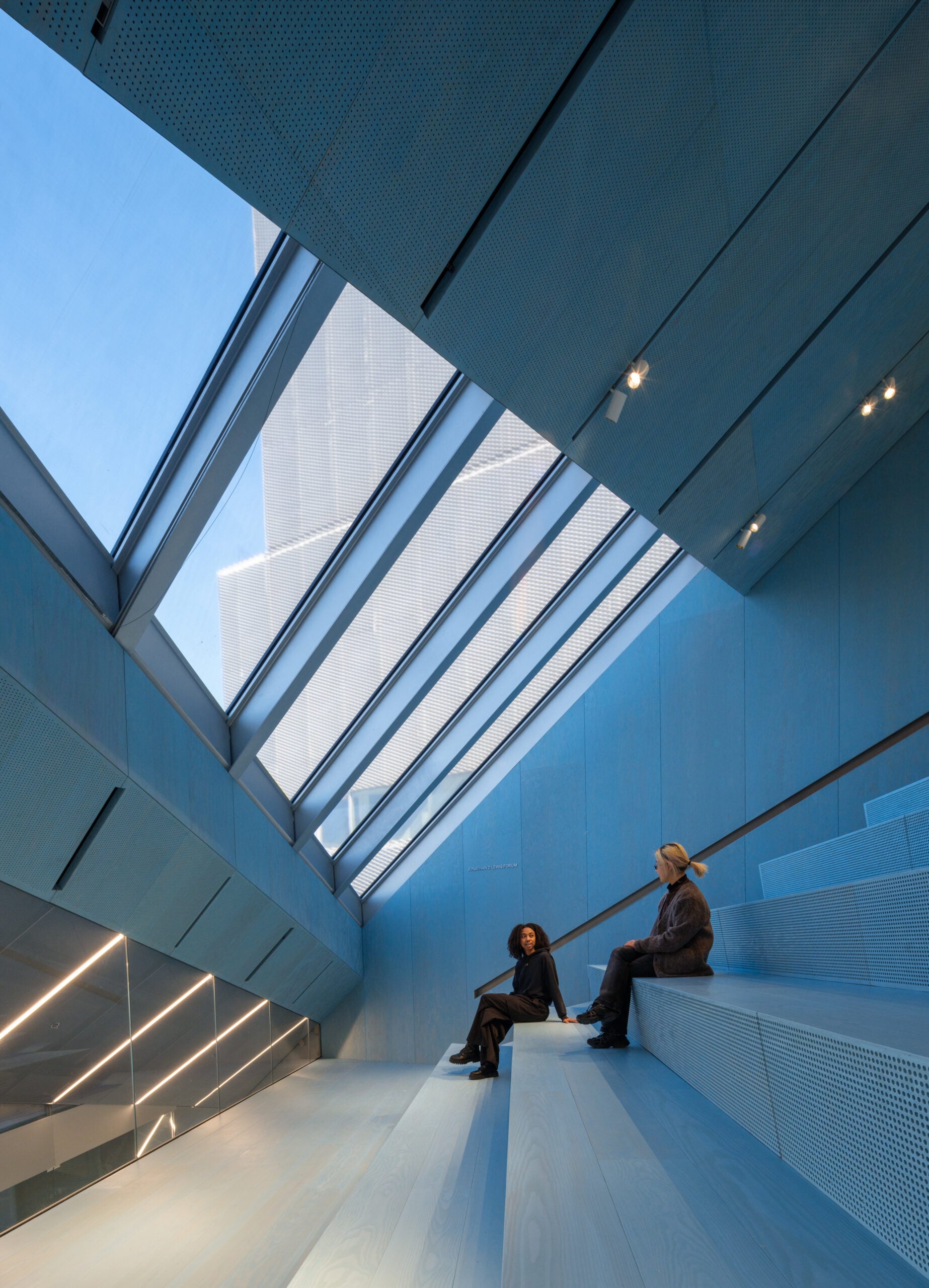
Programmatically, the building expands the museum’s capacity in meaningful ways. Gallery space is effectively doubled, circulation is clarified, and new institutional functions—most notably NEW INC, the museum’s art and technology incubator—are given dedicated, purpose-built environments. A restaurant, to be completed late in spring, public forum spaces, and terraces extend the museum’s civic ideals.
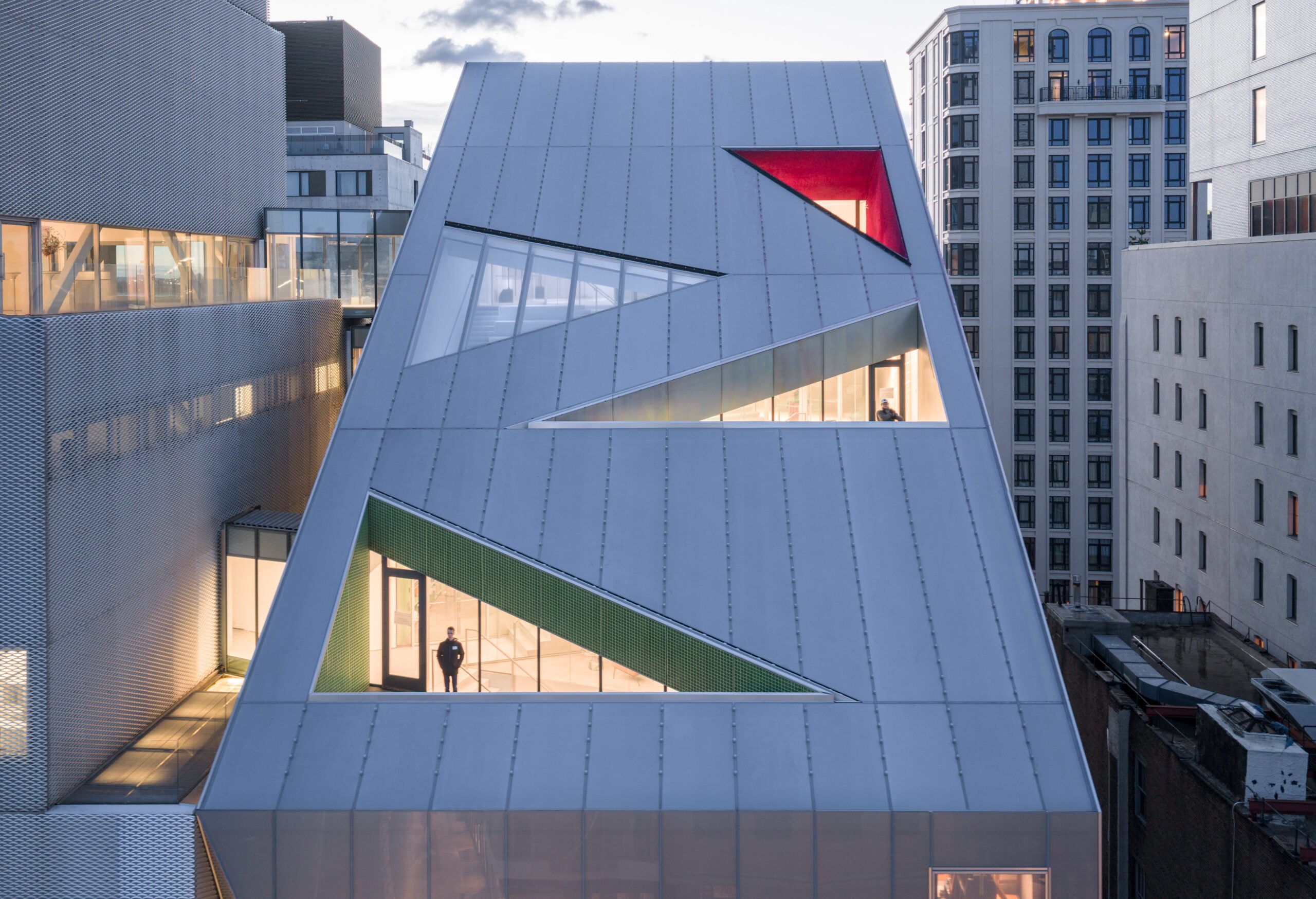
This is, in many ways, OMA operating in its familiar mode: program-driven, diagrammatically informed, both clunky and playful in its form. The building coils and steps to accommodate views from SANAA’s upper levels while opening at the base to create a new public plaza. Bridges connect the two structures above, while a shared lobby anchors them at street level. Though it’s shaped as a new building, it responds as an extension and complement to the original one.
And yet, for all its sophistication, the project also reveals tensions—between ambition and execution, between integration and complexity.
Circulation as Public Space
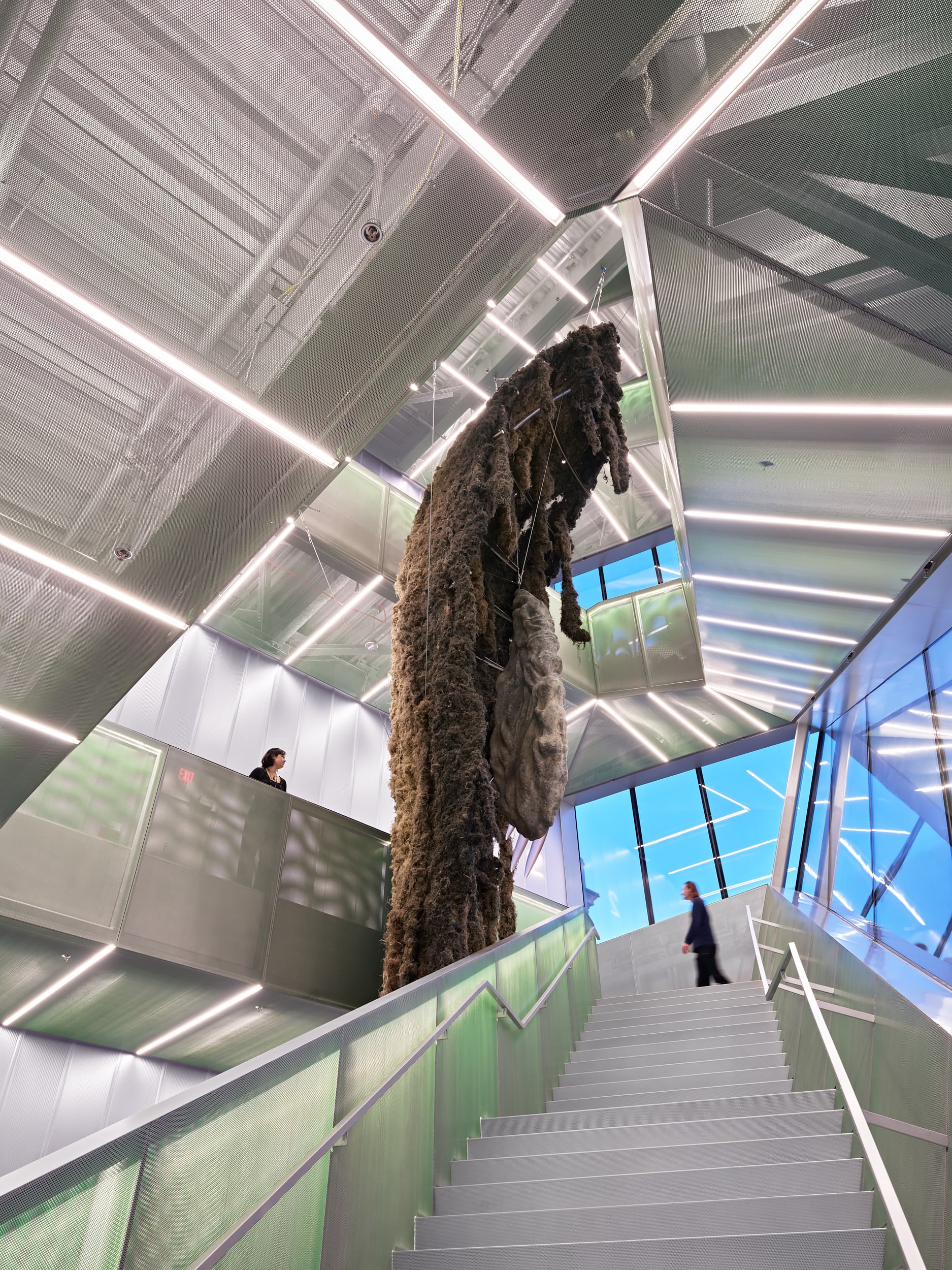
The atrium stair aims to operate as a vertical public plaza, a connective tissue between galleries, terraces, and institutional spaces. It is also the primary visual link between the museum’s interior and the city beyond—a deliberate inversion of SANAA’s more introspective envelope.
The ambition is clear: circulation as social condenser. Not merely movement, but encounter. Not just infrastructure, but program. And yet, the success of this move is uneven. While the visual connectivity is undeniable, the claim of the stair as an “experience” feels, at times, aspirational without places to pause—benches, thresholds, moments of rest. It is an architectural idea that I hope fulfills the highest promise in its lived condition.
Still, the intent follows another design trope in museum typology. Circulation is no longer neutral; it is curatorial, civic, and performative. The New New Museum leans into this approach, with commissioned art at every floor, direct visual connections to the street, and a ceremonially wide, neon-lit “catwalk” stair experience—maybe a node drawn from the studio’s collaborations with the fashion world—that makes circulation the center of the project.
The Frictions of a Contemporary Museum
If the project succeeds in almost all of its urban and programmatic ambitions, it is in its material and technical decisions that the building encounters its most significant challenges.
The integration of multiple systems—structure, facade, mechanical infrastructure, and circulation—into a single architectural gesture is both impressive and risky. The atrium stair, for instance, doubles as structural support for the facade while also housing HVAC systems, all wrapped in green, see-through perforated metal panels.
It is a massive task of coordination. It is also, perhaps, a recipe for complication.
On opening day, some of these complexities were already visible: unfinished edges, corners held by tape, and closed balconies. The building is not yet fully complete—a reality not uncommon in New York—but certain issues feel less like punch-list items and more like the consequences of material assemblies that prioritize integration over adaptability and maintenance.
The perforated metal cladding and other metal surfaces, painted in a green tone referencing SANAA’s elevator interiors, creates a striking visual effect. But it also introduces acoustic challenges, particularly in the upper levels where reflective materials—glass, metal, and concrete—dominate. The result is a sound environment that can feel unresolved, especially in spaces intended for collaboration and presentations.
These details point to a broader issue within contemporary architecture: the tension between expressive integration and operational clarity.
A Museum of Contradictions
The opening exhibition New Humans: Memories of the Future—it’s an astounding tour de force presentation of nearly 780 works exploring representations of the human figure—offers an unexpected mirror to the building itself. Curated by Massimiliano Gioni, Edlis Neeson Artistic Director, the show invites all to see how humans see each other through the lens of technology.
The show is “an exploration of artists’ enduring preoccupation with what it means to be human in the face of sweeping technological changes. New Humans will trace a diagonal history of the twentieth and twenty-first centuries through the work of more than 150 international artists, writers, scientists, architects, and filmmakers, highlighting key moments when dramatic technological and social changes spurred new conceptions of humanity and new visions for its possible futures,” as per the museum’s site.
Both the exhibition and the architecture seem to engage with a similar temporal paradox: a vision of the future shaped by the past.
In this sense, the new building sometimes feels curiously out of time. Its emphasis on transparency, infrastructural expression, and integrated systems recalls architectural ambitions of the early 2010s—when the project was first conceived—rather than the more material- and climate-conscious discourse of today.
And yet, this temporal dissonance is not entirely misplaced. The New Museum has always operated slightly outside of convention—a kunsthalle without a permanent collection, a platform for experimentation rather than preservation. Its history is one of introducing artists to new audiences, of privileging process over canon. From early exhibitions of Jeff Koons and Ana Mendieta to presentations of Félix González-Torres, Nancy Spero, and Cildo Meireles, the institution has consistently positioned itself as a space of emergence rather than consolidation.
The new building extends that ethos, even if imperfectly. Its rough edges, its unfinished qualities, its willingness to expose systems and processes—these are not entirely flaws. They are, in some ways, aligned with the museum’s identity. This is not a precious building, paraphrasing Massimo’s opening remarks. It is one that invites intervention, adaptation, and use. Though in some moments, the irony is as big as the punch list of things that need to get fixed soon, if only from a safety standpoint.
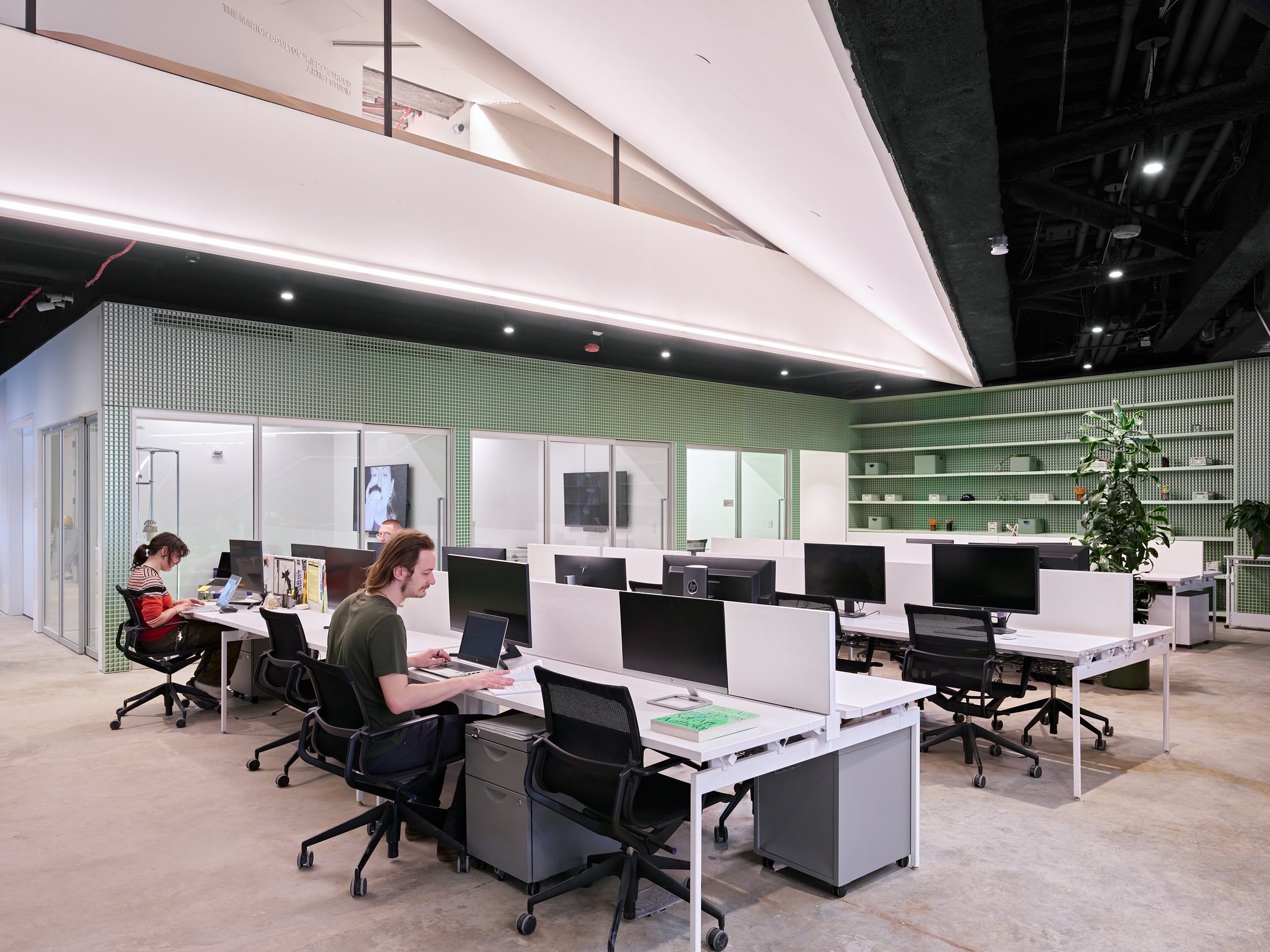
Ultimately, the project marks a significant moment for both the institution and the city. After nearly a decade of planning and fundraising, the $82 million building expands the museum’s footprint, its program, and its ambitions. The inclusion of NEW INC is particularly notable. It represents a shift in how cultural institutions engage with production, not just presentation. The new spaces—co-working areas, fabrication labs, and small auditoriums—introduce a different material and spatial language, one that is more tactile, more informal, and more human.
“I think the materiality is in principle quite neutral for the gallery levels,” Shigematsu explained, “but in the upper levels… we wanted some level of playfulness and tactile materiality.” The upper floors feel like a combination of the ’60s and 2000s optimism: colorful, tufted, dimmed, disorienting, fragile, and performative. The double glass layers, painted plywood, and neon lighting create an elusive “art penthouse” look, designed to connect with future artists and the city in front.
The New New Museum is, in many ways, still becoming. There are details to resolve, systems to refine, and spaces to settle into use. Its success lies not in its impeccable edge but in its potential—in its ability to accommodate the unpredictable, the experimental, and the unresolved.
Would you like to comment on this article? Send your thoughts to: [email protected]
Latest
Viewpoints
Detroit Month of Design: A City’s Work in Progress
Now in its 16th year, the celebration offers insights into the Motor City’s ongoing accomplishments without glossing over its hurdles.
Projects
How a Hybrid Building Helped an Historic Manhattan Congregation Remain in Place
On Billionaire’s Row, FX Collaborative designed a new home for Calvary Baptist Church combined with an office tower.