



July 2, 2026
In North Dakota, a Regenerative Presidential Library for Theodore Roosevelt
About a million years ago, the Little Missouri River began to carve into the earth of western North Dakota, eroding the soft soil and weathering layers of hard rock to create a dry, striated landscape the Lakota tribes later called mako sica, which literally translates to “bad lands” and is the site of what we now know as Theodore Roosevelt National Park. In 1884, heartbroken from the loss of both his mother and his wife, a young Theodore Roosevelt decided to purchase a second ranch there. The ensuing years spent on this rugged land transformed him into the frontiersman we know him as today. North Dakota’s Badlands also sparked his lifelong dedication to conservation: By the end of his presidency in 1909, he had established 230 million acres of public lands.
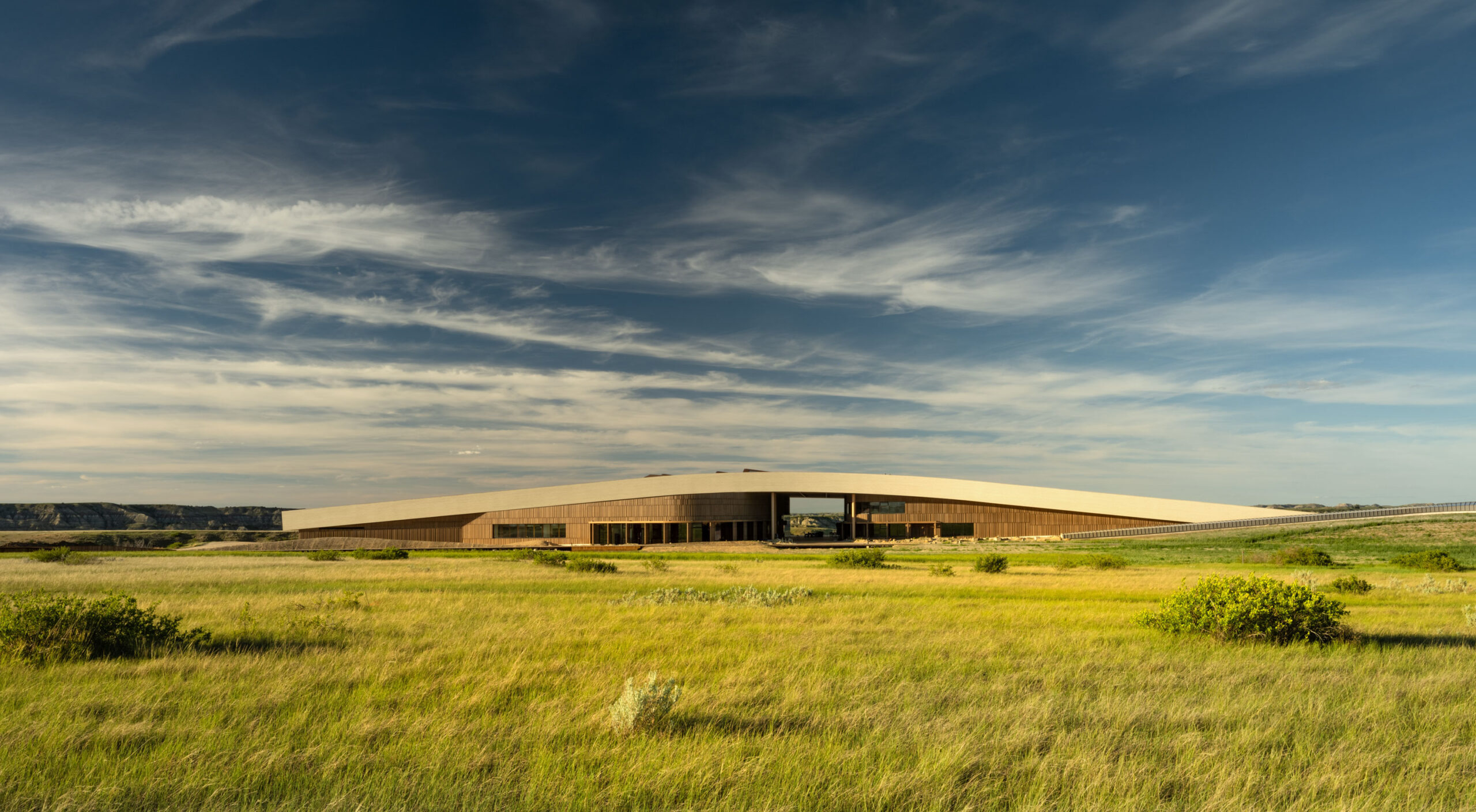
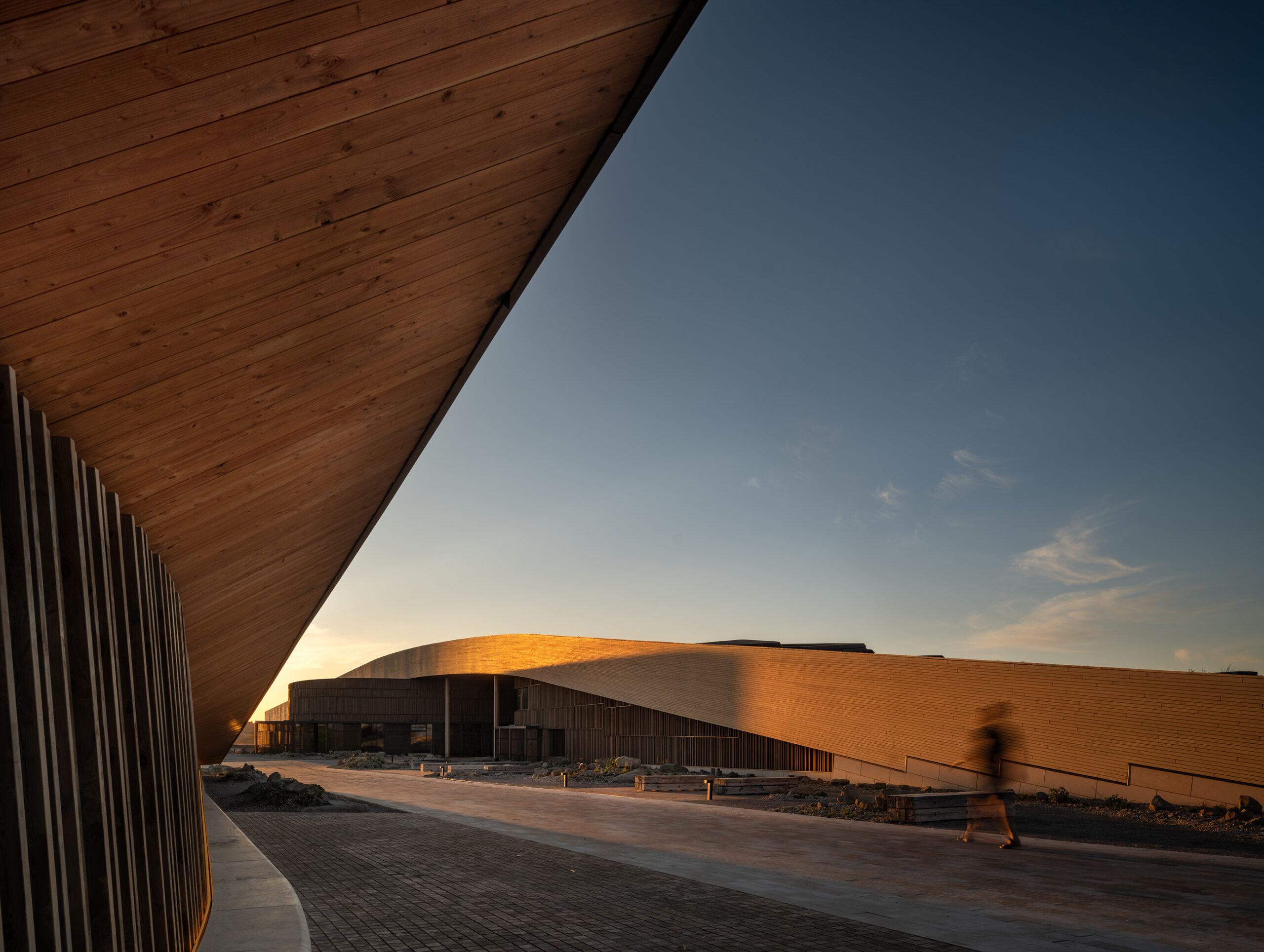
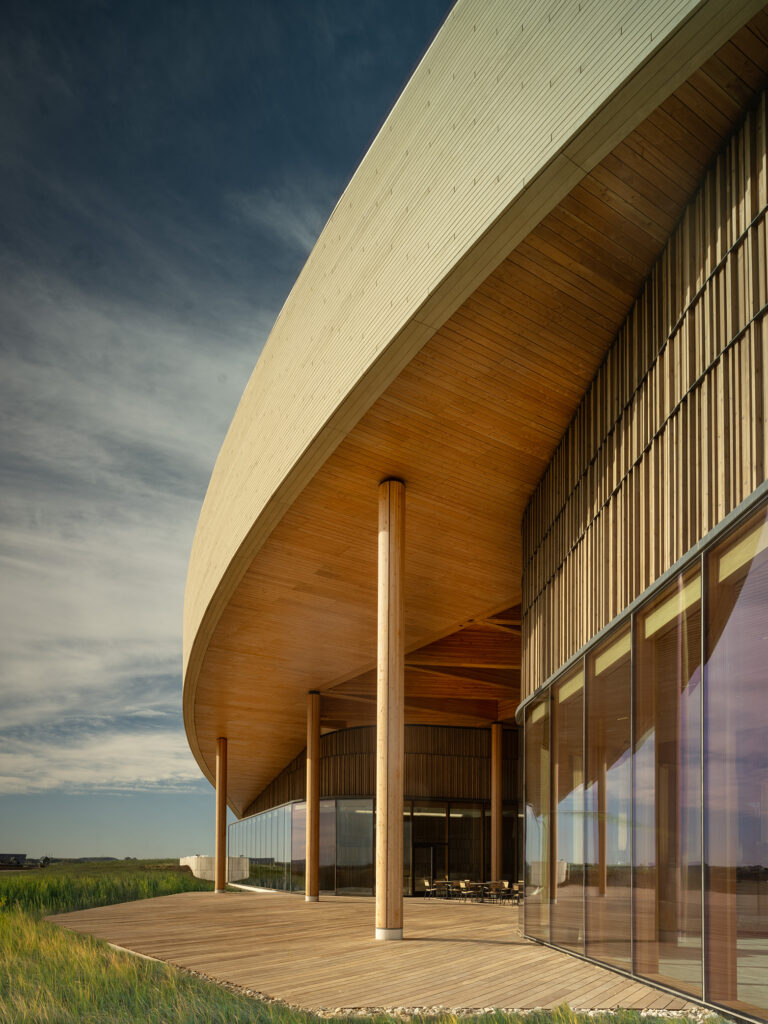
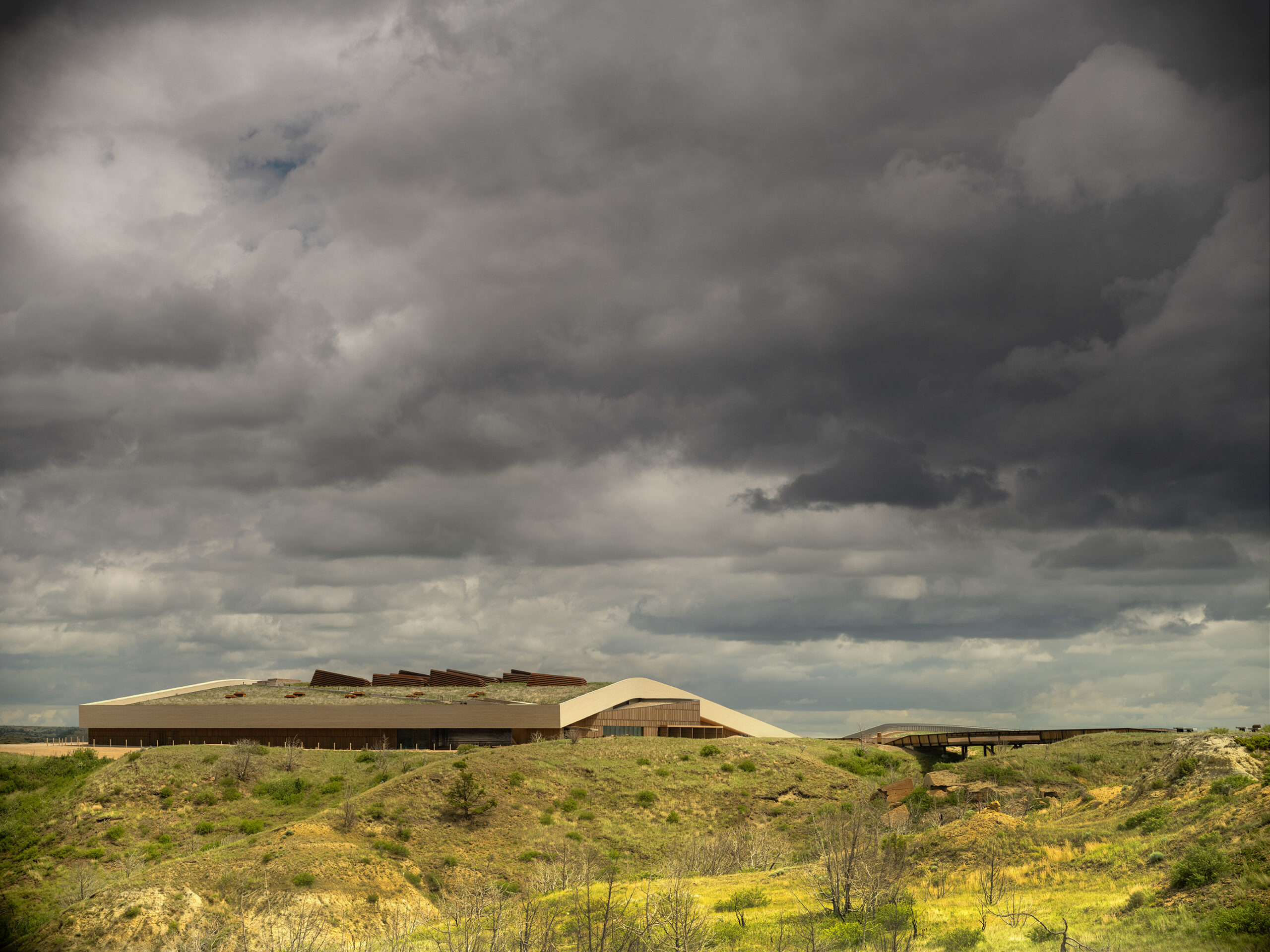
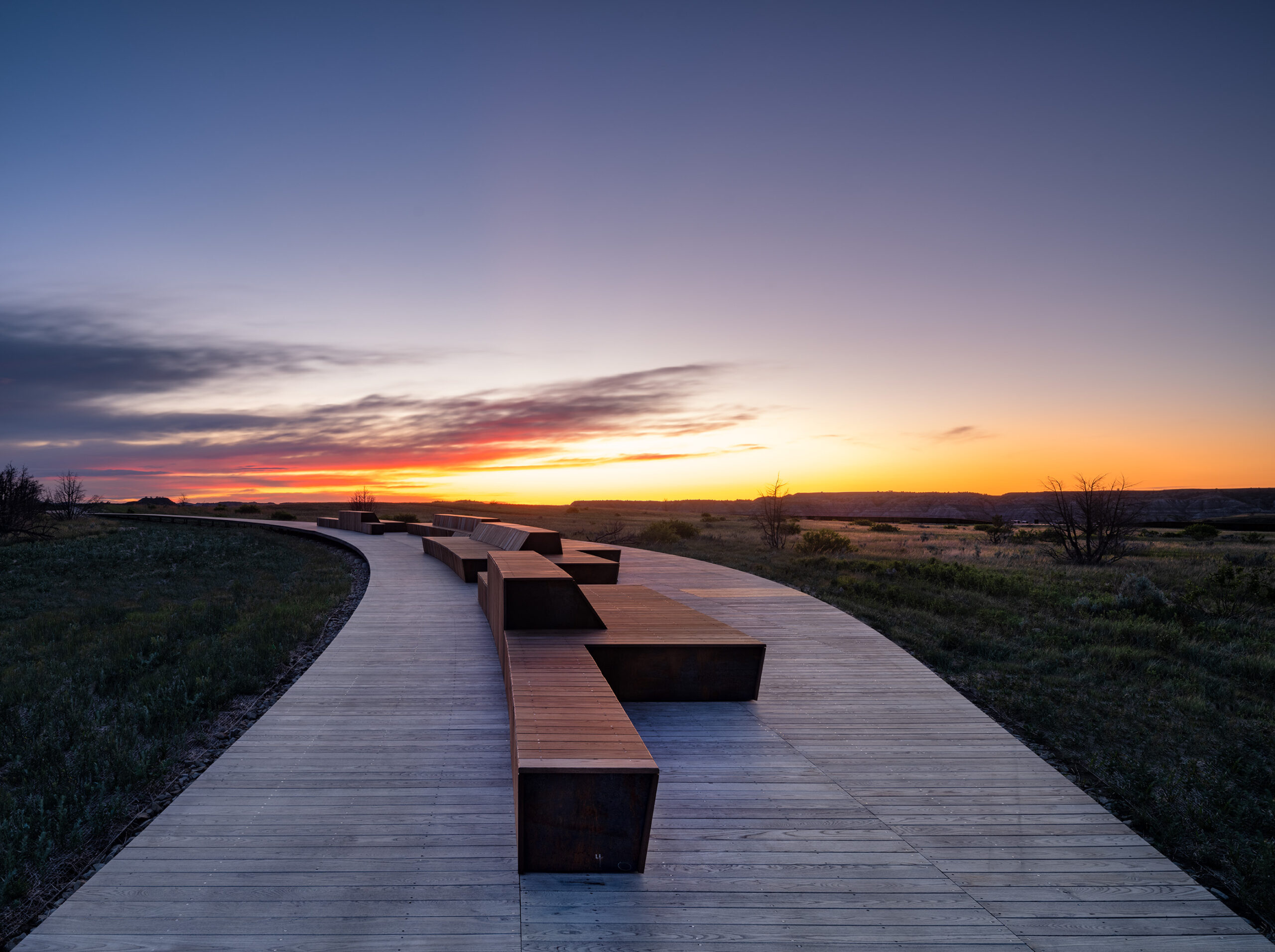
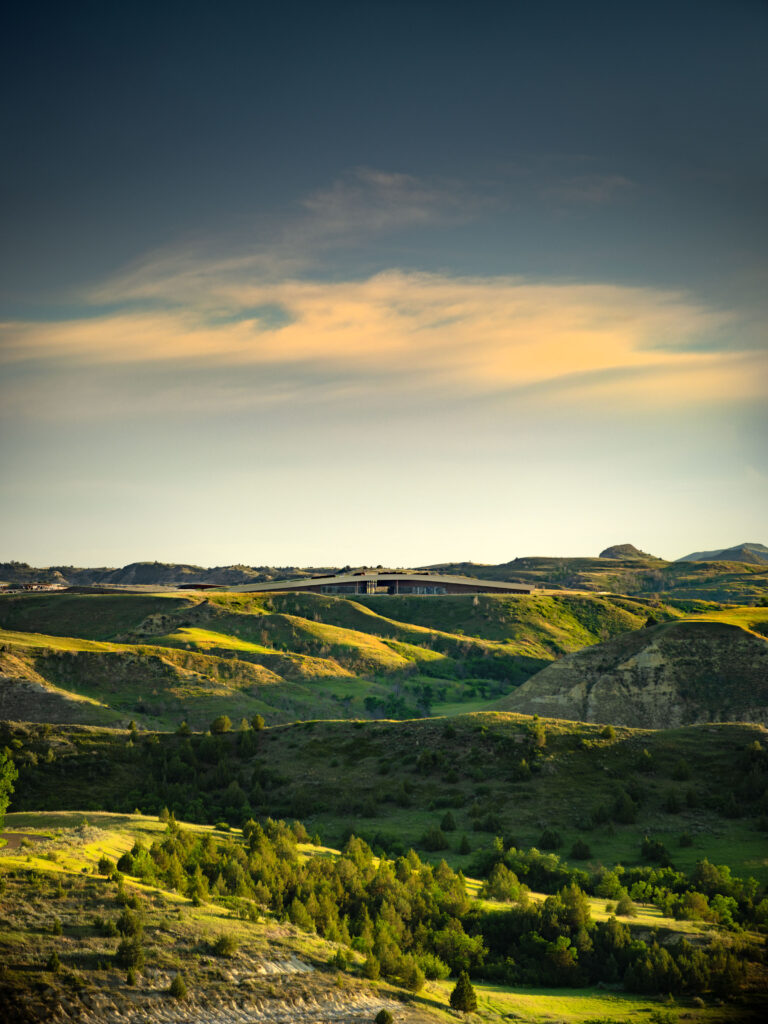
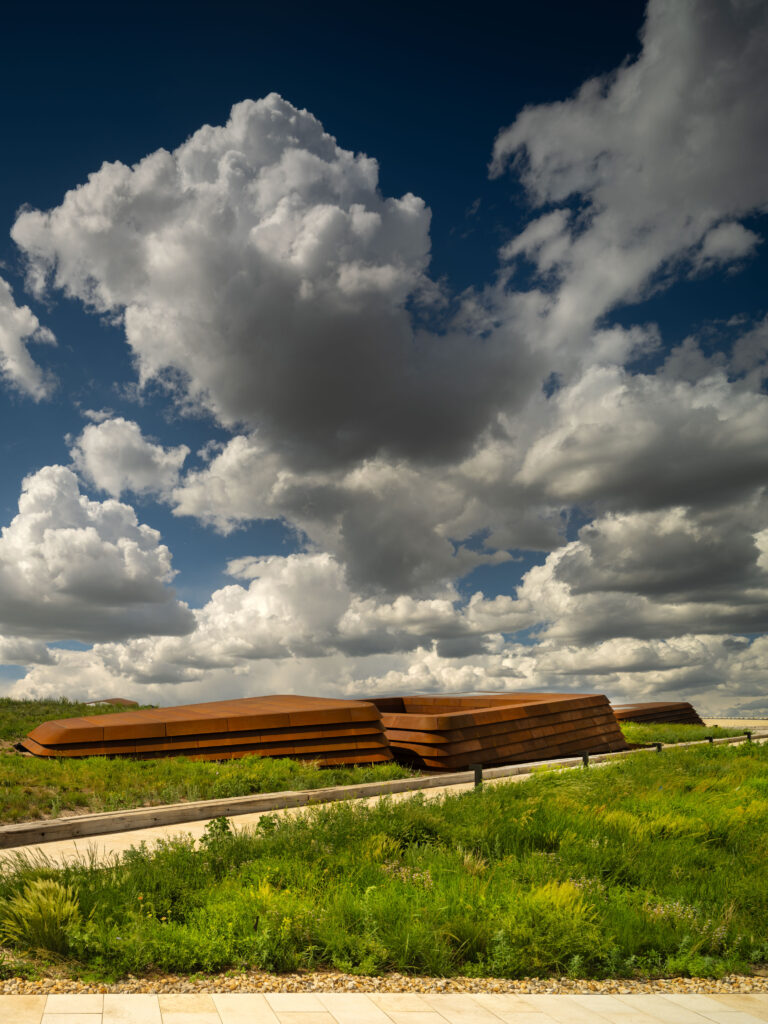
“It’s a rather magnificent setting,” says Craig Dykers, founder and partner of Snøhetta, which has designed the new Theodore Roosevelt Presidential Library on a 93-acre site in Medora, North Dakota. Set to open on July 4, 2026, the library consists of two volumes—one for exhibits, the other for events, totaling about ninety-five thousand square feet. The volumes are separated by a breezeway and sheltered under an accessible green roof that rises out of the landscape itself. The building sits along a mile-long boardwalk that loops through restored native grasslands, revealing sections of the layered landscape in places and providing overlooks where visitors can take in the majesty of the Badlands.
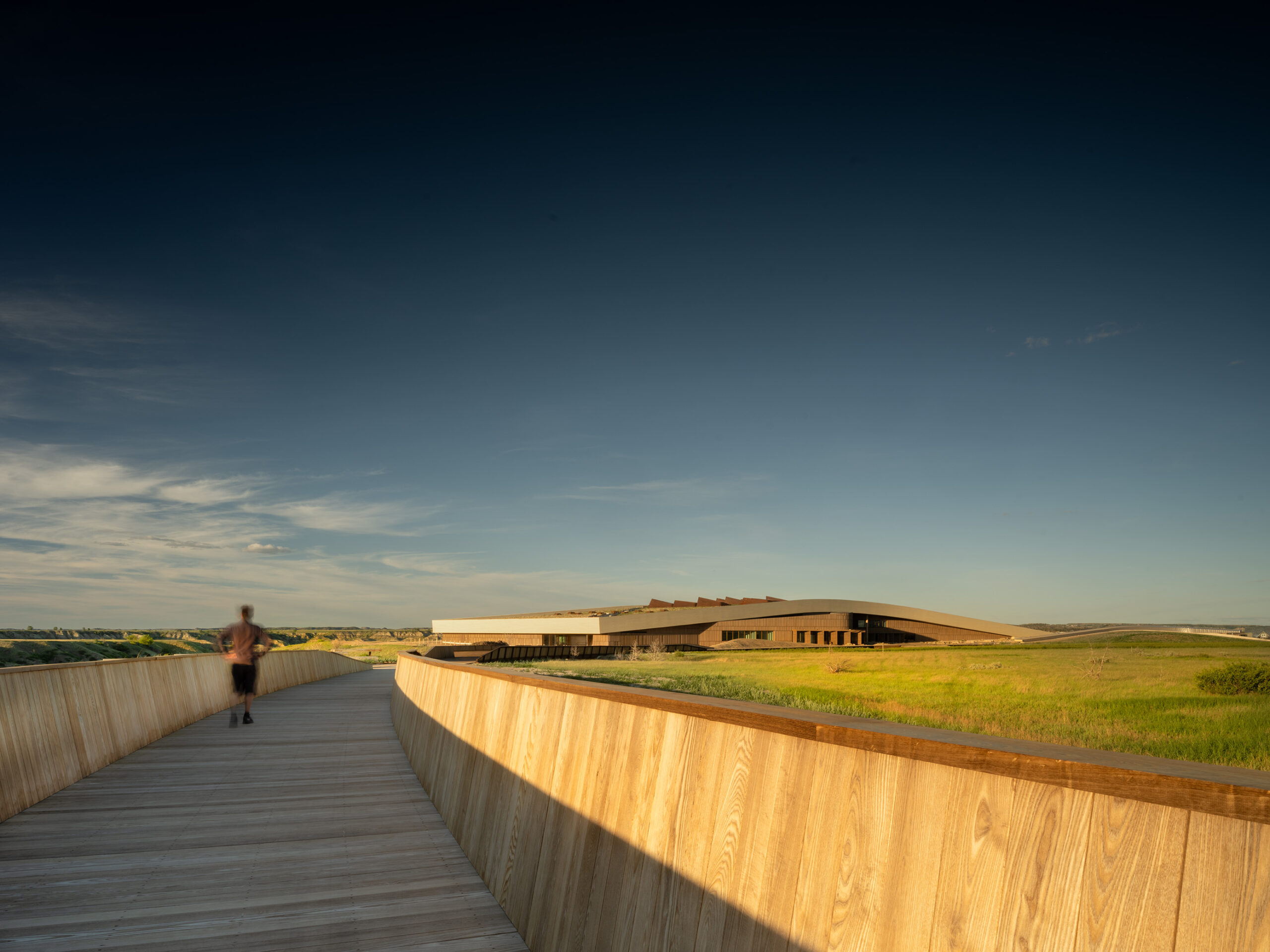
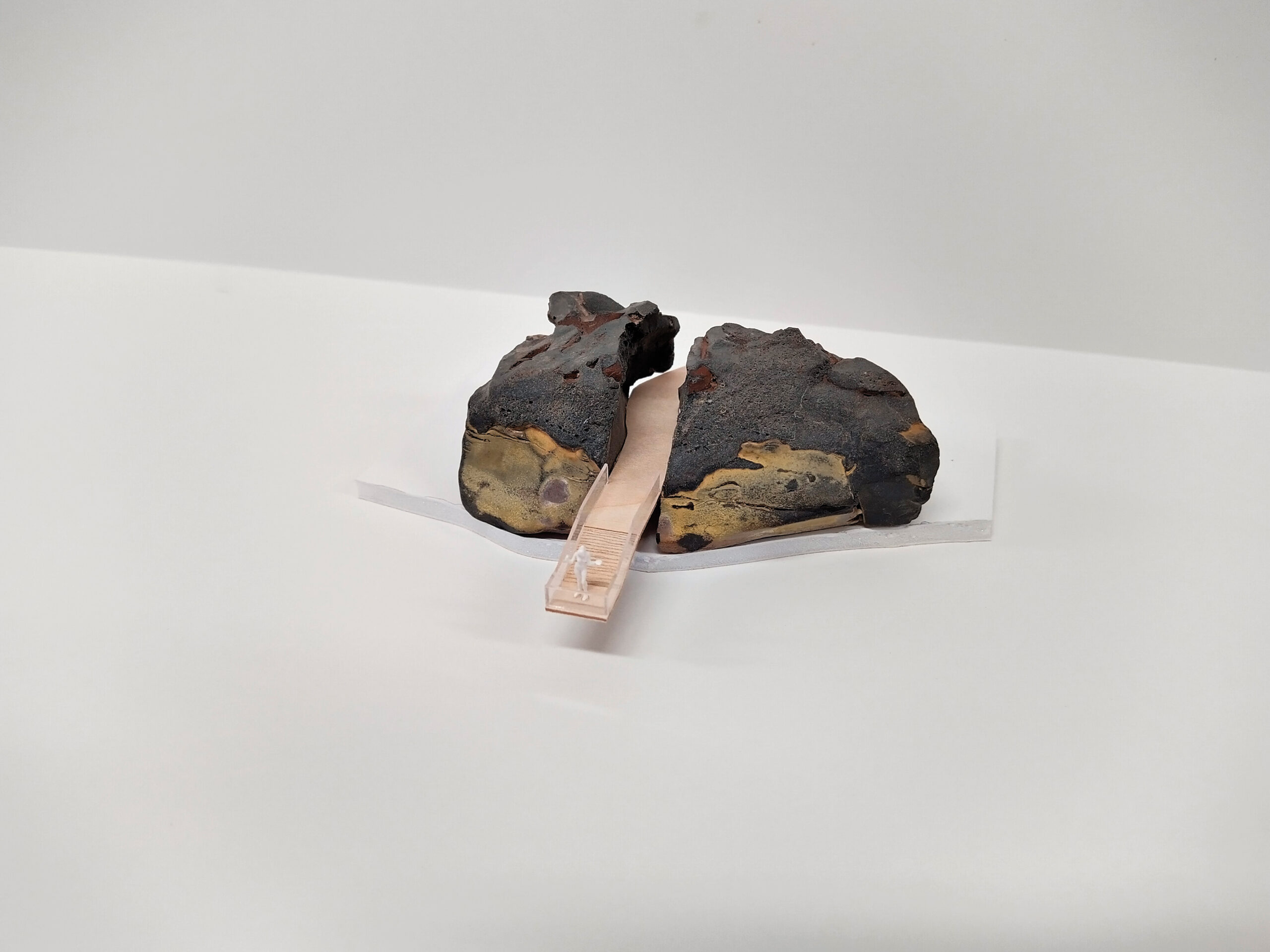
“The geology is on full display,” says Matthew McMahon, director of landscape architecture at Snøhetta. “We treated the project as a way to invite people to read the landscape and experience it.”
The theme of conservation threads through the project, leveraging a tight envelope, timber-and-sod roof, rammed earth walls, a thermal well field, and solar panels to reach the goals of zero energy, zero water, zero emissions, and zero waste. The library’s approach to environmental stewardship has been shaped through conversations with local farmers, ranchers, and Indigenous communities. “If Theodore Roosevelt were here today, he would be thinking about a hundred years into the future of sustainability,” says Ed O’Keefe, CEO of the Theodore Roosevelt Presidential Library. “And that’s a structure in harmony with the people and the landscape in which it sits.”
On the following pages, members of the Snøhetta team explain how they crafted a project that reflects Roosevelt’s legacy and also aims for LEED Platinum, SITES Platinum, and full Living Building Challenge certification. “One of the most powerful things we can do,” O’Keefe says, “is have members of the public come here and see conservation and sustainability in action and how they can apply that to their real lives.”
ENERGY AND CARBON
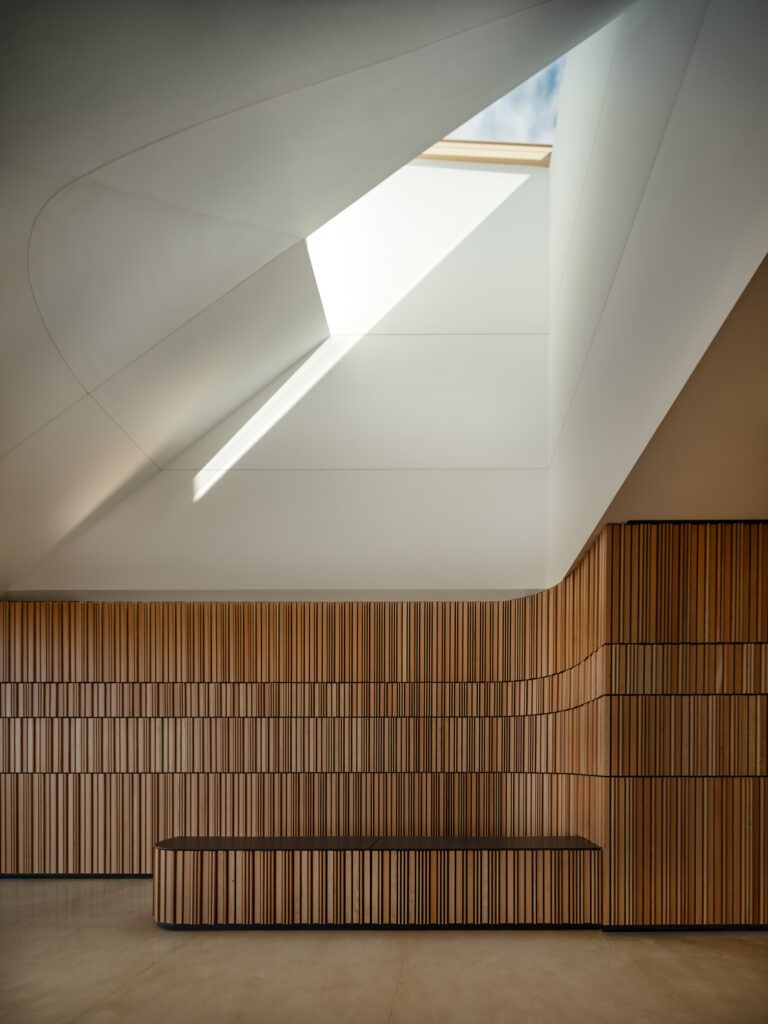
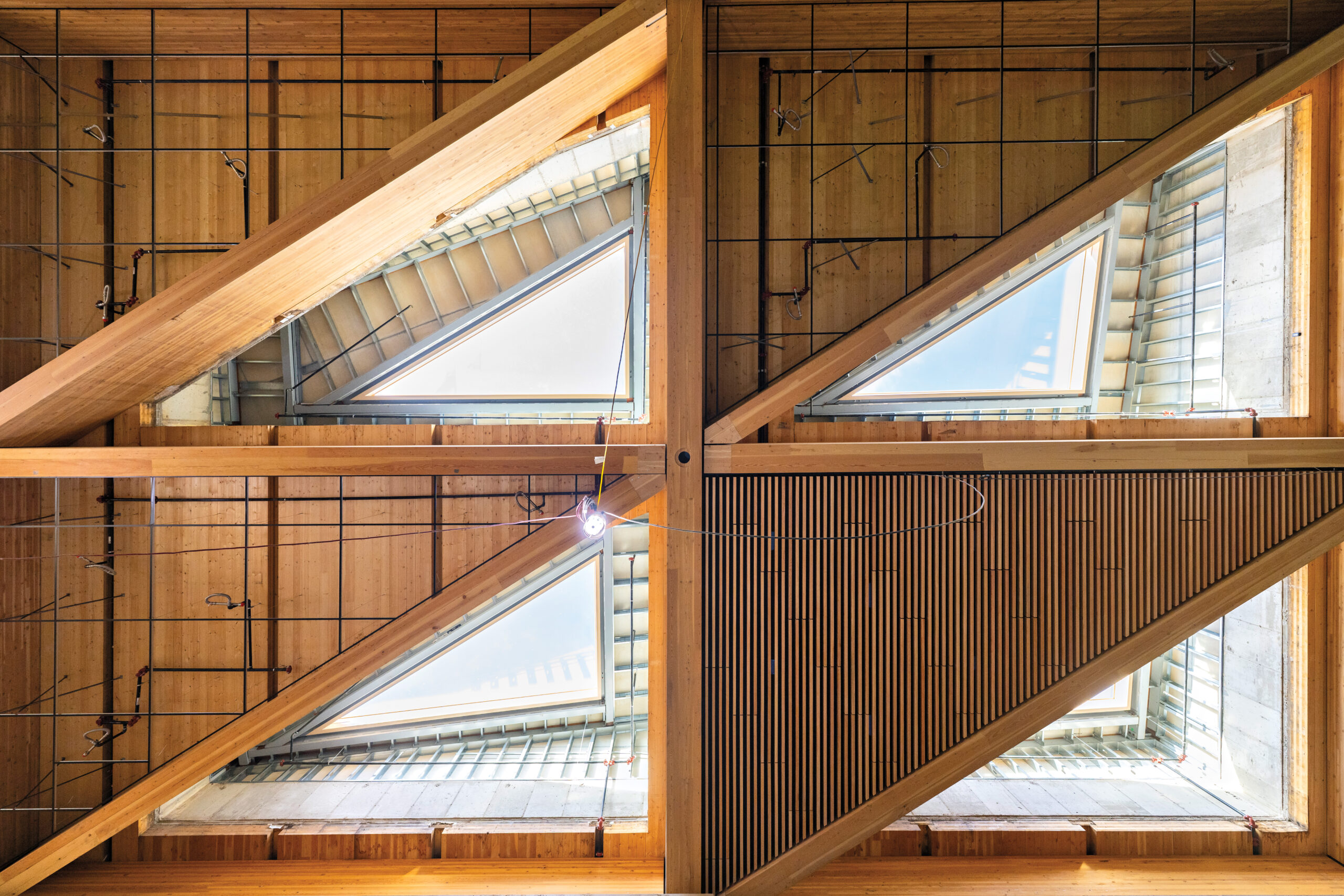
“The building is, in many ways, very simple and straightforward,” says Elaine Molinar, partner and managing director at Snøhetta. “It uses very few materials and uses them in as natural state as possible.” A minimal steel structure holds up a mass timber roof that spans the eastern and western wings of the library, separated by a breezeway. Skylights in the roof bring sunlight and heat into the interiors, where massive nonstructural rammed earth walls absorb and release heat. A high-performance envelope keeps these precious thermal dynamics contained, so “purely from a thermal comfort standpoint, we’ve adopted as many passive principles as we can,” says Aaron Dorf, architect and director at Snøhetta. The energy to run the building comes from both on-site solar panels—installed on a parking lot shared with Medora Musical—and off-site renewables. Taken together, these strategies are expected to meet and even exceed the criteria for energy generation and low-carbon materials set by the Living Building Challenge.
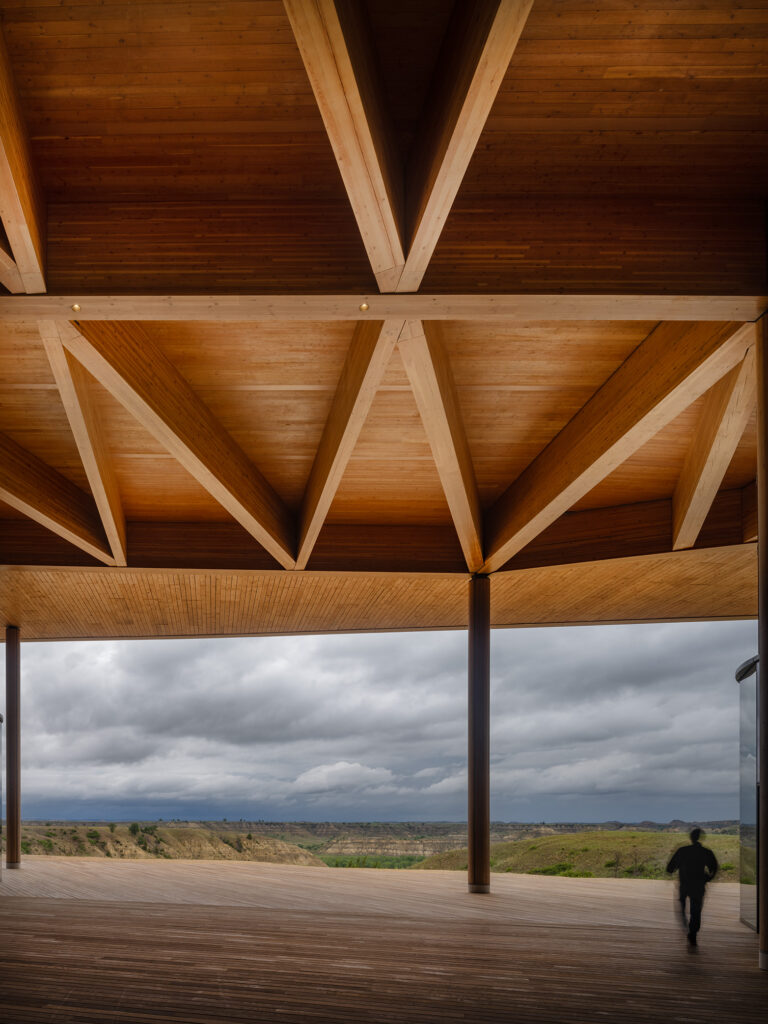
Ventilation
“The building orientation itself is highly specific to the wind on-site. If you draw a line that’s the length of the building, it’s oriented directly into the path of the worst winter winds so they flow up and over the building during the months when people aren’t really going to be on the roof. The summer and shoulder-season winds actually come from more of a perpendicular direction, through the breezeway. During hotter months, the breezeway turns into a wind tunnel that pushes natural ventilation into each wing through automated windows.” —Aaron Dorf
Low-Carbon Materials
“It’s not just the wood and the rammed earth. We worked with a local ready-mix plant to produce low carbon concrete for the project because you can’t get away from concrete completely. We wrote a performance spec for that concrete that took the cement [component] down by a third, compared to normal concrete, and cut the overall global warming potential of the concrete and delivery systems down to half. Anecdotally, what we’ve heard is that the concrete was easy to work with, becoming stronger after twenty-eight days. And we were told that the plant is now adopting that as their typical mix.” —Aaron Dorf
RAMMED EARTH
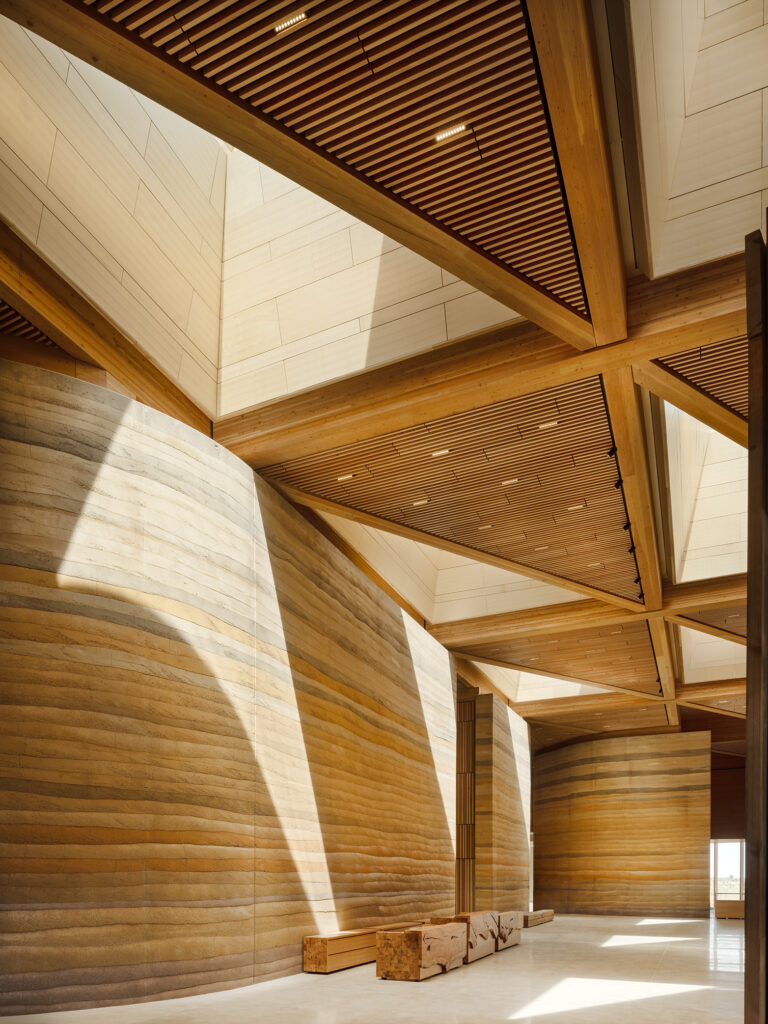
“What’s old is new again,” O’Keefe says. “We have a sod roof and rammed earth for natural ambient heating and cooling. Those are the two most ancient architectural moves that one can make.” However, he found there were no bidders when the firm put out a bid for the twenty-seven-foot-tall walls that define the interior experience of the library. In the end, Winn Construction, a local company, was trained by an external consultant, EarthWall Builders, to craft the carefully composed layers of earth that make up the walls. “The walls aren’t structural, because that kicked in too many different testing and fire resistance criteria,” Dorf explains. “So, the rammed earth goes up to within about twenty-four inches from the underside of the roof beams.” Aesthetically, the idea was to echo the striations of the Badlands canyons within the building, paying homage to the land that played such a pivotal role in Roosevelt’s life.
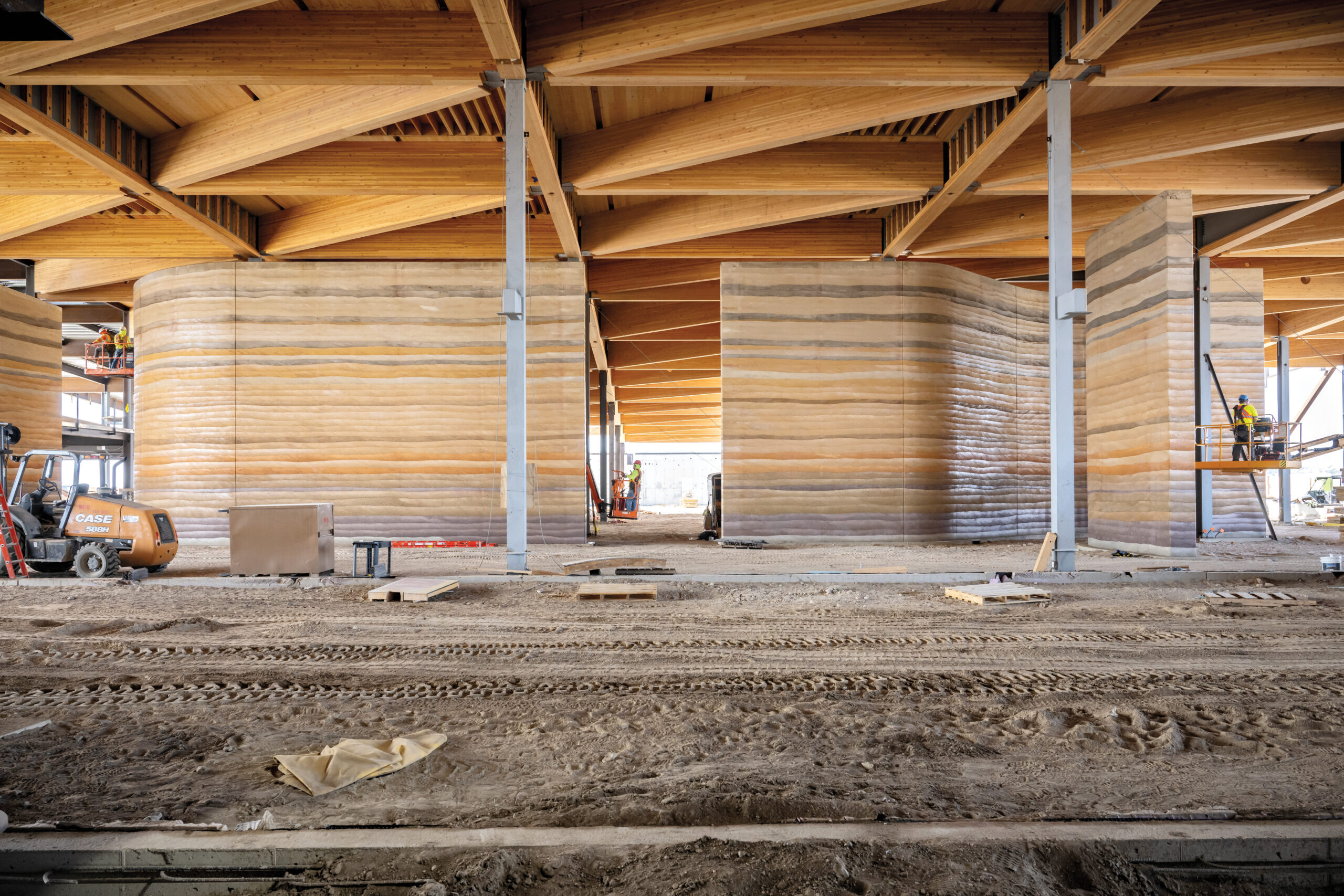
The Colors
“The earth was sourced from less than fifty miles away because the earth on-site was a little bit too structurally weak for this. The layering and the colors are not literal takes of the Badlands’ earth itself. We were really workshopping the layers with local clients who live in Medora to say, ‘What best captures the Badlands experience?’ The shadowing that’s cast over the Badlands from clouds and storms or from seasonal variation in plants creates colors that don’t get represented just purely by taking an earth sample — although we did that too. But you can go out and find the source color for every one of these layers. I went and found a rock for every one of these colors because they’re all lying right there.” —Aaron Dorf
THE ROOF
The concept that won Snøhetta the project included a green roof that would meet the grassland, so that from a distance the building would appear to be tucked into the landscape itself. But early on, the team realized that “if you did a normal green roof, it would be vibrant and green if you’re irrigating it in the middle of the summer when the rest of the grassland is brown,” McMahon says. “So we needed to design something that would mimic the Badlands and be affected by the seasonality.” Once the needs of local species, soil hydrology, and the thermal conditioning of the building below were all taken into consideration, the team ended up with an eight-foot-thick roof stratum: The beams are four feet deep, followed by seven-layer CLT, some concrete on top for waterproofing, and then the earth that holds the plants. The skylights set into the roof are triple glazed, making the entire structure a key factor in the insulation of the building. “From a performance standpoint, one of the inspirations was Native American earth lodges,” Dorf adds. “These are structures that perform passively with thick earth roof buildups. We’re able to leverage both by having a low carbon roof assembly—local soils and woods that are sequestering—and also the incredible insulative properties of that sandwich.”
Technical Challenges
“There’s five different moments of transition across this roof: It’s on fill, then over conditioned space, then over open space above the breezeway, and then back over conditioned space again. So it meant that we would need the depth of soil and the same kind of soil that the Badlands have, so that we could grow the same species. We also needed the hydrology of the soils to behave the same way so that it would dry out, just like the bluff itself. And then we dealt with all the insulation needed to mitigate the warmth within the building or the air of the breezeway underneath it. Technically, that’s what we’ve achieved. The planting all went in last year, and so we had a full growing season, and we could see that it behaves as the Badlands do.” —Matt McMahon, landscape architect and director
LAND AND LANDSCAPE
“In many ways when I first saw the site, it didn’t strike me as a piece of ground that wanted architecture on it,” Molinar says. “It felt like an imposition.” To respect the land, Snøhetta located the building away from the expected position at the top of a bluff. The project ceded the bluff to a boardwalk that would allow visitors to “read” the landscape. The mile-long walk doesn’t simply lie on top of the land, explains Michelle Delk, partner and director of landscape architecture: “It cuts into the earth in places, and accesses this sort of datum in the land that allows it to be very legible.” As they walk, visitors might find the surface of the grassland at eye level in one spot and then be able to enjoy an overlook at another point. “You see the land falling away. The Badlands is shaped by erosion, and there’s a fragility to it.”
The Ecosystem
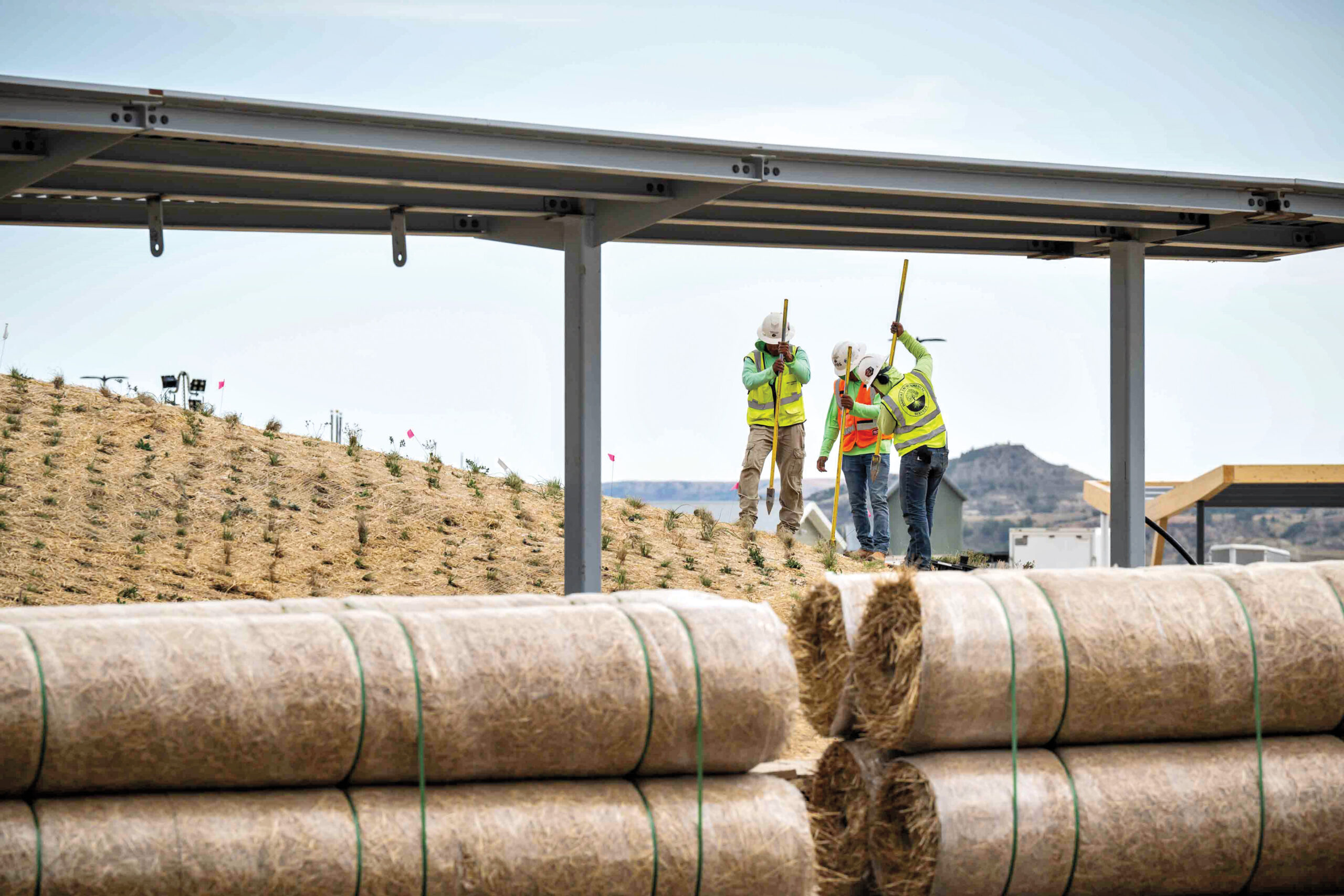
“The plateau itself had been grazed for years and really didn’t have the management to take care of the health of the land itself. There hadn’t been forest fires, which are a natural part of a healthy ecosystem. The ecologists on the team, RES, led the Native Plant Project with Snøhetta and Confluence. We had been talking about how we could restore the healthier prairie ecosystem. As we were talking about grazing practices and having conversations with ranchers about what that could look like, there was a wildfire that came through the area. Fortunately, people’s homes and their livelihoods were safe, but it did burn a lot of the site. That’s of course nature’s way of helping maintain healthy grasslands. Very quickly, within a couple of weeks, the plant material began to reemerge and we had our ecologists, the design team, and members of the client group go out to the site and see that magic.” —Michelle Delk
Native Plants
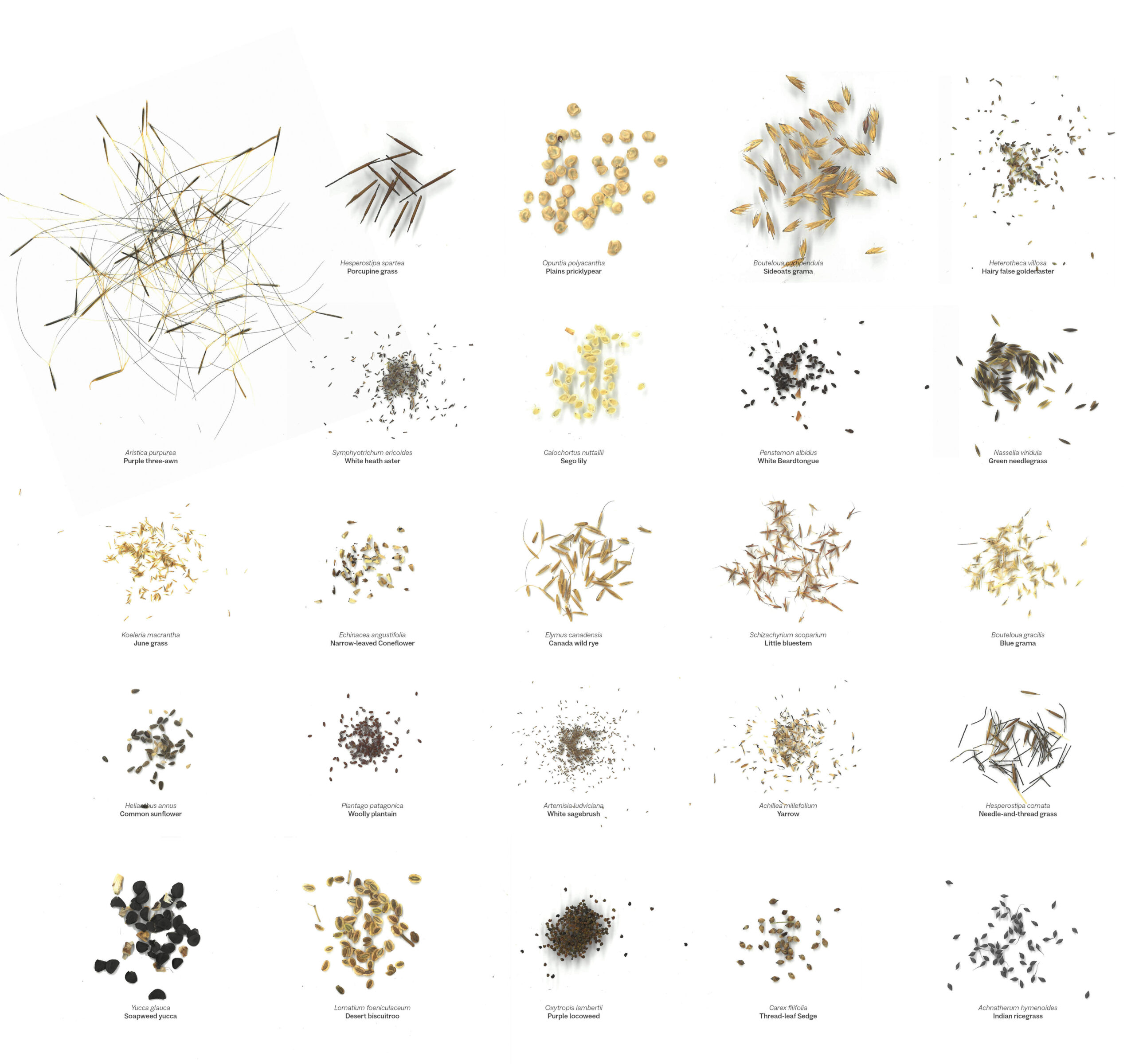
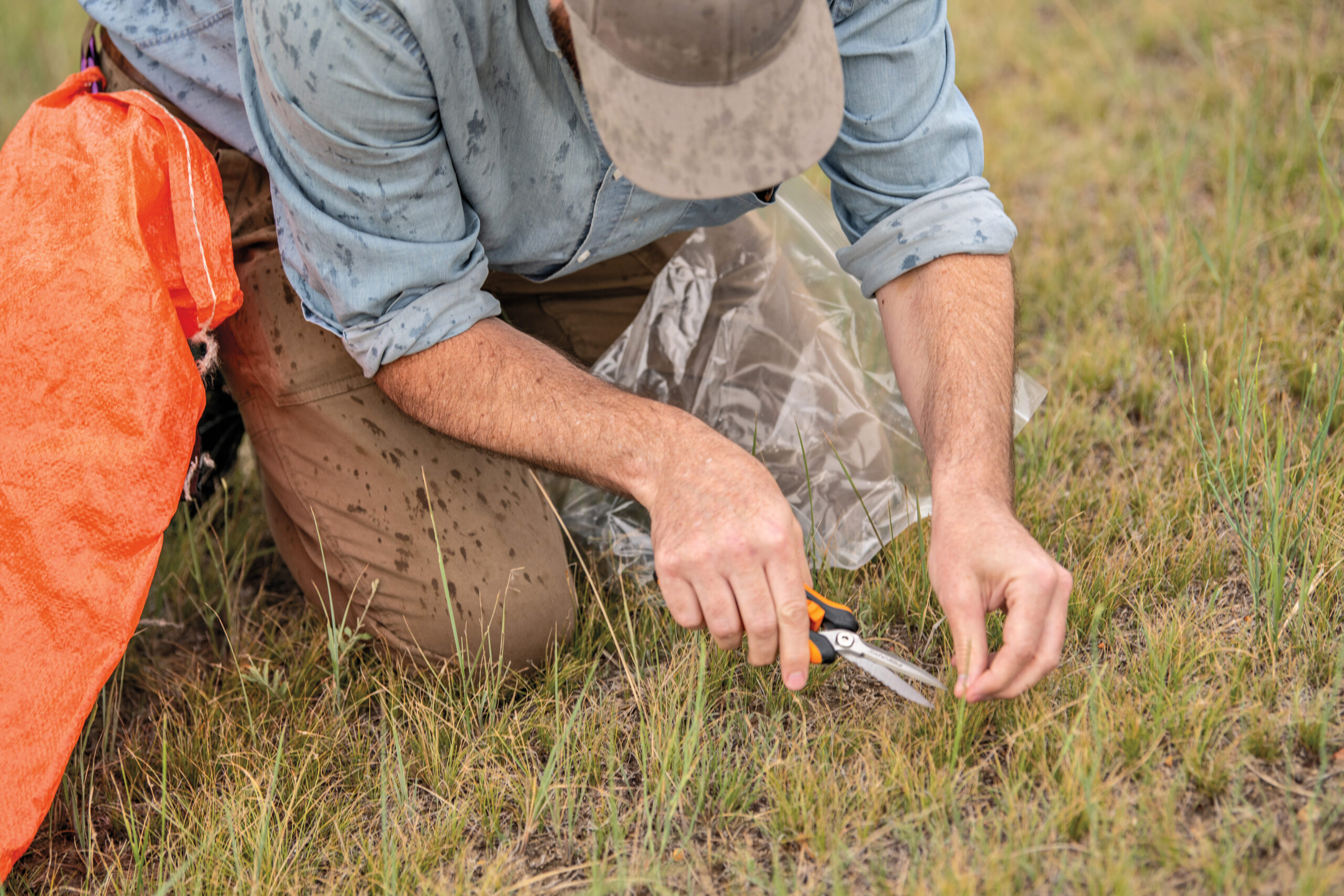
“The idea of land management ultimately led to the native seed collection project. We learned very quickly that commercial nurseries in the area couldn’t provide the plant species that are specific to the Badlands. So adjacent landowners were contacted, and they invited the project to come to their land and collect the seeds under the guidance of the ecologist. So those landowners have a vested connection to the project. Anyone then that wanted to volunteer could come, learn about the seed collection project, and be a part of helping regenerate this ecosystem. The library has a partnership with North Dakota State University so that the project can hopefully live on. It was a way to propagate and have the plant material for the project, but there could be educational opportunities or even other resources that could come out of it.” —Michelle Delk
Carbon Sequestration
“The grasslands store carbon in the soil. So one of the first things that we did was to test the soils to understand how much carbon was there. Upon opening, we will do another round of testing to understand what the impact of construction was on the soil. And then the project will be studying the carbon over time, periodically taking additional core samples from the earth to understand how the long-term management strategies are benefiting the flora and the carbon story of the project and also allowing it to be a feedback loop into the management regime. So, we’re not only tracking carbon, but the library can also be a place to understand grassland management in this part of the world.” —Matt McMahon
Would you like to comment on this article? Send your thoughts to: [email protected]
Latest
Viewpoints
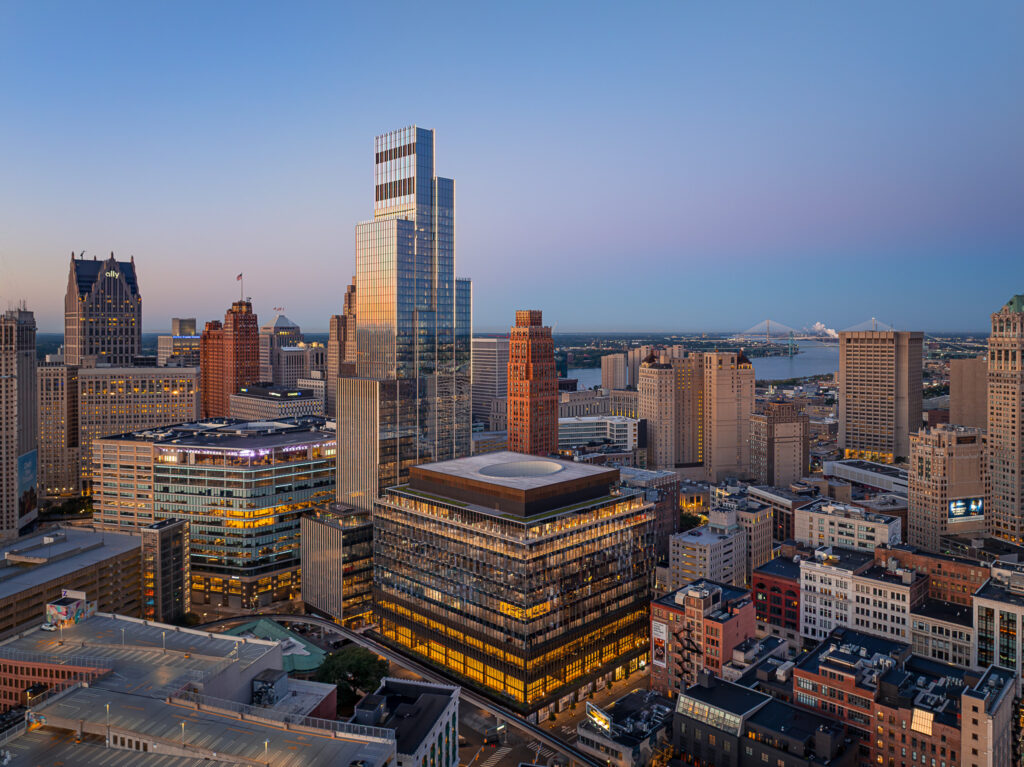
Detroit Month of Design: A City’s Work in Progress
Now in its 16th year, the celebration offers insights into the Motor City’s ongoing accomplishments without glossing over its hurdles.
Projects
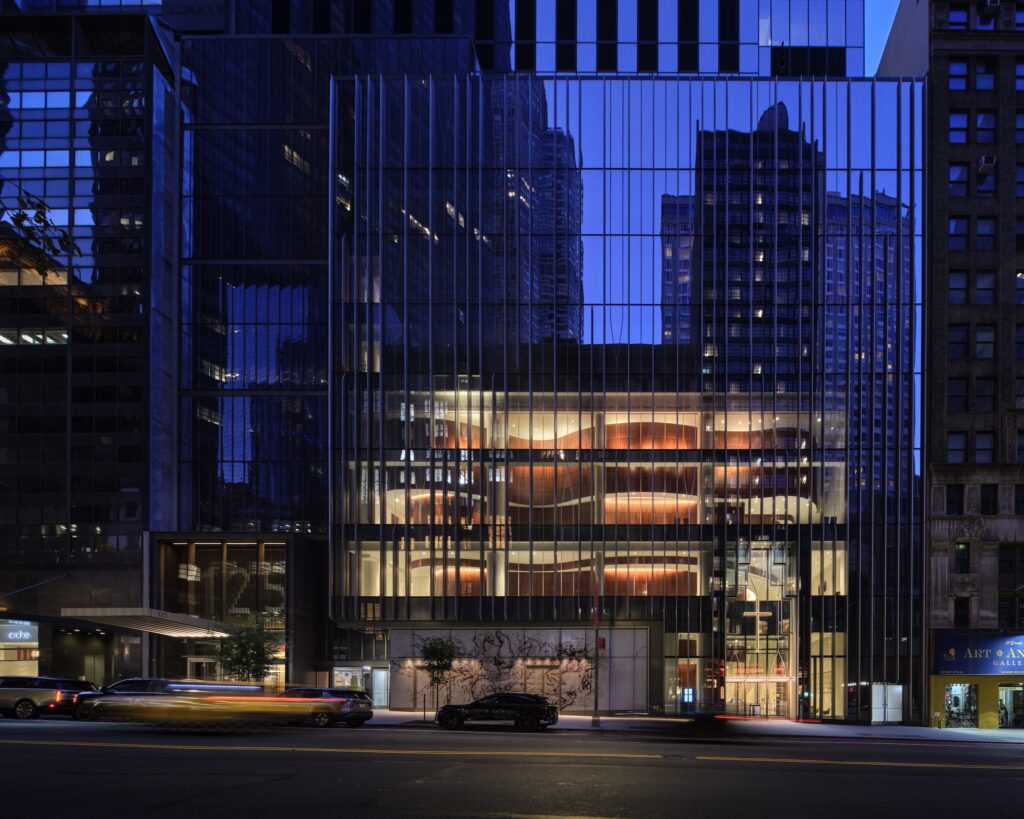
How a Hybrid Building Helped an Historic Manhattan Congregation Remain in Place
On Billionaire’s Row, FX Collaborative designed a new home for Calvary Baptist Church combined with an office tower.