


June 25, 2026
Antoni Gaudí, On the Spectrum
The two main criteria for an ASD diagnosis are: “persistent deficits in social communication and social interaction” and “restrictive, repetitive patterns or behavior, interests, or activities.” If we reframe some of these diagnostic criteria into strengths-based language, it might read something like this: autistic people pursue passions with exceptional dedication and expertise, they demonstrate perseverance that allows for mastery of their “special interest” subjects, they find joy in repetition, they are highly logical, they have a rich sensory experience and heightened perception, strong visual processing and memory, and their sensory sensitivities often result in an enhanced awareness of the subtleties in sound, light, texture, and pattern. I don’t know about you, but many of these characteristics sound to me a lot like the characteristics of a great designer.
But one of my favorite things about autistic and other neurodivergent people is our incredible, intuitive understanding of how environments affect human comfort—simply because the world was not designed for us.
Where are the Autistic Architects?
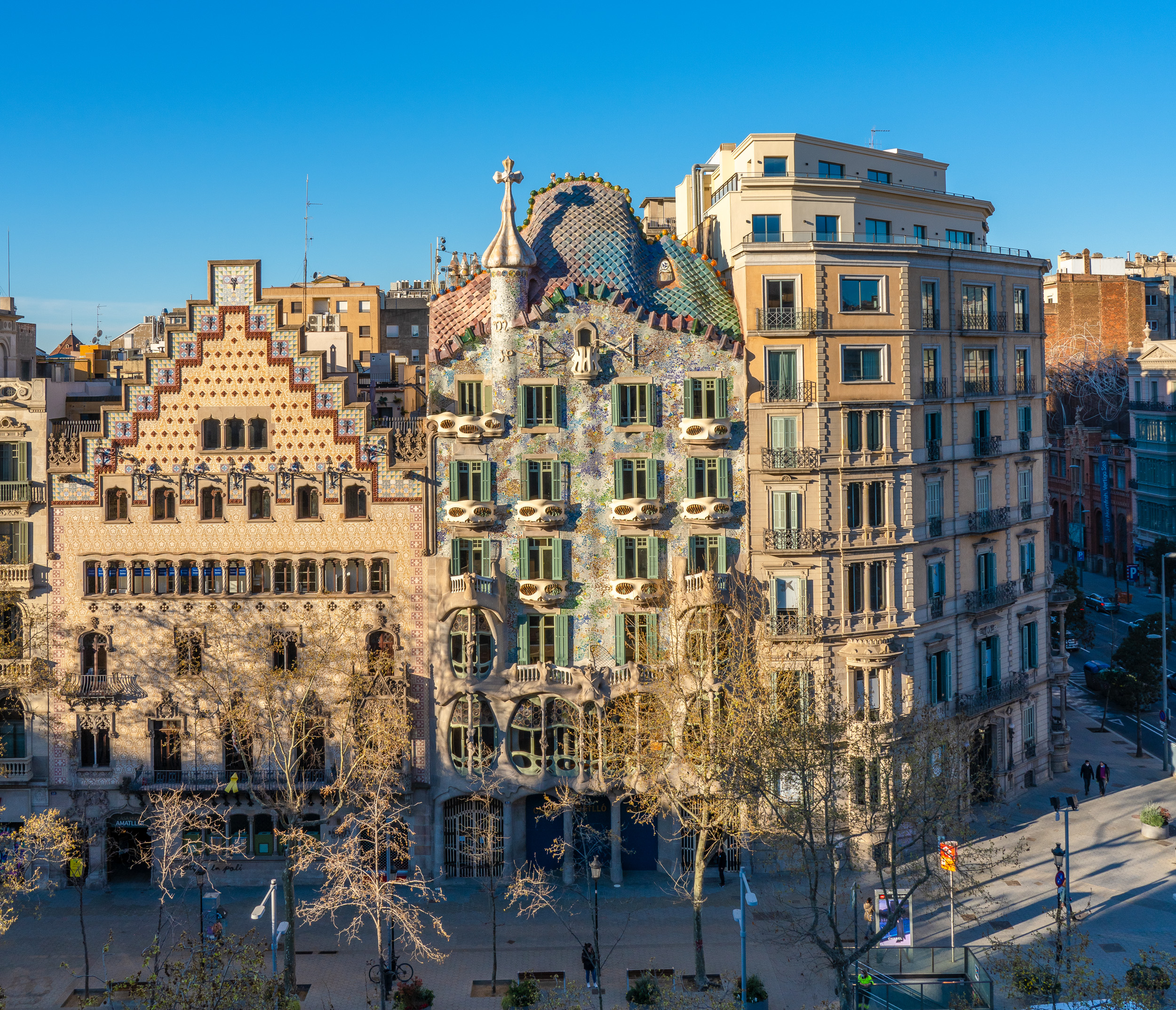
Plenty of historic figures in architecture have been speculated to be on the autism spectrum, notably the Catalan modernisme architect, Antoni Gaudí. Michael Fitzgerald, an Irish professor of child and adolescent psychiatry that specializes in ASD, has offered many theories on the relationship between creativity and neurodivergence in his books Autism and Creativity (Routledge, 2003) and The Genesis of Artistic Creativity: Asperger’s Syndrome and the Arts (Jessica Kingsley Publishers, 2005), as well as his 2024 Academia.edu blog post, “Autism and Antoni Gaudí” Other sources, such as the American Library Association and organization Dyslexic Positive Libraries see Gaudí as a key representation of a historic dyslexic artist, and use his image in library accessibility programming (research shows around 30-50 percent of autistic people are also diagnosed with dyslexia.)
Accounts describe Gaudí as meticulous, repetitive, and reclusive, with daily habits that were rigid and ritualistic, and a communication style that was blunt and highly literal. He was described as a “solitary genius,” but someone who would go on long monologues about his work and interests. One Gaudi biographer, J. Castellar-Gassol, highlighted his contradictions, describing him as being a bit “clumsy with a fork and knife,” but expressed “great manual dexterity” when it came to drawing and sculpting. He wrote in Gaudí: The Life of a Visionary, that “His teachers could not have considered him a good student, and his classmates, naturally given to fun and games, could hardly have accepted as one of them this boy who did not enjoy jokes, who went his own way and never participated in the oblivious vacuity of the group.”
In Gijs van Hensbergen’s 2001 biography, he wrote that Gaudí was “a creature of habit” so much so that you could, “set your watch by him.” van Hensbergen also described his as a “man of action who lacked the means to express himself adequately.”
Of course, this is all 100 percent speculation, as there’s no viable way I or anyone else can diagnose an architect who died in 1926 (autism as a medical concept didn’t even exist until 1943). “His personality is hard to capture for various reasons. In the first place, Gaudí’s shy and retiring nature meant that there are virtually no original documents in existence that show what he was like,” writes Jeremy Roe, author of a 2019 biography writes. “Hence the numerous fantasies that have been written about Gaudí — fabrications that are of no historical value despite their appeal to the public, ever eager for details of the intimate lives of great men regardless of whether or not they are true.” Yet, the theories offer a compelling explanation for why I, and other scholars and art historians, are not only captivated by his work, but are drawn to his personality as an historic figure.
The fact that millions of tourists from all over the world flock to Barcelona to experience his architecture, is a powerful statement on the lasting impact of unique sensory experiences, of the healing power of fractal geometry, of the role of spiritual spaces in public life, and of what we now call “biophilic design.” These spaces aren’t just beneficial to autistic and other neurodivergent people, to Catalonians, or even to devout Catholics such as Gaudí—but to everyone in different ways.
Gaudí’s Architecture of Sensation
One of the main criteria for ASD is a “restrictive, repetitive patterns or behavior, interests, or activities.” In the autism community, we call these, “special interests.” We could say that I have a special interest in Antoni Gaudí. At least enough to organize my entire two day trip to Barcelona around seeing as much of his work as possible, at the expense of doing anything else (no Picasso Museum, no tapas tours, no beach, no shopping the Ramblas…)
To my disappointment, despite my careful research and planning, I found myself almost immediately overstimulated at most of the sites—Casa Pedrera, Parc Guell, Casa Batlló, and of course, the Sagrada Familia. (The exception was his first major project, Casa Vicens, but I credit that to the early hour I visited.) I couldn’t believe that I had been teaching these buildings to my history of interior design students back in New York, without experiencing the commodified, almost Disney-fied, reality. Casa Pedrera had a photo line that wrapped around the perimeter of the rooftop. I learned after my visit that the Sagrada Familia introduced a selfie zone to ease the overcrowding in the street. Despite signs that declared certain interior spaces were for “silencio y recogimiento,” there wasn’t a silent, meditative spot to be found.
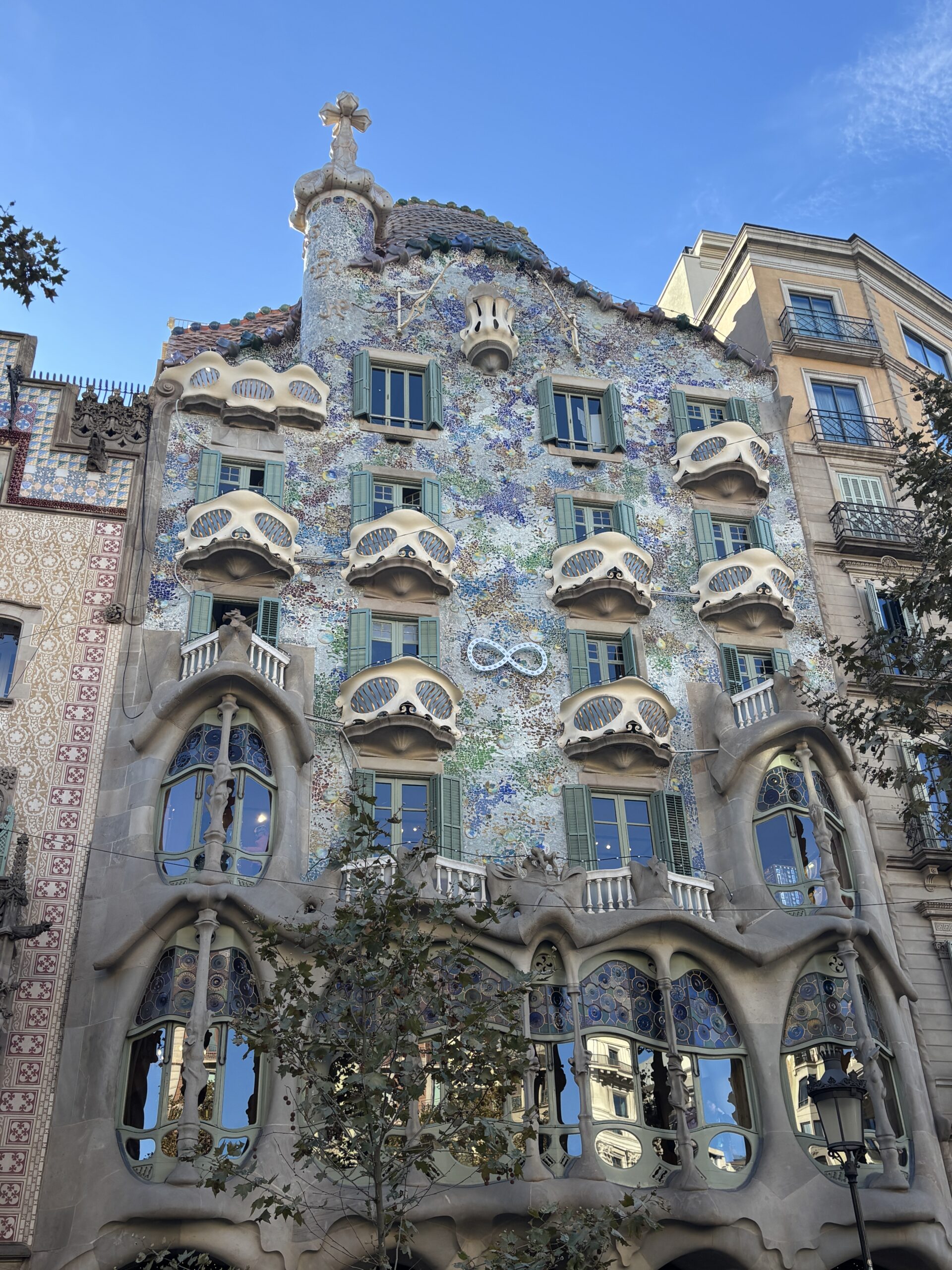
I was too busy pushing my way through the crowds taking photos to notice Casa Batlló’s big, blue infinity symbol illuminated on the building’s facade—a symbol that has been used by the autism community since the early 2000s. I began to think that those viral Barcelona protestors angry about over-tourism are right—this is way too much. I was warned, but I was not prepared. I took deep breaths and flowed through the soft curves of the rooms’ walls and railings as I wound up the narrow staircases, taking any small moment of solace I could away from the tour groups and families wandering around with their eyes glued to their augmented reality audioguide tablets, taking in the same details, through a screen rather than through their own senses.
Once you walked through a room, it really wasn’t feasible to turn around if you wanted to go back to look at something more closely, so if you get stressed out and need to leave a room like I did multiple times, it’s only up from there. I tried to ignore how loud and packed the spaces were, particularly the hallways, and got lost in the details: the undulating ceilings, the skylights that resemble tortoise shells, the serpentine wainscotting, play-dough-like doorknobs, the Morano glass mosaics, the ceramic tile that got darker in hue as you move up the stairs, because as the tiles extend higher and the windows become larger, the darker color of the glaze can absorb more light. You finally reach the rooftop and are able to look down on the crowds on the street you pushed through to get up here.
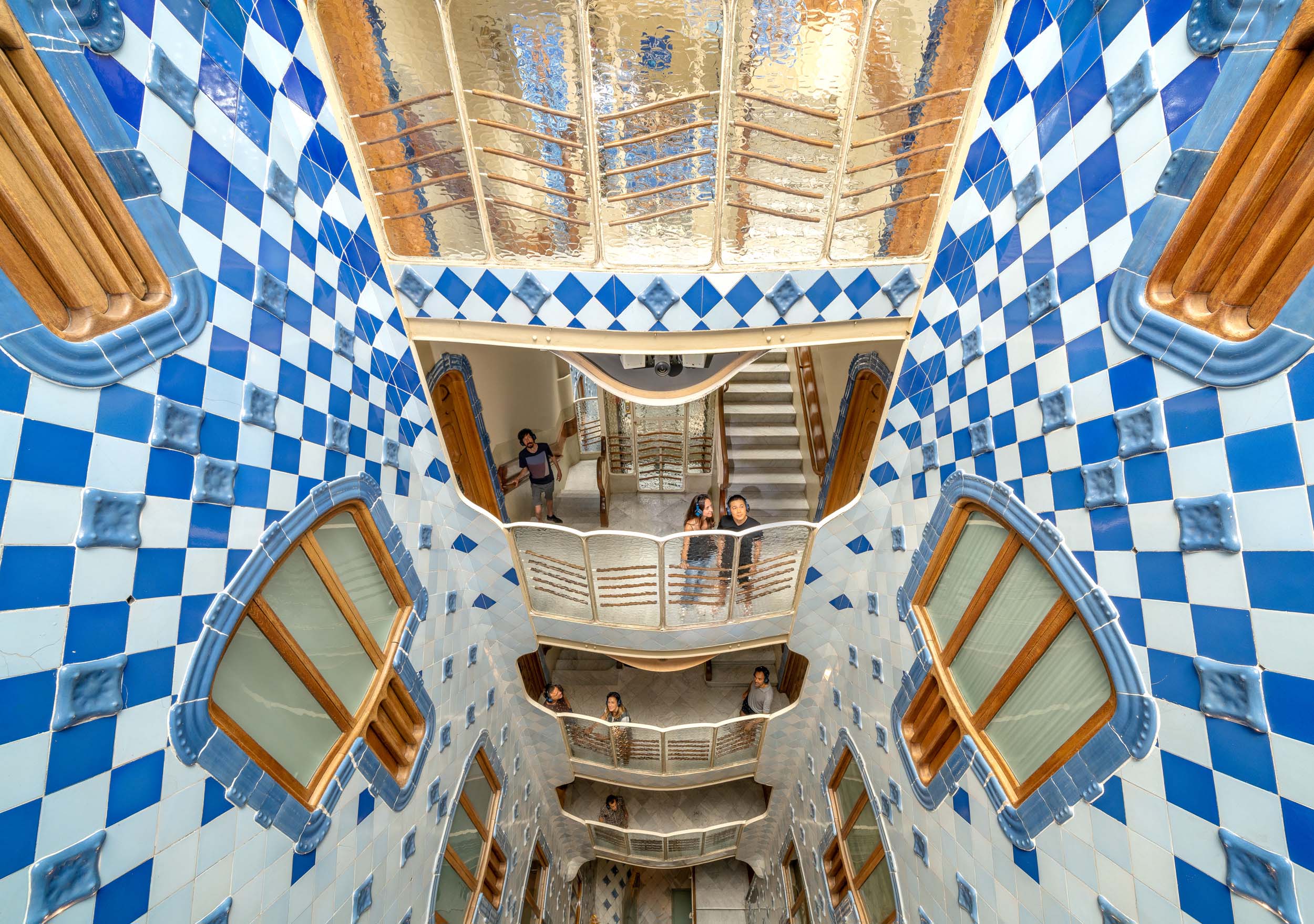
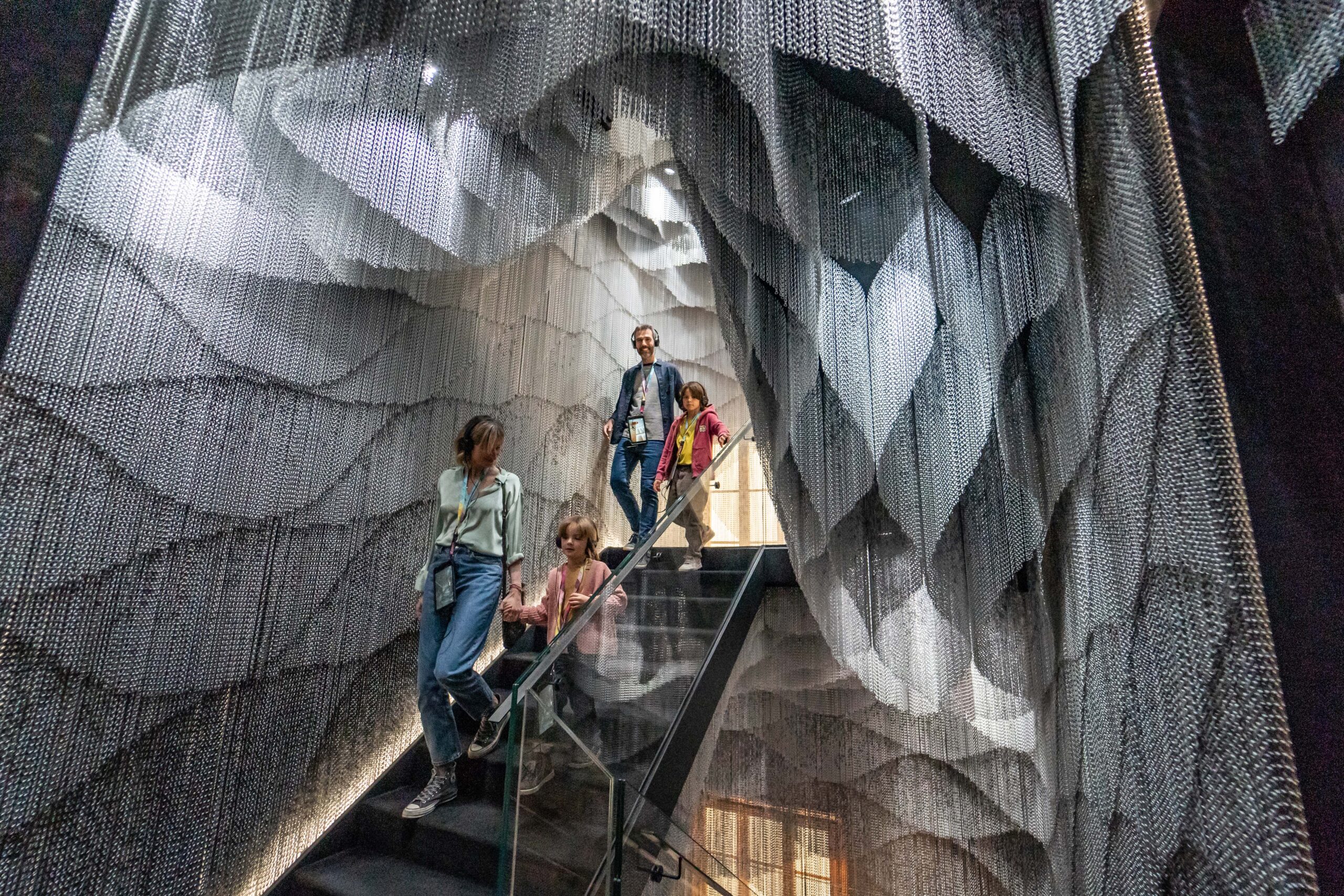
The worst part of the experience had to be coming down the Kengo Kuma–designed aluminum chain-clad staircase, which opened in 2021. My guide told me that its opening sparked mixed reviews, having a non-Catalan architect come in and insert such a contemporary intervention in Gaudí’s masterpiece. He didn’t say directly, but I could tell he hated it. At that moment, I hated it too, because all I wanted was this tour to be over, and yet, I still had to muster every ounce of patience as a family of six was descending the stairs at a snail’s pace, each child slowly running their fingers against the aluminum chain curtain (courtesy of Kriskadecor), letting the sound of the chains entangle with their voices, rattling and echoing through the atrium the entire eight flights down.
The fun thing about autism, is that what can be a pleasant sensory experience for one person, can be a nightmare for another. It’s one of the things that makes general guidance for “designing for autism” nearly impossible.
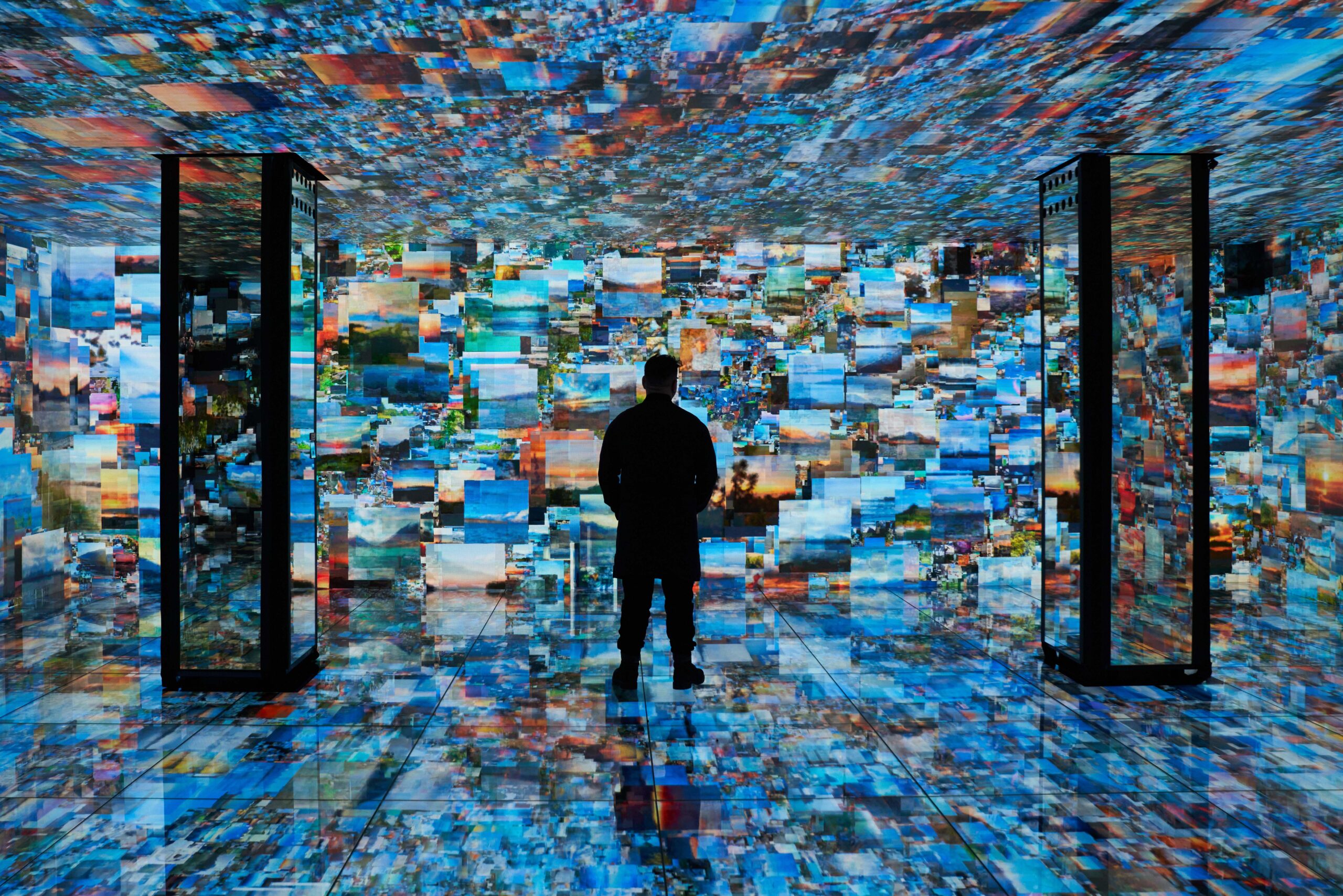
When we finally reached the basement of the building, I felt nauseous. The sound of the chains were ringing in my ear, I was sweating, and Kuma’s light installation was reflecting off my fogged up glasses. But there was one more “immersive experience” to endure before getting spit out into another gift shop. I entered into what the house calls the “Gaudí Cube,” a 360 degree audiovisual installation by artist Refik Anadol that uses augmented reality, AI, and volumetric projections to “engage visitor’s senses” within a cramped six-sided LED room.
As I watched the flashes of imagery under my feet, above my head, on my arms, on the other people—compiled from the largest digital repository on Gaudí in the world—I again thought about how there are autistic people out there who would love this type of thing. I was not one of them. But upon exiting the installation, I spotted something peculiar. I saw a small sign that read in Catalan: “Casa Batlló: Compromesos amb l’autisme,” (Translation: “we are committed to autism.”)
Que interessant. Considering how I had come to my architectural hero’s buildings seeking a positive and spiritual sensory experience, and that what I had just been through was nothing short of a sensory hell, what could this possibly mean?
A World Heritage Site Committed to Autism
I ran outside, immediately sat down on one of the mosaic lamppost benches (often mistaken as Gaudí designs but were actually designed by Pere Falqués i Urpí in 1905), and I googled “Casa Batllo autism.” It turns out, Antoni Gaudí’s last work, a UNESCO World Heritage site since 2005, is the first cultural institution in the world to create a robust employment inclusion program for neurodivergent people. Since 2021, the institution has recruited over 100 neurodivergent individuals through this pioneering social sustainability initiative—including people on the autism spectrum, as well as those with ADHD, dyslexia, and dyspraxia—to staff visitor services roles. Today, 85 percent of Casa Batlló’s front-of-house staff are neurodivergent, most of which are on the autism spectrum. Casa Batlló describes the project as a way to redefine what public-facing cultural work can look like when inclusion and diversity are prioritized, and they reinvented its talent, recruitment, training, and support processes to be an example for others.
Key to making this possible is the collaboration with Specialisterne—a social organization that specializes in employment services for neurodivergent individuals. On April 2 2025, World Autism Awareness Day, Casa Batlló lit its facade blue and launched the campaign “Neurodiversity with New Eyes” which includes a monthly podcast of the same name where staff members share and discuss their personal experiences with the program.
Marta Mas, workplace coach and one of seven psychologists on the Specialisterne team, explains in the podcast’s first episode that the support networks put into place focus on training the teams, but it also focuses on the work environment itself. “In the end, there are aspects of the environment that we can try to modify as much as possible. Sometimes it’s not easy, as Casa Batlló, in the end, has a structure that is what it is,” she explains. “But we can try to ensure that people are clear with their instructions, we can try to reduce the quotas a bit, we can lower the volume of the music. There are a whole series of aspects we can try to adapt to make it easier for an autistic person to do their job without overloading them with extra stimuli.”
Julia, an autistic woman and art historian who leads Casa Batlló’s shop, responds, “As a neurodivergent person, I’m a queen of masking. My diagnosis came late, which is typical for women, because we are queens of masking. It’s horrible, I shouldn’t have to change who I am, why can’t society change, or include, or accept the diversity it has? Because society is not neurotypical—it’s made for neurotypicals, but it’s actually neurodiverse.”
Casa Batlló Takes off the Mask
I didn’t know about this initiative prior to coming into the museum, because these types of initiatives are not something that autistic and other neurodivergent people come to expect. Access and availability of accommodations or systems of support simply don’t exist in most public spaces or workplaces. This is why we don’t know how to design for neurodivergent people, because we are so often cast out of these spaces to begin with, and often left out of the conversations entirely. So many public spaces are inaccessible to neurodivergent and other disabled people because of controllable factors such as crowds, mobility accommodations, and sensory input.
Despite the radical inclusivity of Casa Batlló’s initiative, there will still be some negative reactions like my own. Take for example this 2024 Trip Advisor review where a parent points out: “Casa Batllo’s ‘autism verified’ certification just means they hire neurodivergent employees, but that wasn’t that helpful when we had to carry our nonverbal six year old up about five non-airconditioned stories.” In other words, workplace accommodation for neurodivergent people is just one end of the equation, and often targeted toward those diagnosed with Level 1 autism.
Regardless, Casa Batlló is doing something right: they are showing that accepting and celebrating “neurodiversity” can not just be surface level, but must be engrained within structural systems. The more other monuments, historic sites, schools, hospitals, commercial businesses, and public spaces start to employ similar initiatives to raise awareness and respect for neurodiversity, while also actively hiring and training more neurodivergent people to work in public facing positions—the faster “design for neurodiversity” will become a baseline. When workplaces within all sectors, not just the arts and culture, start to do this, doors will open, perspectives will evolve, new systems of being and working will emerge.
The more we openly talk about and celebrate neurodivergence in the workplace, the more these conversations will infiltrate all aspects of everyday life. The more we make the workplace, and public life in general, accessible to autistic people, the more inherently inclusive and sensory-friendly society, and its built environment will become. The perceived need for specialized interior designers to “design for inclusion,” will dissipate.
I was lucky enough to be in Barcelona during the annual switching on of the Christmas lights last November. Last year, Casa Batlló celebrated “A Christmas for Neurodiversity” and its facade lighting design boldly featured that infinity symbol I failed to notice on my way inside the building, and powerful symbol that strongly echos the curvilinear forms of Gaudi’s mask-like balconies.
“So often, autistic or neurodivergent people are expected to act ‘normal’—what is expected as normal by a society that has a set of rules that are deeply ingrained, but are not explicit,” Marta Mas explains, “We expect the person to have internalized these rules—to enjoy parties, to participate openly in everything—we could list many social impositions here which the person tries to follow and mask to fit into a world that demands the autistic person to change. We’re trying to reverse that a bit…ultimately these are adjustments that positively impact everyone.”
Would you like to comment on this article? Send your thoughts to: [email protected]
Latest
Viewpoints
Detroit Month of Design: A City’s Work in Progress
Now in its 16th year, the celebration offers insights into the Motor City’s ongoing accomplishments without glossing over its hurdles.
Projects
How a Hybrid Building Helped an Historic Manhattan Congregation Remain in Place
On Billionaire’s Row, FX Collaborative designed a new home for Calvary Baptist Church combined with an office tower.