



October 27, 2025
Rediscovering Tile for Sustainable Design
Tiles are among the most enduring building materials. Glazed brick tiles have been discovered in archaeological sites and in ancient and medieval buildings around the world. The first glazed porcelain tiles, which date back to 15th-century China, are still around today. And yet, when one thinks of sustainable building products, tile might not be the first to come to mind.
More often than not, today’s building industry—with its culture of constructing and demolishing—fails to take advantage of tile’s inherent sustainability. In today’s context, we require that building materials have the lowest possible carbon footprint and be easily reused or recycled. So, how can tile—with its thousands of years of history—fit into today’s frameworks? And how can we build better with this time-tested material in North America?
In the latest episode of Deep Green, created in partnership with AHF and Crossville, host Avi Rajagopal sits down with Noah Chitty, vice president of sustainability and technical services for AHF. Part of the AHF family of brands, Crossville has made great strides in optimizing tile manufacturing by innovating with new technologies and providing transparent information to the design community—efforts Chitty has helped drive. To learn how this ancient material is being reimagined for a more sustainable future, read an excerpt from their conversation below or listen to the full episode on the Surround Podcast Network.
Avi Rajagopal: Could you give us an introduction to sustainability in tiles? What makes the ceramic tile inherently sustainable, and where is the scope for improvement?
Noah Chitty: If we look back and take a general view of it, probably durability and low maintenance are the two things that stick out. It depends on when we say what’s sustainable about it, who the audience is, and what is the customer looking for when they look for sustainability.
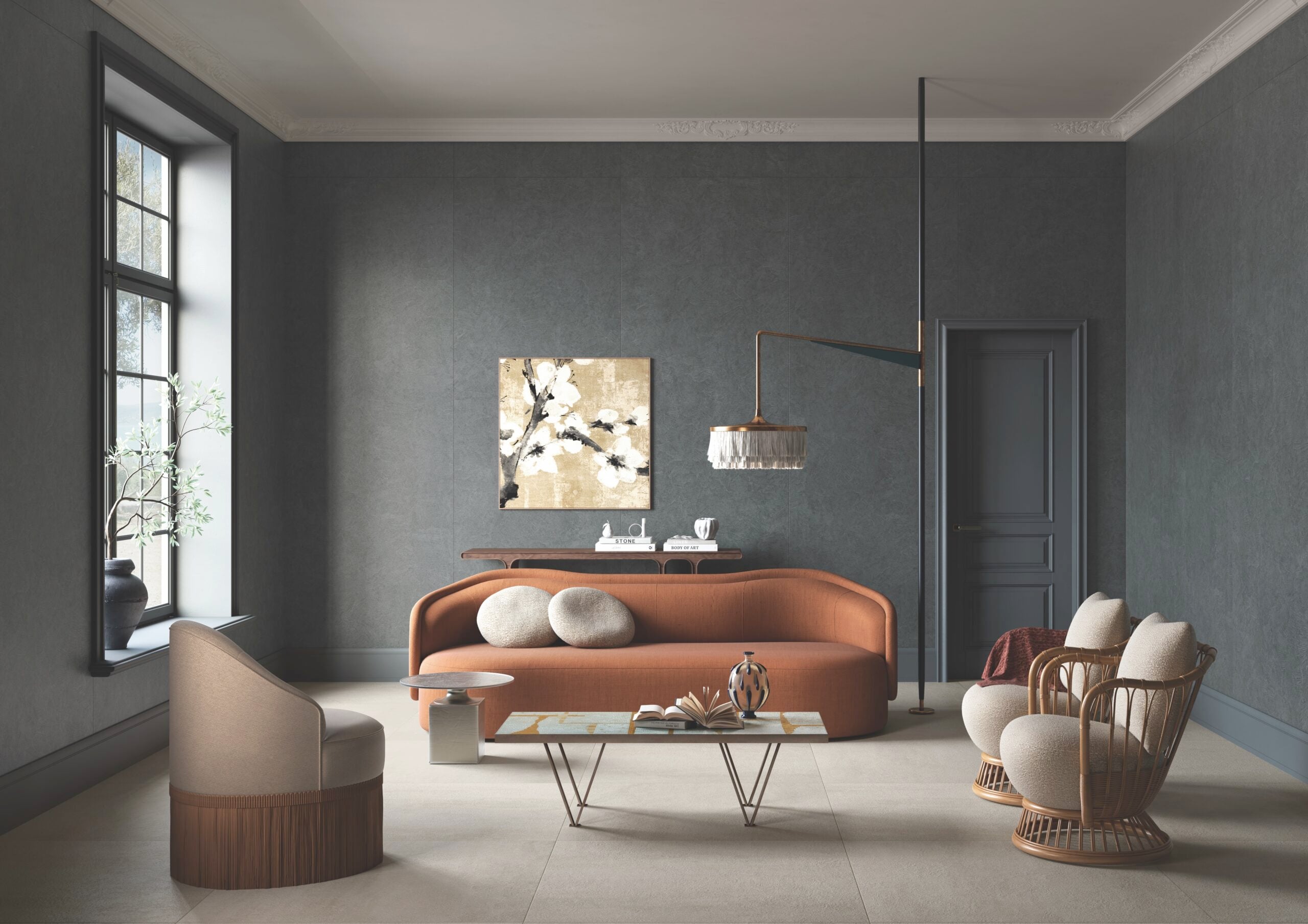
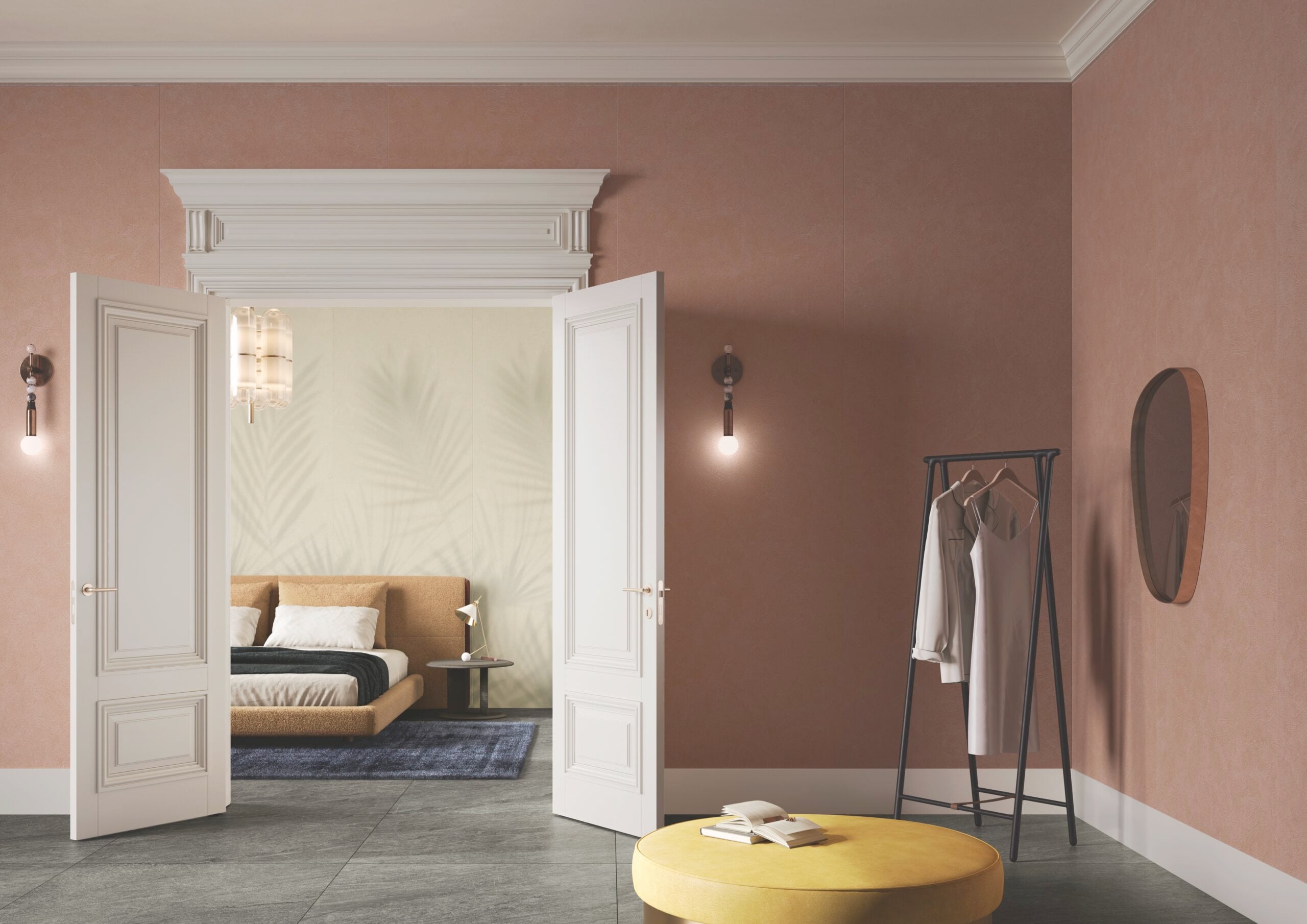
The qualities of durability that you talked about have been around for a long time, and the easy-to-maintain aspect takes care of some of the harsher chemicals. Innovation in the tile industry has come from digital printing 10–15 years ago, which allows us to replicate natural materials—or anything else—much better than we used to. Pressing has changed in the last 10 years too, allowing for larger sizes and thinner profiles, which also have sustainability benefits from using less energy to fire. So, we have lots of opportunities, just like any other industry.
AR: Given the current landscape, how did Crossville determine its carbon emissions goals? I understand sustainability in general, but when it comes to carbon footprints—which became a topic of discussion a decade ago, particularly regarding embodied carbon materials and building products—could you take us back in time and explain the initial steps Crossville took to establish its focus?
NC: The first step probably started in 2013 with the first EPD we published—a product EPD in 2014. That allowed us, like everyone else who takes this step, to understand what the baseline is, what our product is, and what it’s doing. It probably wasn’t until the second EPD in 2019 that we saw we could reduce things through simple steps, like changing motors and other components that weren’t as efficient as they could be.
That’s when we realized we could make progress. It also helped us understand the impact of natural gas and electricity, which we have less ability to control. We started to look at what we can control now and what we can build on long-term. This process led us to set a 30 percent reduction goal by 2030. For a long time, many organizations had 2050 goals, but we realized that if we wait until 2050, we either won’t achieve it, or it’ll be too late. So, the goal came from asking, “What can we do if we work really hard without making it too easy?”
Honestly, more than just reducing carbon emissions, it was important for me to start a conversation about carbon emissions—to get people to understand what they are and what we’re targeting. Could we add an extra column to the ROI spreadsheet that asks, “Does this achieve all our objectives, and does it reduce emissions too?”
That conversation was the most important part—more than the goal itself.
AR: Often, that’s the case when it comes to carbon assessment. We’ve done things a certain way for so long, and while our methods have evolved—obviously for some advantages, such as producing efficient and affordable products—it’s important to reconsider these processes.
Once you layer a carbon assessment onto these methods, it prompts you to think about your processes differently. Could you take a step back and explain how tiles are made? Also, could you highlight some of the concerns you just pointed out?
NC: I’m going to focus more on the porcelain process because that’s mainly what we’re making, but it’s not much different from some of the others. Porcelain tile is mainly made of three things: feldspar, which makes up about 50 percent of the body. It’s a material that naturally occurs in granite and is extracted from granite; about 30 percent is clay, a mixture of different clays that gives us low carbon and high strength. Then there’s usually a filler like sand or quartz, making up the remaining 20 percent—in those ratios: 50, 30, 20. What’s important, since we’re essentially taking three materials from the earth, is that we’re close to them. That’s why we’re here in Tennessee, where we have easy access.
We take these raw materials and add a whole bunch of water and grind them into a mix. We can add color if needed, and then we turn it into a powder—a little coarser than beach sand—with a moisture content that allows us to pack it into a die. We press it hard, bring it out, dry it a bit so it doesn’t retain too much water, and then put it through a kiln at almost 2200 degrees Fahrenheit. It sounds simple, but it’s not simple.
AR: In what parts of this process did you realize that there was scope for reducing carbon emissions?
NC: Scope 3 emissions are obviously harder to figure out and have less ability to control. So, you look at Scope 1 and Scope 2 and say, “Okay, where’s the opportunity with natural gas, where’s the opportunity with electricity?” We found when we did our last EPD that TVA (Tennessee Valley Authority), which provides us with energy here in Tennessee, is actually better than the national grid mix. We saw a better reduction in our last EPD when using our mix as opposed to the national grid mix.
One of the things we can do is figure out where TVA is going and how quickly they are going to get greener. In the meantime, because we’ve still got natural gas—which has some potential for improvements but is still a fossil fuel—it is going to be what it’s going to be.
The opportunities we’re looking at include determining if we are using that gas as efficiently as possible. Are we firing at 55 minutes? Could we fire at 53 minutes? Do we have a tile that’s nine and a half millimeters thick? Could it be nine millimeters thick? Can we recycle more things? So, those were the initial considerations: let’s go see if we’re doing everything as optimally as possible and using these things—like gas and electricity, that we can’t get rid of immediately—in the best and most efficient way. I think we still have some strides to make before we hit the wall.
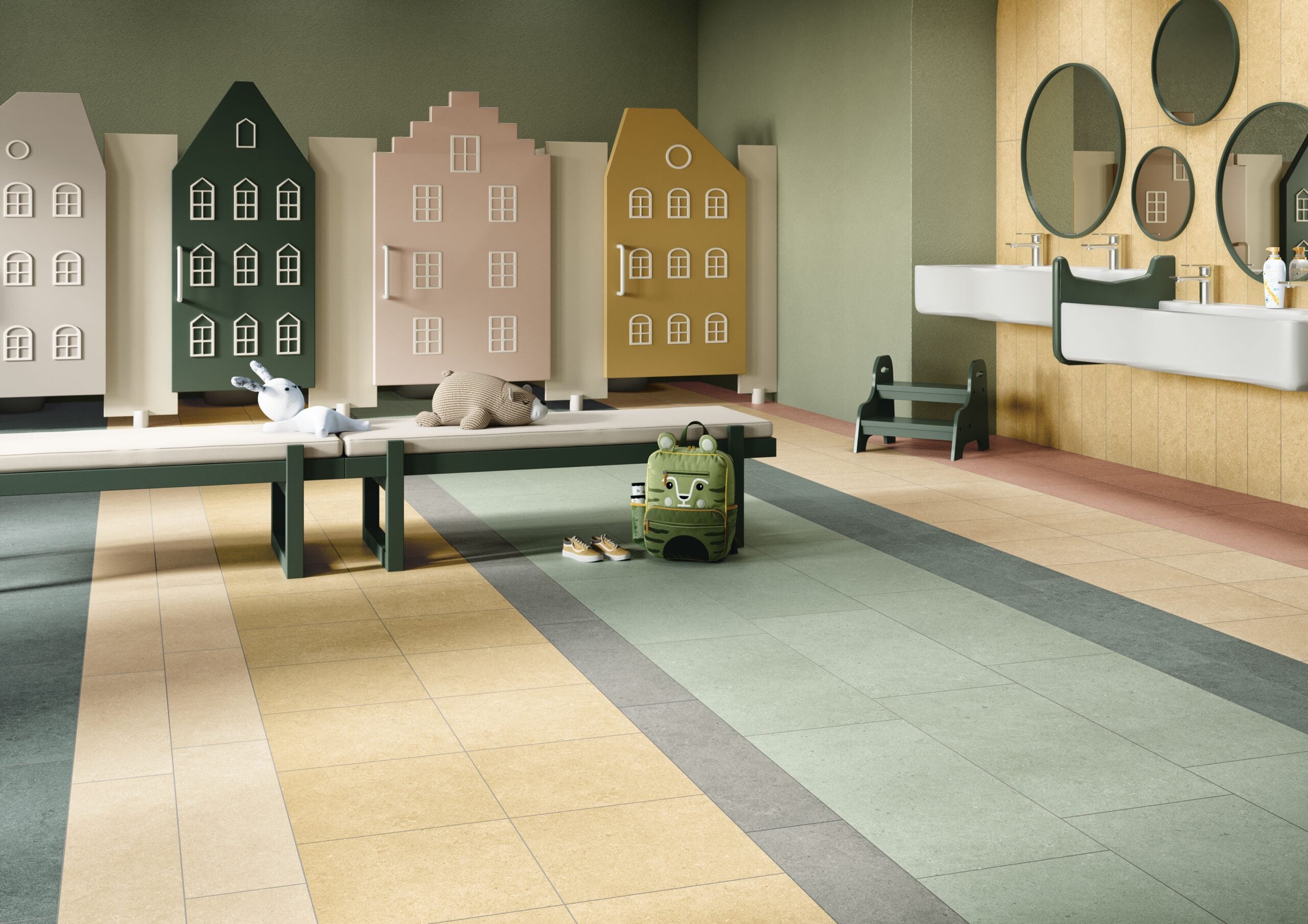
AR: You have EPDs so people can see the carbon footprint of your products, but you also offer a few collections of carbon-neutral tiles. Tell me a little about at least the two newest ones—Billion and Arjun 2.0—and how you achieve carbon neutrality.
NC: The first thing that may not be apparent is that there’s nothing different about those two collections compared to the other collections we make. Those collections that we call carbon neutral aren’t manufactured any differently than any other collections.
Those were collections we decided to take to the market and say, “Hey, you guys were asking us for carbon-neutral, zero-carbon products. We can’t provide you with zero-carbon products today because we don’t have the technology to get there, but here’s what we can do—let’s start having a conversation and push things forward.”
In my view, if we can’t eliminate gas and electricity today, and the client need a product that’s carbon neutral, my only available path is to lower my carbon footprint as quickly as possible and offset in the interim. It’s buying into the problem, but I think a lot of people perceive it as buying out of the problem. We must make sure we have this conversation that clarifies it’s buying in, especially if you’re coupling it with reduction at the same time.
AR: I think that’s an interesting conundrum. I think the most interesting thing you said is that these collections are not any different; they just have this additional investment in carbon offsets. It really depends on the people conducting the LCA (lifecycle assessment) of buildings to figure out how much this matters and which numbers they want to use effectively because the product is the same.
Tile is not a material that’s known for being easily recyclable and yet you created this program. Tell me why it was important and what it achieves now?
NC: In the early ’80s, the Crossville factory had started the process to recycle all the water in the factory. They also had started a lot of processes to try and capture all the unfired tile that was either quality checked or didn’t make it through the process. There are fired pieces that are landfilled or even out in the market. What do we do with them?
At that point, we weren’t owned by AHF. Our current family had some connections with a mining company who was able to find a mining piece of machinery that was durable enough to break fired tile into something small enough that we could reuse it.
A building in Illinois asked if we could take the tile out of the building, recycle it, and send it back. We said yes and that led to a second question: “Can you take all the toilets and sinks too?” And a final request: “We want those things recycled and put into the actual tile that’s going to go back into the actual building.”
It was an incredibly difficult undertaking—honestly, a horrible experience. But we did it! We lost money, but it brought us to this place of being able to do something that we couldn’t before. It brought us to the partnership with Toto, recycling unfired toilets that were coming out of their Morrow, Georgia, plant and finding these resources that we could use that weren’t virgin raw materials.
AR: There’s a lot to love about this story.
NC: Yeah, it’s a good story. With the fired tile, we’ve increased our recycling percentage. We are now having a conversation about take-back programs. I get all these questions: I don’t know if it’s better for us to take a pile of dirt from a mile from here or if to put toilets on a truck from 150 miles away and add its carbon footprint to come to our facility.
AR: I love that you bring that up because that’s exactly where I was going. You take this building material that’s made to last—maybe hundreds of years unless you take a sledgehammer to it— and then you invest in very specialized equipment to break it down to make a durable product.
Again, I think the design community should also be asking: how can this durable product actually endure?
NC: Right. That should be the only important thing. Let’s look at the inputs and ensure they’re accomplishing what they’re supposed to.
Listen to the full episode for more on how tiles are being reimagined for a sustainable future.
Latest
Viewpoints
Detroit Month of Design: A City’s Work in Progress
Now in its 16th year, the celebration offers insights into the Motor City’s ongoing accomplishments without glossing over its hurdles.
Projects
How a Hybrid Building Helped an Historic Manhattan Congregation Remain in Place
On Billionaire’s Row, FX Collaborative designed a new home for Calvary Baptist Church combined with an office tower.