



December 10, 2025
Inside Harvard’s Next Big Urban Experiment
Institutions, regardless of their scale or import, tend to cast long shadows of impact and influence that parallel the civic histories of the places they occupy. But they are anything but predictable chronometers. Their abstract processes and mechanisms of change can rightly prompt excitement and further impetus for the institution’s pursuit of academic excellence. Still, the antipode can be trepidation: What will be transformed and to what end?
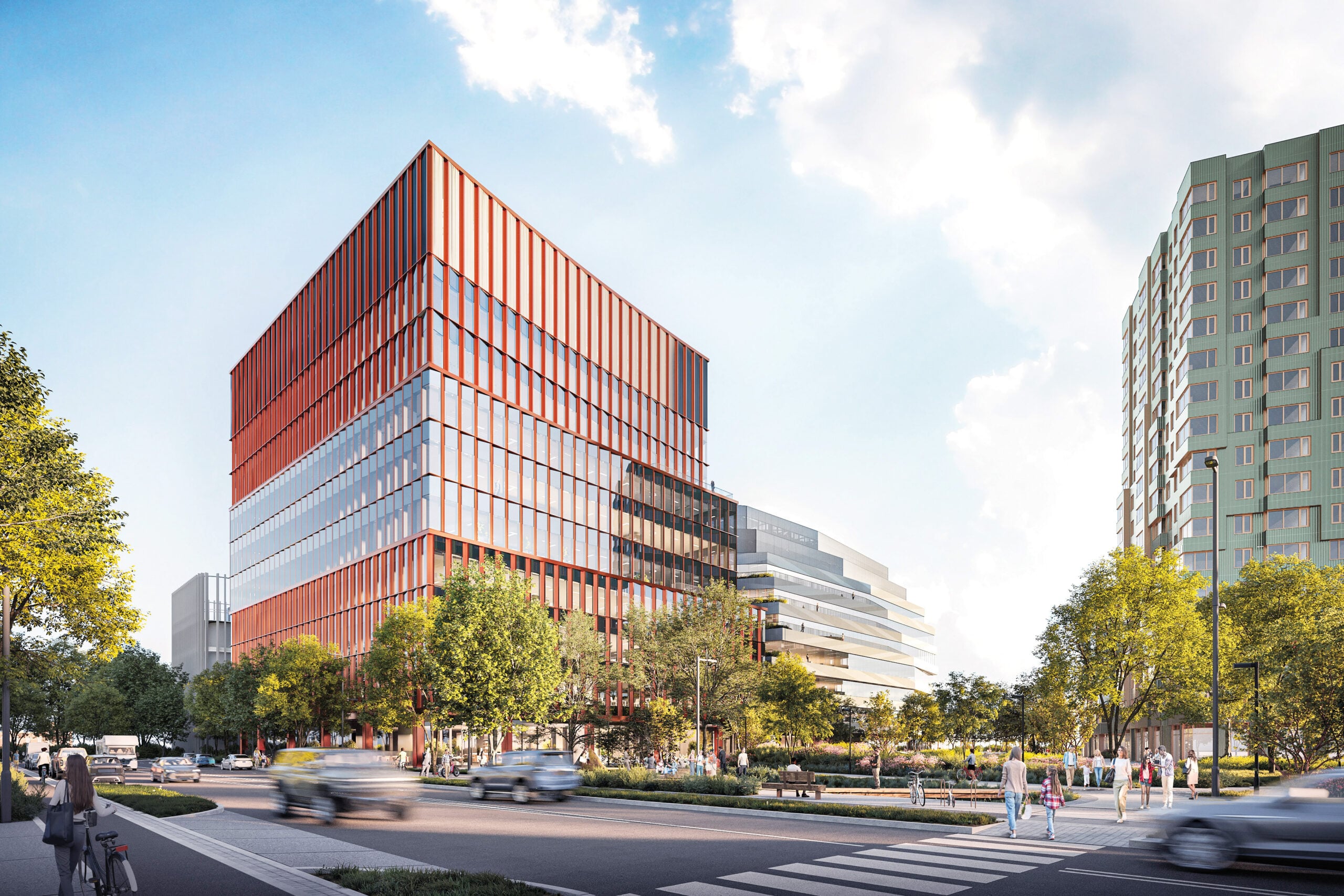
The Enterprise Research Campus (ERC) will fully open next spring to senses of both excitement and trepidation. As Harvard University’s first venture into commercial development and real estate, in partnership with Tishman Speyer, ERC sets a high bar amid a broader ten-year master plan for the community of Allston—across the river from Cambridge, Massachusetts, where Harvard was founded in 1636.
A Multidisciplinary Team Shapes a New District
These two powerhouses, Harvard and Tishman Speyer, have substantial field experience in the realm of urban development, albeit from opposite missions, which raises a question about their outcomes. What does a nearly 400-year-old institution overwhelmingly associated with its role as a foundry for knowledge have in common with a commercial titan attuned to social and financial patterns? Both are in the business of shaping environments and gathering people.
Tishman Speyer assembled a team of designers who could establish their shared terms of engagement and aesthetics from day one—Boston-based Utile was selected to support all planning endeavors; New York’s SCAPE is at the helm of site infrastructure and landscape design; New York and Copenhagen’s Henning Larsen is developing one of two lab buildings; the Dutch collaborative MVRDV is designing the 343-unit residential complex; Fayetteville-based Marlon Blackwell Architects the hotel; and Chicago’s Studio Gang for both a conference center, the Treehouse, and the remaining lab. Studio Gang and Henning Larsen led the master plan and overall coordination of the project.
If the ERC seems like a peculiar assemblage for a university’s campus planning arm to undertake, it is, by design. In part, because it’s intended to be something of an experiment in social and spatial inclusion, breaking with traditionally tense models of “town and gown” frameworks. With proximity to Harvard’s business school and the engineering and incubator facilities, the area’s demographics will be academically varied, but with the addition of a hotel, residences, and businesses, not only does the user base broaden, but so does the schedule and nature of activity in a dense footprint.
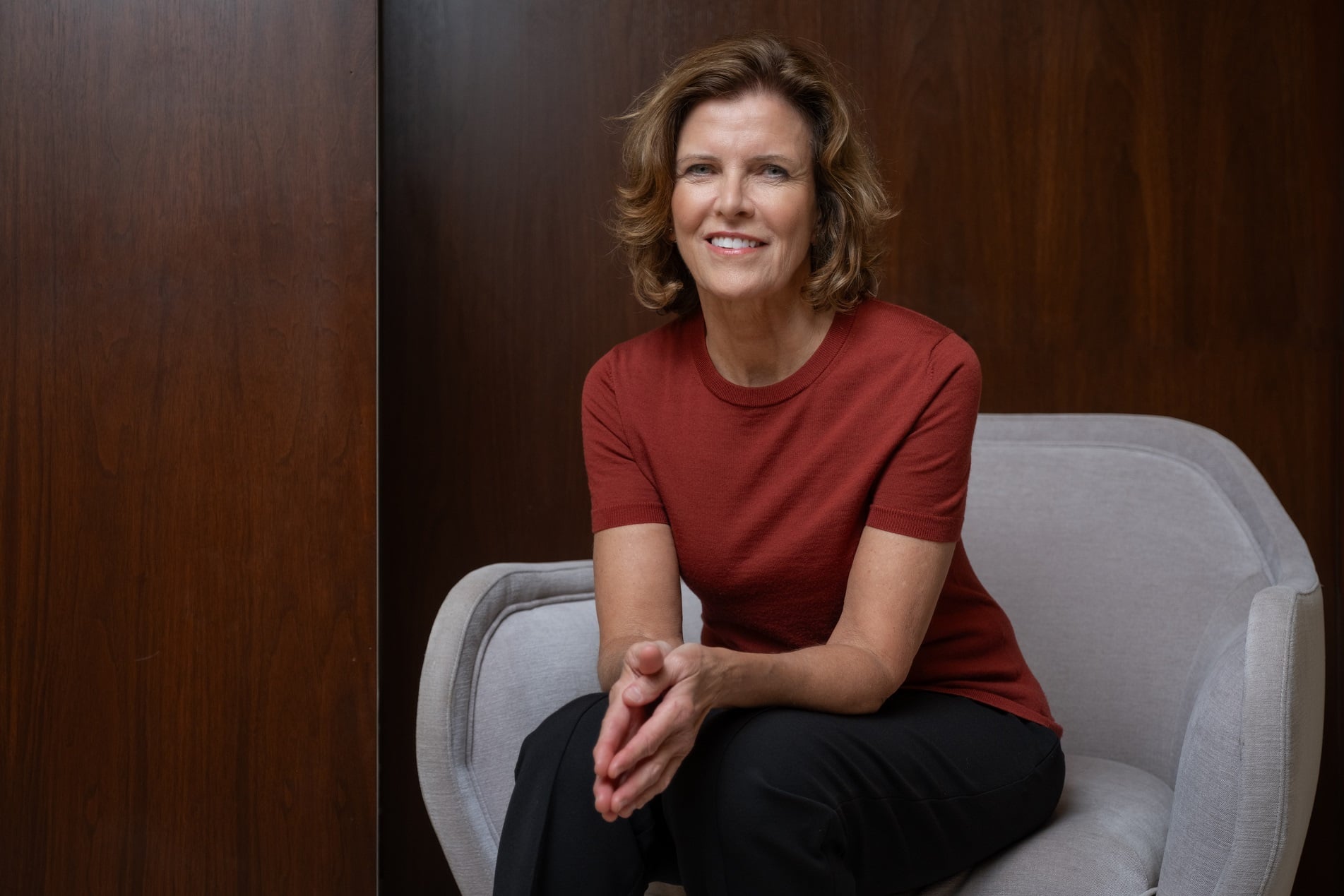
Jeanne Gang on Harvard’s New Rubenstein Treehouse
The architect unpacks the design for the university’s first mass timber building. Read the full conversation.
Building Inclusivity Into the Plan
The plan will also deliberately embed resources for the Allston neighborhood, with 25 percent of the residential units allocated as affordable housing. Local minority stakeholders have contributed a portion of the investment financing, and the ground floors of all buildings will be occupied by local women- and minority-owned businesses.
All elements of the campus embody Harvard’s latest Sustainable Building Standards and support the university’s environmental commitment to be fossil fuel neutral by 2026. Other details are tailored and specific to the buildings’ functions, such as all-electric commercial kitchens, healthy material selections, or structural system specifications.
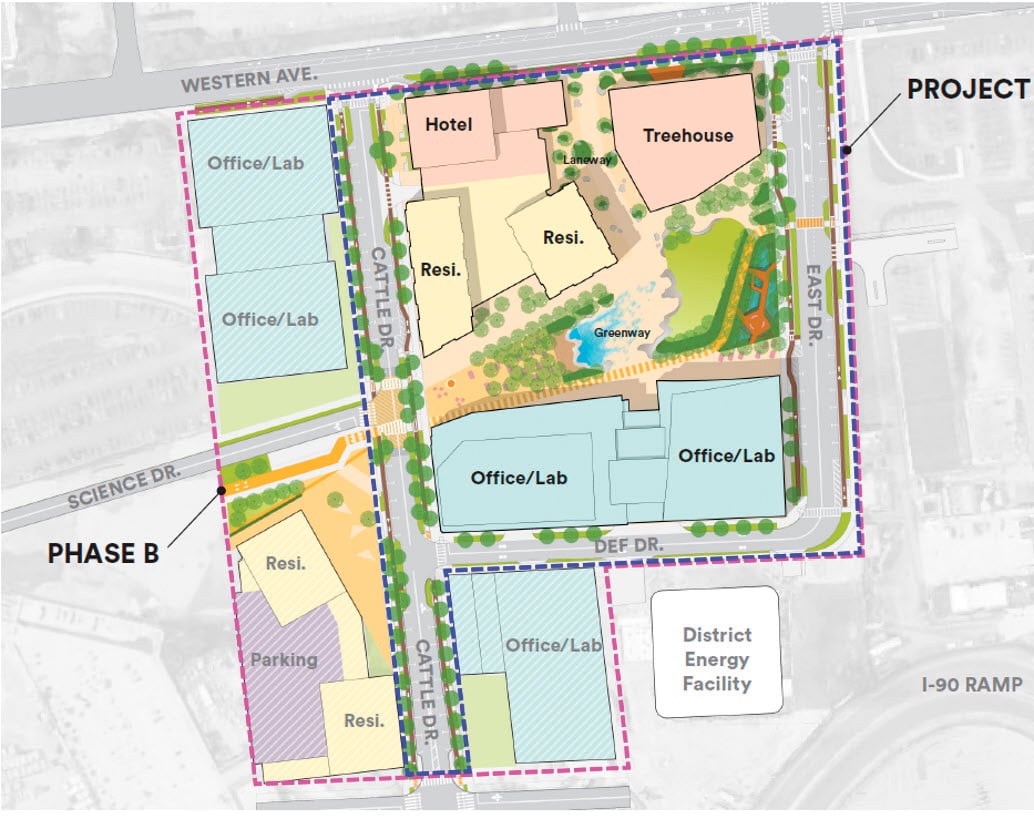
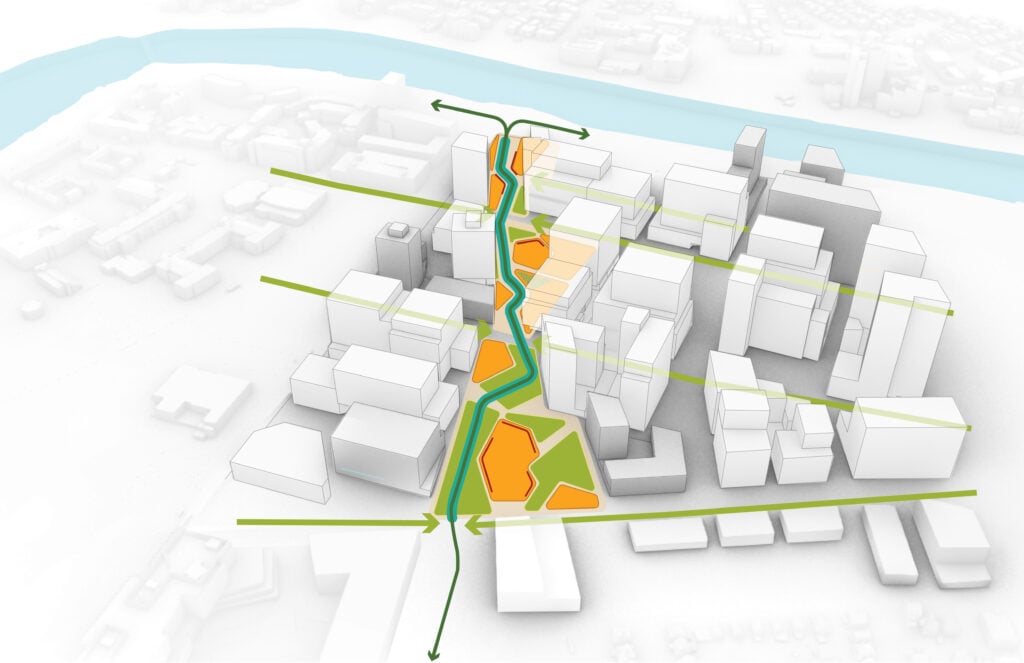
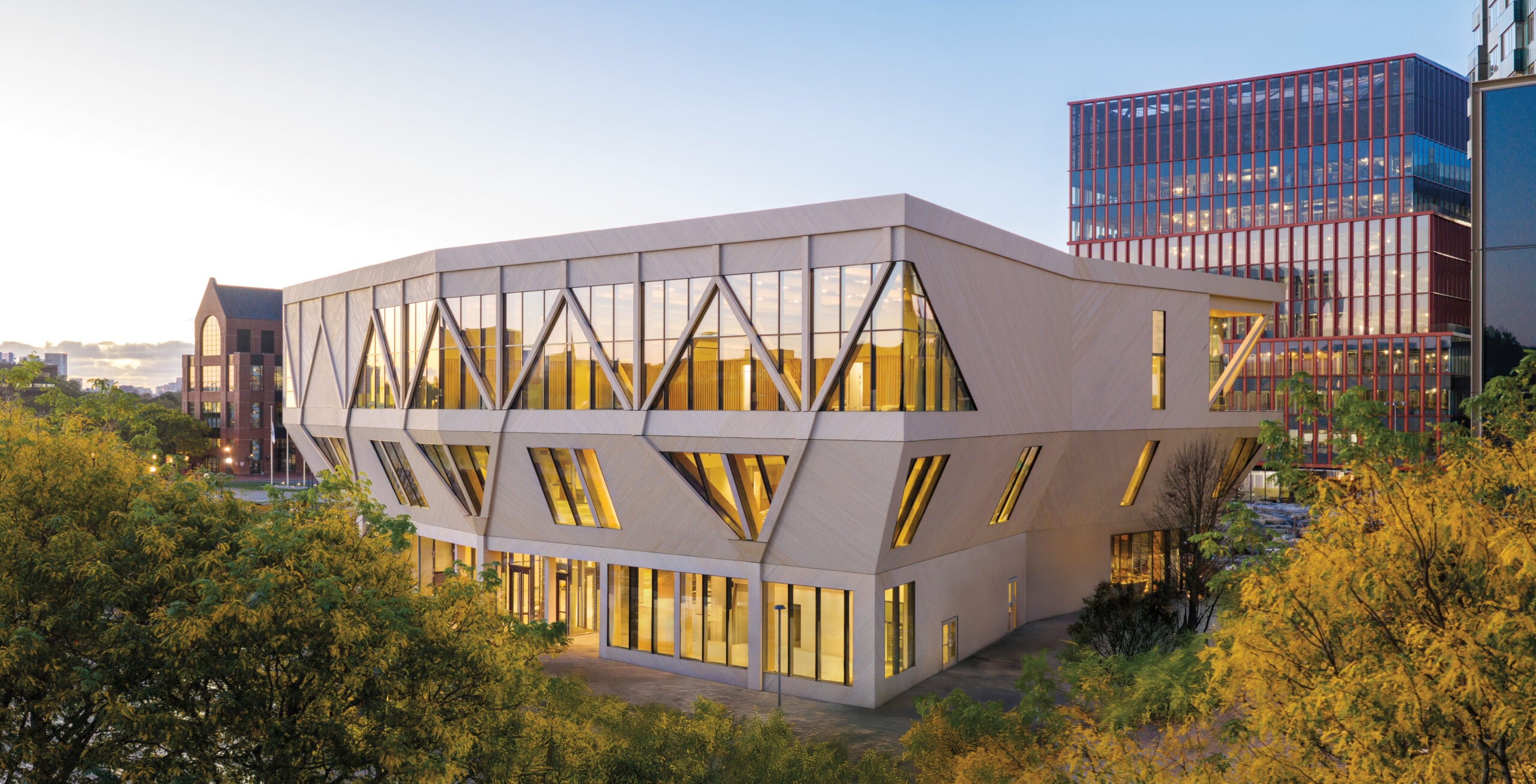
When I walked to the site on a late September afternoon, I was specifically there to visit the David Rubenstein Treehouse, which has now been substantially completed.
“The David Rubenstein Treehouse demonstrates Harvard’s commitment to advance holistic, sustainable development,” says Heather Henriksen, Harvard’s chief sustainability officer. “By leveraging multidisciplinary research to pilot leading sustainable design practices, the university is providing scalable building solutions that address climate, health, and well-being.”
A Mass-Timber Landmark Takes Shape
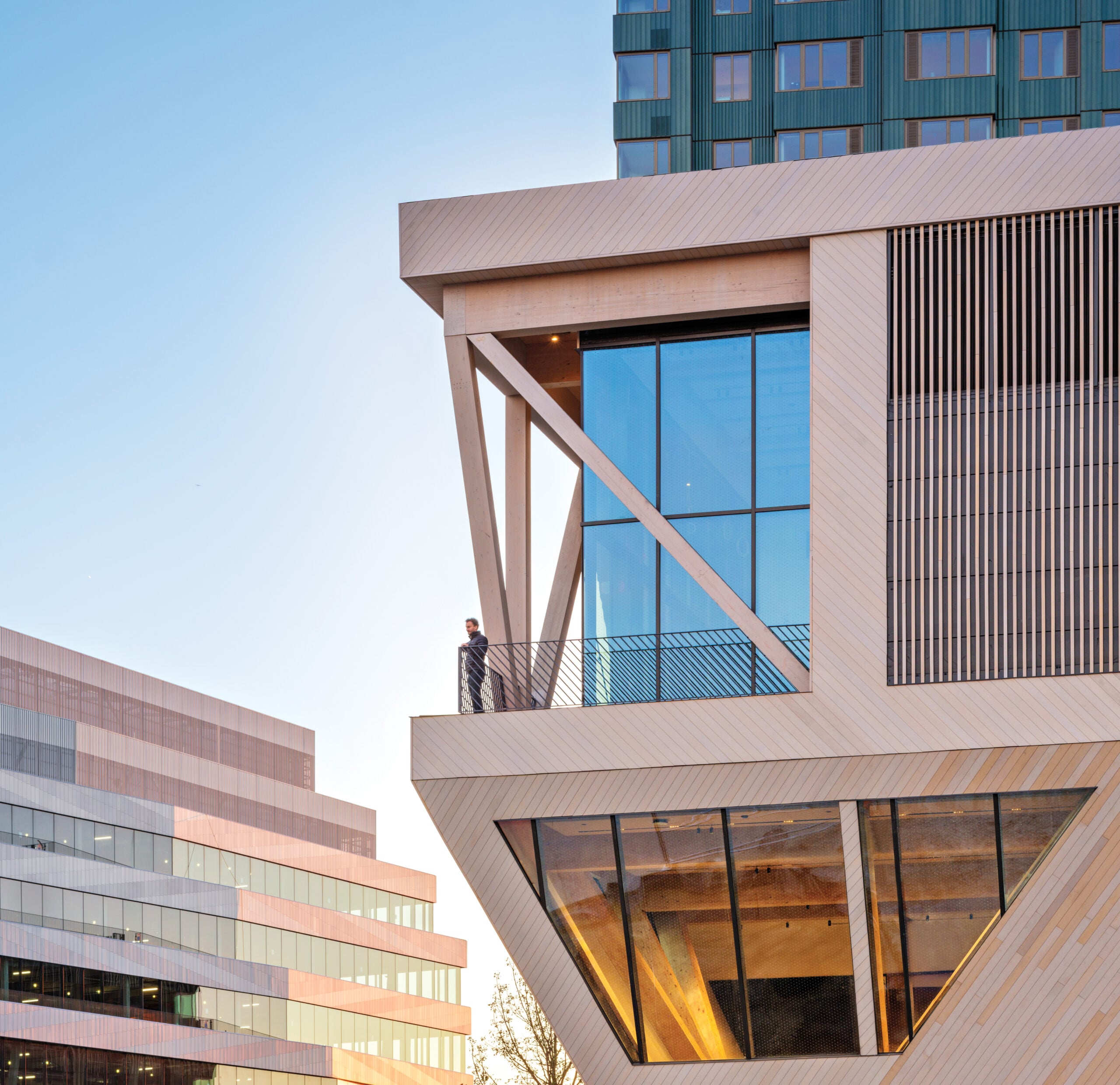
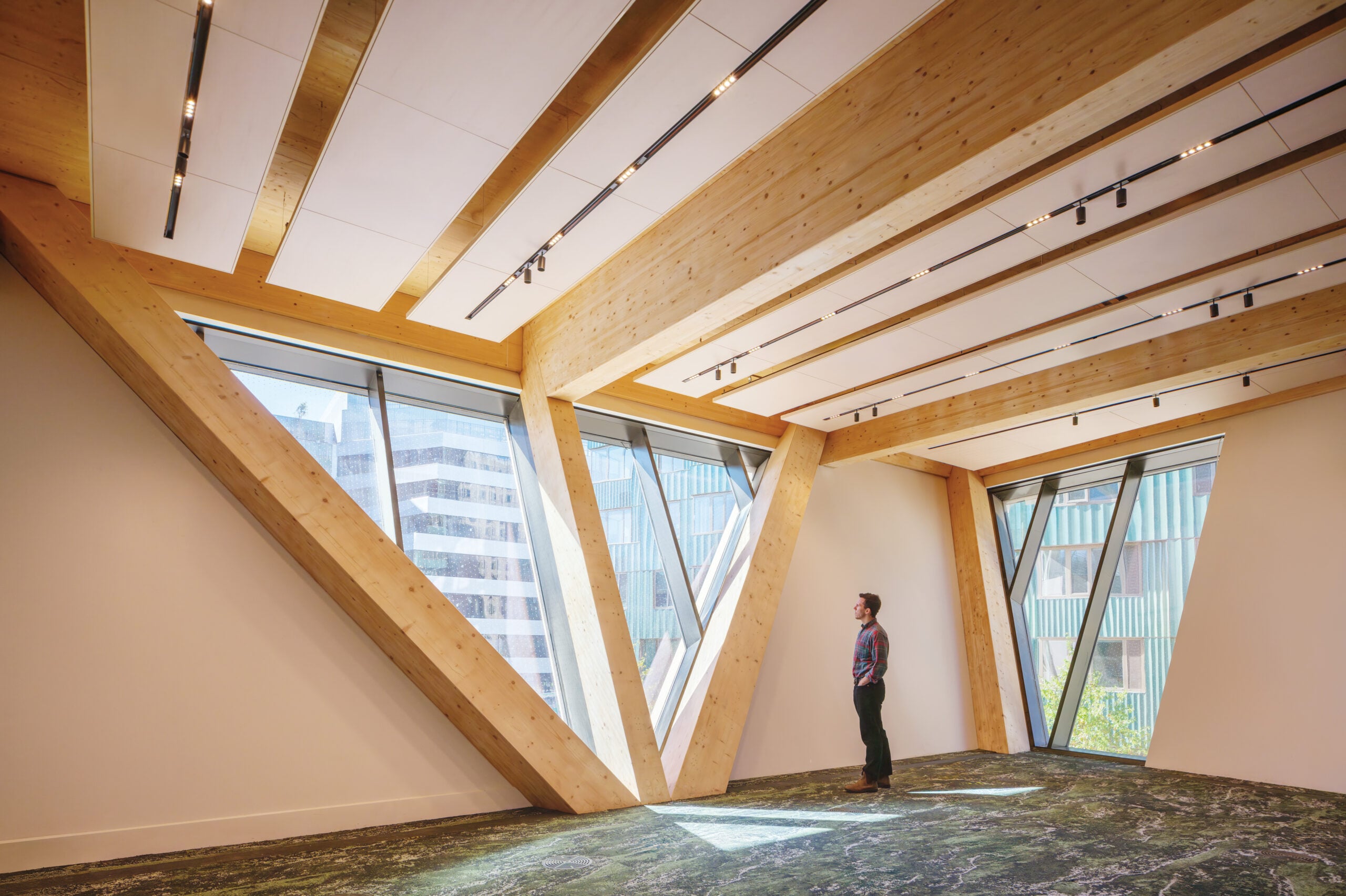
The outer shell of the building is wood-clad—a fine pseudo-herringbone of Alaskan yellow cedar and a spruce-fir mix forms the rain screen and the composite thermal jacket, which expresses the structure beyond, much like veining in variegated leaves. The effect is such that your eyes can follow the stand of primary columns that are mostly visible through its sheath of curtain wall, to a coppice point of flared inflections, up to the final terminal shoots of the crown. That structural hierarchy of its mass-timber skeleton is gifted to the viewer as a visual cipher to the building’s predominant architectural language, even if the true breadth of nuance is not yet fully evident.
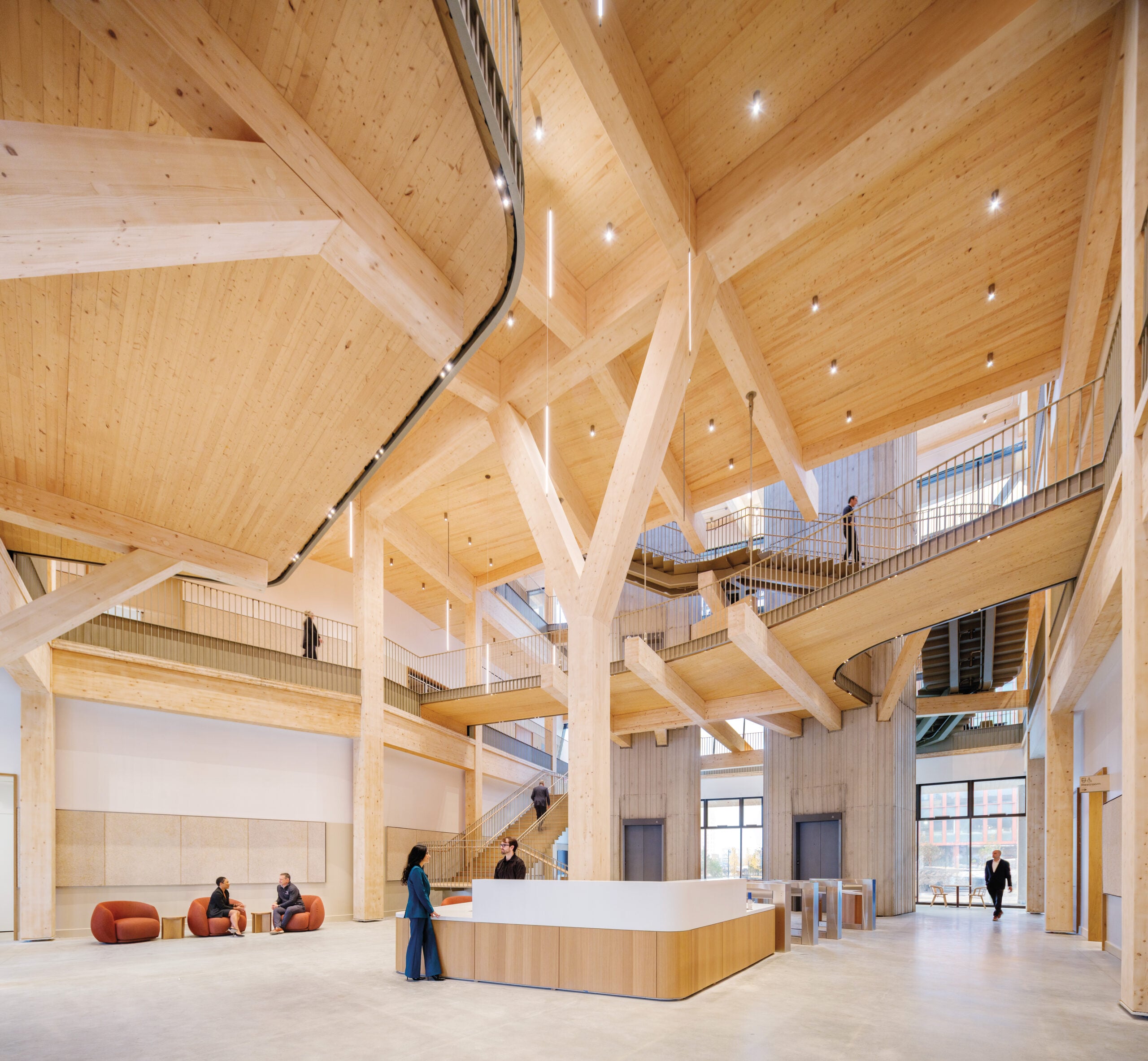
The pentagonal plan, combined with its short stature and northwestern positioning, simultaneously maximizes solar exposure while aiming to buffer wind and traffic noise for the plaza beyond. It also maintains a long view corridor to the Charles River beyond for occupants in the neighboring buildings.
Any preliminary sense of grasping the building’s nature from its crisply folded exterior massing almost instantly dissolves when you enter it.
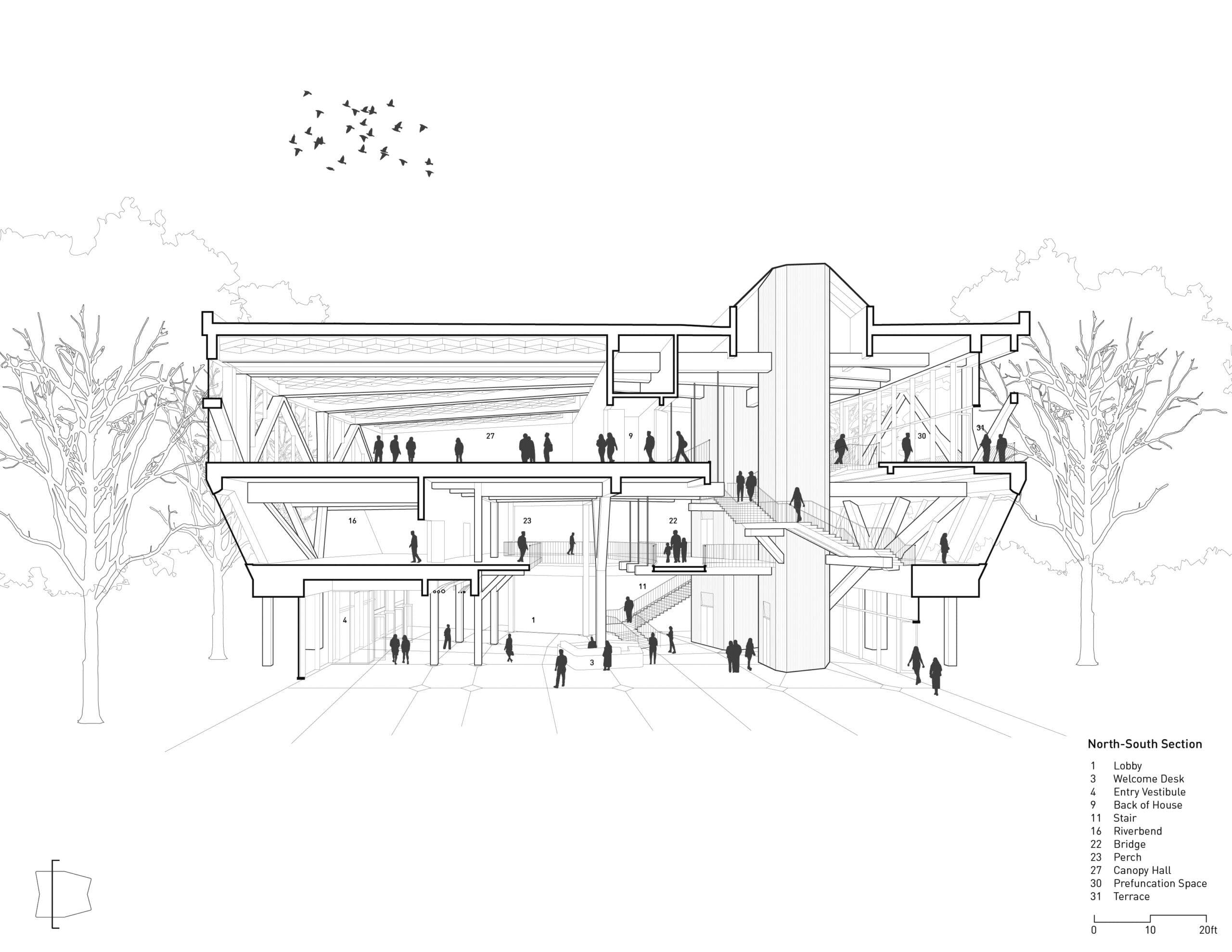
At the head of the Treehouse is a single atrium, orbiting twinned concrete shafts—the grain and module of their wooden formwork is not only on display but appears to be buffed into high relief. These contain two elevator hoist ways and are neatly pocketed to anchor the network of heavy timber beams and CLT, which either span to rest on the surrounding grid of glulam columns or suspend from hanger rods attached to levels above.
The building as a whole is astonishingly quiet—attributable to the isolative properties of heavy timber; the thick, multilayered glazing, pleasingly speckled with a faint fritted diagrid pattern to uphold Studio Gang’s trademark commitment to bird safety in the built environment, but also to something I almost didn’t notice: its enhanced MEP systems, which meet Harvard Healthier Building Academy requirements, and provide about 75 percent more outside air than required with an energy-efficient displacement ventilation system.
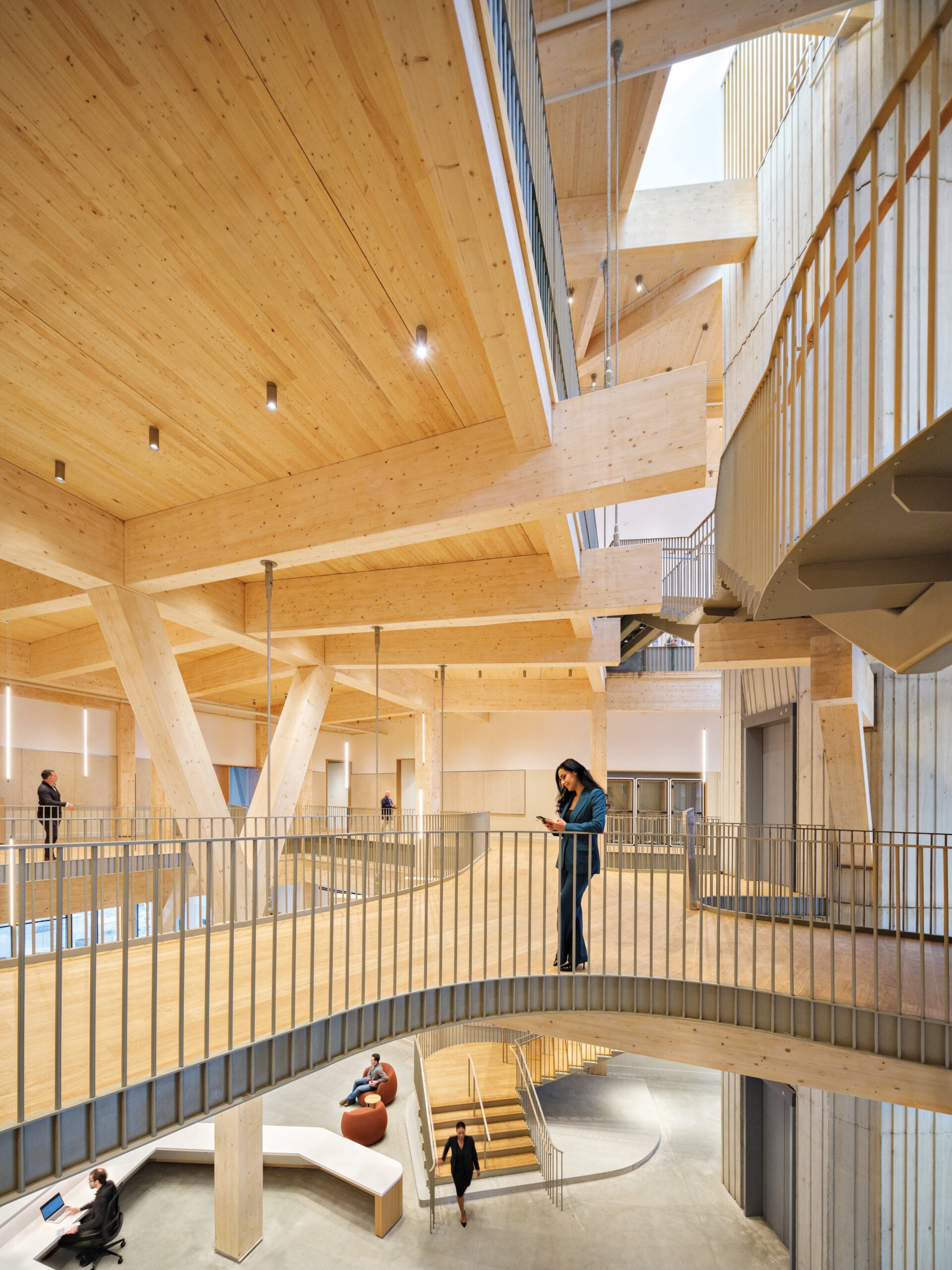
Each floor above is organized with a balance of flexible common areas and breakout rooms of varying sizes. All materials have been vetted as free of chemical classes of concern, in support of a campus-wide effort to transition to healthier finish products. Ceilings are either fully exposed or outfitted with a microperforated wood veneer panel with acoustic absorption above. The quiet visual simplicity of this palette allows the small but tricky details and tectonic expressions to shine.
While it is often difficult to accurately predict exactly how new multifunctional spaces will be activated and occupied after they are opened to the public, it is not difficult to imagine that the new Treehouse and the ERC as a whole will be an energetic and highly sought location. “It is the institution’s hope that the Enterprise Research Campus will be a space for innovation to grow and expand through connection,” says Amy Kamosa, Harvard’s associate director of communications and outreach. “The ERC will be a place where ideas and people come together and where cutting-edge research meets real-world solutions. We are thrilled to see this vision become a reality and look forward to opening its doors to the community and visitors alike.”
Would you like to comment on this article? Send your thoughts to: [email protected]
Latest
Viewpoints
Detroit Month of Design: A City’s Work in Progress
Now in its 16th year, the celebration offers insights into the Motor City’s ongoing accomplishments without glossing over its hurdles.
Projects
How a Hybrid Building Helped an Historic Manhattan Congregation Remain in Place
On Billionaire’s Row, FX Collaborative designed a new home for Calvary Baptist Church combined with an office tower.