



January 29, 2026
Water, Wellness, and the World We Build
In the latest episode of Deep Green, created in partnership with Kohler, host Avi Rajagopal sits down with Laura Kohler, the company’s chief sustainable living officer. Over her career, Kohler has championed initiatives that support employees, advance circularity, and expand access to safe water—from launching one of Kohler’s first flexible workplace programs to overseeing Innovation for Good, the I-Prize, Safe Water for All, and the Kohler WasteLAB. She also released the company’s first ESG report and has guided the company’s Arts/Industry residency program, which has hosted more than 500 artists from over 25 countries.
In their conversation, Rajagopal and Kohler discuss how a global brand translates vision into action—from integrating sustainability into every stage of design and manufacturing to advancing water stewardship and empowering professionals across the built environment to lead meaningful change. Read an excerpt of their conversation below or listen to the full episode on the Surround Podcast Network.
Avi Rajagopal (AR): How do you keep your mission of sustainability front and center within the core operations at Kohler?
Laura Kohler (LK): What we’ve done is take a classic sustainability role—chief sustainability officer—and upgraded it to sustainable living. And that little word ‘living’ is really important because it provides an end-to-end focus on sustainability, from innovation to manufacturing, footprint to marketing.
We start by thinking about a new product we want to innovate and what attributes we want it to have. Do we want it to reduce water? Do we want it to have recycled content? Do we want it to use less energy? How do we design for that? How do we then manufacture that with the lowest footprint possible? How do we assign attributes and pull it into our data system so that the marketing and sales teams can then use it to drive the business forward? So, you know, it’s more than just footprint management. It’s actually part of the growth strategy for the business.
AR: Shaving off a little here and there is vitally important—especially when you’re talking about business at scale. However, I love the more fundamental approach you’ve taken.
I got to read your 2024 Global Impact Report, and I loved a couple of different stats in there because I think it shows me how you think about your impact as a company. For one, around 18 percent of all of the products that you sell have some of those sustainability features that you’re talking about, which means you’re actually selling the stuff that’s making people’s lives better. But you also translate those numbers into the amount of water you’ve saved for building owners, and that is just mind-boggling. Ultimately your goal is that the products do what they’re designed to do—they save water and they help communities.
You’ve been working with this idea of the 50L Home. Tell me about that through-line from your product development to real-world impact.
LK: As a 153-year-old company, we’ve lasted the test of time because we actually continue to focus on innovation and sustainability. What’s happening in our environment around the world is a great catalyst for innovation. Everybody wants access to a lot of energy, and there’s just not enough energy. Adversity forces people to problem-solve and innovate. So that’s exactly what we’ve chosen to do as a brand: to continue our drive to innovation to help people live more graciously and in a healthy way.
It goes along with the idea that our brand has been really tested over the decades, and this is the newest test: how do we deliver luxurious bathing solutions while saving water? So it becomes a great challenge for our engineering teams and our design teams to do just that—to take your toilet and make sure that it performs well and has a beautiful design, but is also water conserving.
It will become more important for brands like Kohler to take the talents we have and really use them in the development and the manufacturing process to deliver the new solutions that people are going to need as their lives and their communities change.
About five years ago, Procter & Gamble approached Kohler to be a partner in the very first conversations on how to make a 50L home, when most homes use about 400L of water a day. We thought that challenge was something that we wanted to be a part of. We wanted to be an innovator to help people live at the lowest possible water use, yet not sacrifice performance.
Alongside some of the best brands in the industry, we have been working on this for five years now. We’ve got a recirculating shower from our advanced development teams that’s in place, and some low-flow toilets, showerheads and bath faucets. I believe they’ve actually gotten down to 80L. We have another 30 to go, but when you put yourself in a pressure cooker of innovation, you’re able to work with others to really create a new paradigm. And that’s exactly what 50L Home did for Kohler and for some of the other manufacturers that were part of it.
AR: I love that focus on how people’s lives will change, especially in relation to the large challenges we’re facing in the world. As you said, we want to lead comfortable and gracious—as you call it—lives, but we are doing it in an era of increasing resource scarcity. Water is so valuable in that sense, and it’s also right at the heart of Kohler’s business. Other than saving water for your consumers, you’ve been working on some of those larger issues as well. Can you talk about your initiatives around safe water or preserving watersheds?
LK: Water is the golden thread that connects every life on this planet. I don’t care if you’re a billion-dollar tech executive or you are working in the fields in a country far away from the United States. Every person needs water to survive. It is a human connection point.
We are very focused on being part of that solution. And when you think about that, what can a company like Kohler do? In the locations where we have facilities and large populations, we can help those local communities have access to water. We go out to the communities, meet with community members, and figure out the solution that best fits their needs—providing sustainable access to water for the next decade or two that helps lift up their lives. Those are things we care about, Avi. We believe access to water is a human right.
Number two, safe toileting and safe sanitation is something that everyone deserves. And three, I would say we need to replace water that we are pulling out of a watershed for a manufacturing facility. As a manufacturer, we’re learning to recycle and reuse water and if we do send water back to a watershed, we try to send back the amount we took—and cleaner than it was pulled.
AR: You mentioned, putting back what you take. As with water, so with all materials. One of the other initiatives at Kohler is finding solutions to deal with waste. Can you talk about WasteLAB?
LK: WasteLAB came out of an incubator called Innovation for Good, a loosely organized group of people that got together around 15 years ago to innovate solutions for underserved parts of the world. They wanted to use their talents outside of the commercial product development cycles of Kohler Company.
Walking around the factories right here in Kohler, Wisconsin, these artists, designers and engineers saw piles of dust, chunks of ceramics and clay, and metal shavings coming from our foundry system and our pottery process. Through their eyes, they saw piles of materials and they thought that something had to be done—like, we can do something with this material. We can make it into a beautiful product once again. So that is exactly what happened over the last 10 years.
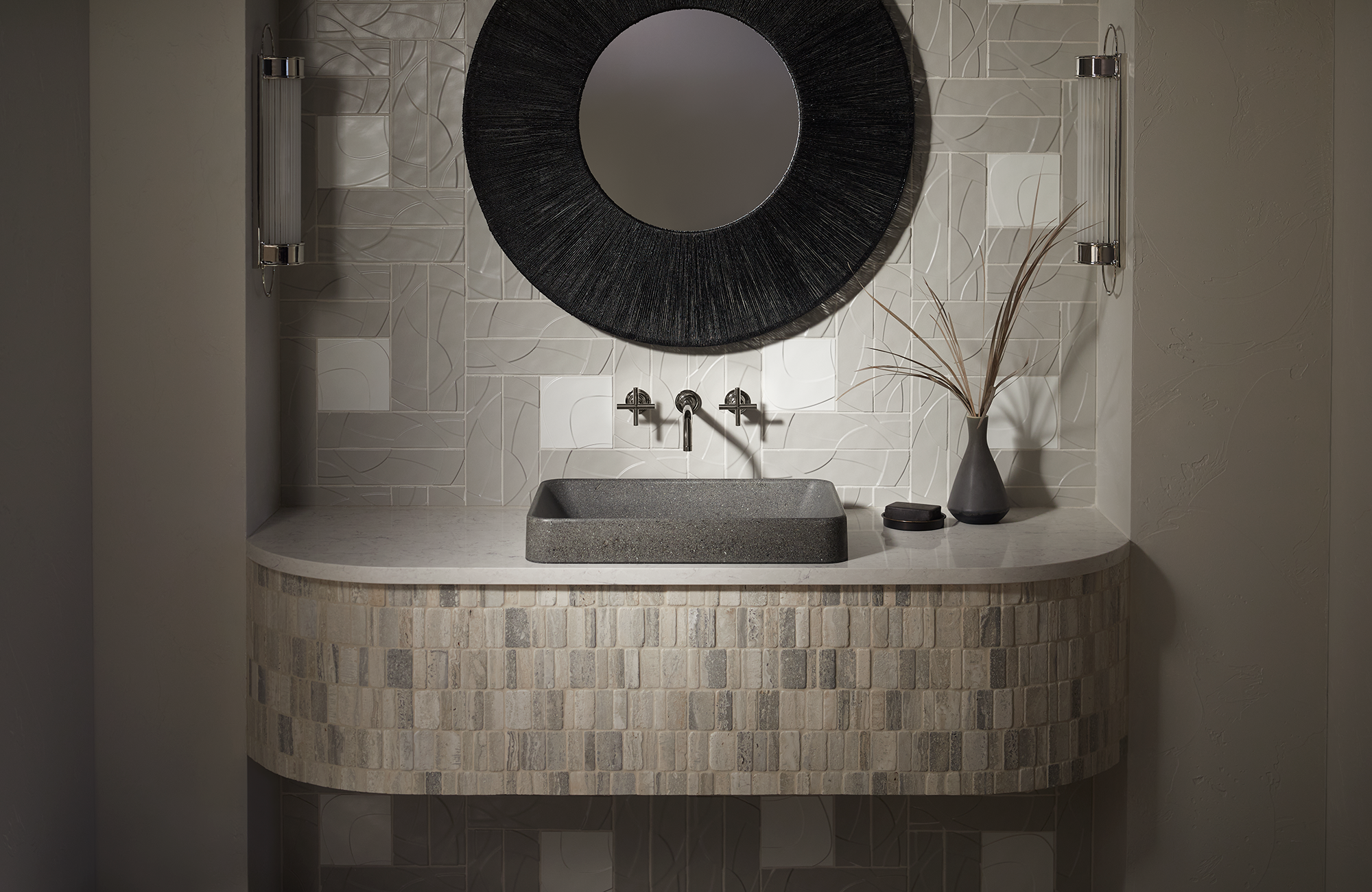
WasteLAB has become a production facility, an incubator and a commercially viable small business that produces beautiful tile planters and bathroom sinks that are over 80 percent recycled content. That’s recycled content coming out of our own manufacturing facilities. And our proof there, Avi, that you can do beautiful things with materials that you find that have either come out of your processes or are in your areas.
AR: Now, this is what I love about your impact report. Yes, there’s a through-line that runs through all your initiatives, but the initiatives themselves are so diverse and so different from each other. As a business leader, how do you identify these opportunities? How do you decide that an initiative is worth pursuing?
LK: That’s a really great question. I go back to this idea of connecting purpose with people. And no matter what job they’re doing in your company, they’re more than the job they’re doing. How you, as a company, use that person to deliver value is really up to you—how you connect them with purpose, give them freedom of ideas, and show them what’s possible. That’s all part of culture. So the unique programs you’re talking about came about because people at Kohler felt like they could connect with their purpose through different areas of our work.
AR: That is so wonderful. Returning to the idea of water, I come from the world of sustainability and the building industry. I talk to architects and designers and look at sustainable projects all the time. And while I see a lot of attention around carbon emissions and waste materials, I feel like water still doesn’t get as much attention in the built environment. Do you feel that too? Do you feel like the building industry needs to be paying more attention to water use and to bring its creativity to water systems?
LK: Totally. Avi, I think we’re 10–20 years behind the work of the energy industry or the work of governments in understanding how to incentivize and problem-solve energy usage.
The good news is that renewable energy is being supported, funded, and incentivized, and we’re already seeing the benefits of that—particularly in the data center world, where we’re going to need as much energy as possible. Water is coming up on some of those more mature practices, but incentivizing more efficient water design in our buildings and our communities is critical because we’re losing a lot of water through old infrastructures.
Governments are realizing that clean water is finite, and we need to start fixing things with the same kind of eye that we did toward energy, but with a focus on water. It’s coming. It’s just slower.
And that’s why knowledgeable companies who have a voice in this space need to speak up and partner with architects and designers saying, ‘No, there is a better way.’ A better way to design a building, a better way to design a community, to really work with governments on updating infrastructure so you can put in water-conserving products and interface with systems that can handle them.
AR: At METROPOLIS, we’ve been tracking some thinkers and doers in the design space who are directly engaging with water. And one of the things that strikes me is that, unlike energy, which is produced at scale, water is a direct natural resource. And there are questions of quality, but there are also questions of community around water. So it’s actually a really rich area for innovation. Do you have a message for architects and interior designers in particular?
LK: Some of us wait for the consumer to pull a new trend or topic. I don’t think it’s going to happen with water because the price of water is still low. The challenge—and the expense—can be is in the delivery of water. That’s where I think architects and designers can lead: to consider new delivery systems that create more efficiency and allow homeowners to monitor their usage without feeling like the performance is being impacted.
The design process will really help lead the consumer to a better way, rather than waiting for the consumer to be aware that they need it. Unfortunately, we’re going to have to be on the frontier of it. Whether we are designing a community or a commercial building, an airport or a residential project, I think it’s going to have to come from the planners, because it’s not going to come from the consumer immediately.
Listen to “Water, Wellness, and the World We Build” on the Surround Podcast Network.
Would you like to comment on this article? Send your thoughts to: [email protected]
Latest
Projects
UC Berkeley’s Newest Building Is All About Human Interactions
The long-awaited project highlights uncomfortable truths about Los Angeles’s cultural sector and civic health.
Projects
ZD+A Brings a Modernist Mexico City House in Line with its Context
Architect Yuri Zagoin Alazraki reorganized the speculative house to respond to its site and create unique spaces for contemplation.