




March 27, 2026
We Need a New Approach to Designing for Autism
IF YOU WALK INTO a newly renovated corporate office or a progressive school today, you will likely see it: the “sensory room.” It is often painted a soft sage green, equipped with dimmable lighting, and perhaps features a plush chair tucked into a quiet corner. It is a well-intentioned symbol of the design industry’s commitment to neurodiversity.
It is also increasingly an outdated idea.
Architects and designers have operated with a generalized approach that assumes “design for neurodiversity” means a generalized sensory scale between “hypersensitive” (needs less) and “hyposensitive” (needs more), where broad interventions like acoustic pods or wayfinding color codes are applied. While these strategies are helpful, they only scratch the surface of the complexity that is required. This approach treats autism spectrum disorder (ASD) as a binary condition, ignoring the reality that a space designed to soothe one autistic person might actively disorient another.
The future of neuroinclusive design is no longer about vague notions of warm or cool colors. It is about the different developmental patterns or traits that shape how a person experiences and responds to their environment. It is about rigor. It is about a new framework that demands we design not just for autism, but for the specific biological and developmental reality of the human in the room.
The Urgency Is Real
The numbers alone demand a new approach. Recent data from the Centers for Disease Control and Prevention (CDC) in April 2025 highlight the urgent need for change as diagnoses of ASD in the United States continues to rise. In the past two years, the number of eight-year-olds diagnosed with ASD has gone from roughly 1 in 36 to 1 in 31. The increase is attributed to improved screening, broader diagnostic criteria, and increased awareness. However, the prevalence of ASD is likely higher than reported, due to the limited scope of this study. Regardless, the trend solidifies the idea that designing for autism is no longer a niche specialization but has become an essential component of inclusive design.
Yet research consistently shows that built environments remain poorly calibrated to autistic needs. A 2021 scoping review by Tola et al. identified three critical factors: sensory quality, intelligibility, and predictability as foundational to autism-friendly design but noted that existing guidelines remain fragmented and context dependent. A 2022 case study on light and color found that autistic children’s behavior and mood were significantly affected by environmental conditions, with “dull and pastel colors and muted lights” proving more suitable for visually sensitive individuals (Haq et al., 2022). The problem is that these findings treat the spectrum as uniform, when biology tells us otherwise.
The Scientific Catalyst: Unlocking the Trait Groups
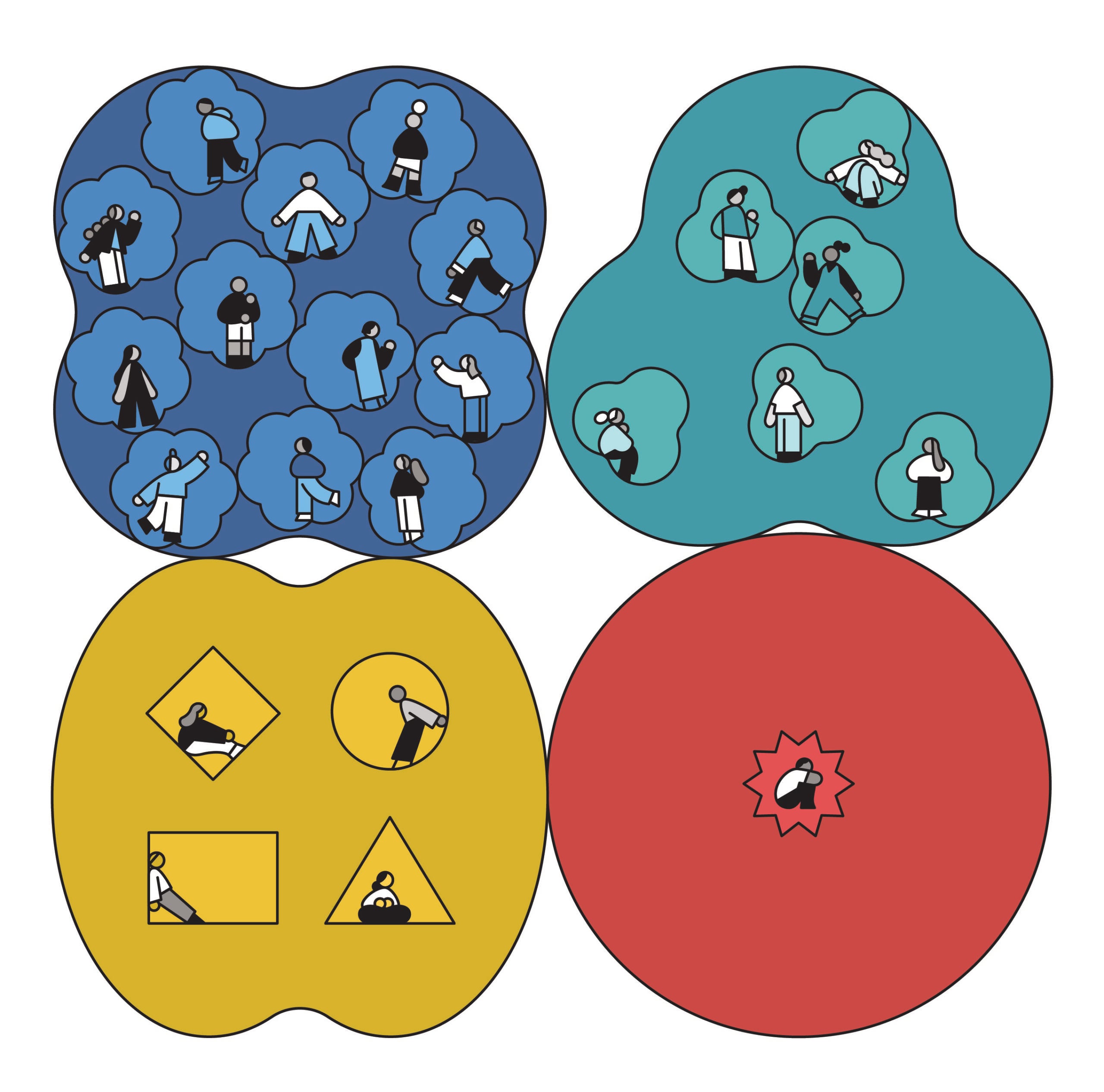
For decades, we relied on labels like “high-functioning” or “low-functioning,” which were not only imprecise but biologically inaccurate. The breakthrough came from a recent study by Litman et al. (2025), published in Nature Genetics, that challenges how we categorize the spectrum.
The research team analyzed data from the SPARK cohort, the largest genetic study of autism ever conducted. They examined over 5,000 children ages 4 to 18 years and 239 exhibited characteristics—ranging from developmental milestones to anxiety levels and medical history—to find natural groupings within the autistic population. Instead of looking at one symptom at a time, they looked for natural “clusters” of traits, or phenotypes, that appeared together. From the findings, four distinct groups were identified (see below). Next, the researchers organized the 239 identified characteristics into seven categories (development delay, anxiety and/or mood symptoms, attention deficit, disruptive behavior, self-injury, restricted and/or repetitive behavior, and limited social communication) to address the nuance and severity of each phenotype. A major revelation: The type of autism a person has is strongly linked to when genetic disruptions occurred during brain development.
The four clusters of traits, referenced here as “trait groups,” are:
Moderate Challenges: This group often requires the least amount of support needs compared with other autistic individuals. Individuals in this group typically meet the developmental milestones as those without autism, but also meet the diagnostic criteria for ASD.
Social/Behavioral Challenges: These individuals exhibit core autism traits such as social challenges, emotional regulation, and repetitive behaviors, while generally reaching developmental milestones. They are often diagnosed with co-occurring conditions such as anxiety, depression, and Obsessive-Compulsive Disorder (OCD).
Mixed ASD with Developmental Delay: This group has the highest variability among the ASD characteristics. This group typically presents developmental delays, such as walking and talking, and experience milder cases of anxiety compared with the Social/Behavioral subtype.
Broadly Affected: The most vulnerable subtype, this group often faces profound developmental delays, varied communication styles, challenges with emotional regulation, repetitive behaviors, and co-occurring psychiatric conditions.
This discovery explains why one-size-fits-all approaches fail. A “calm room” designed for the anxiety-prone Broadly Affected trait group may also be helpful for the Mixed ASD group, who prefer less social connection. However, addressing their needs from a whole-person perspective may ultimately require two different spaces. Different trait groups at different developmental ages may require fundamentally different solutions.
Standing on the Shoulders of Pioneers
We can make this leap today because of foundational work by leaders who translated neurological difference into architectural language. Dr. Magda Mostafa introduced the Autism ASPECTSS™ Design Index, the first evidence-based framework linking architectural features to behavioral outcomes (Mostafa, 2014; Mostafa, 2024). AJ Paron championed design empathy and neurofunctional design, emphasizing how sensory and environmental stimuli can affect brain functioning to shape perception (Paron, 2013; Paron, 2020). Kay Sargent advanced the conversation in workplaces, moving from “accessibility” to “cognitive well-being” (Sargent, 2019; Sargent, 2025). Dr. Eve Edelstein bridged neuroscience and design, using EEG data to show how architectural ambiguity triggers measurable neural responses (Edelstein et al., 2008; Edelstein, 2022). In fact, Edelstein stresses the need to translate clinical research into design strategies (2020).
The New Approach: The ASD Design Matrix
To move from theory to practice, we introduce the ASD Design Matrix, a multilayered framework that moves beyond static checklists to informed suggestions. Recent literature supports this multidimensional approach: A 2025 taxonomy study on sensory-informed design identified 83 distinct design qualities for autism, organized across sensory control and spatial typologies, demonstrating the need for systematic, layered frameworks (Al-Mahadin et al., 2025). This tool requires designers to triangulate the users’ biological reality with environmental context across five intersecting dimensions. *Because this study focused on a specific age group, the matrix should not be applied to autistic adults exclusively with this instrument.
01. The Person (The Trait Groups) you’re designing for. Are you serving the high-anxiety Social/Behavioral trait groups which need acoustic retreat and clear social boundaries? Or the Broadly Affected trait group which prioritizes safety and absolute visual clarity? The trait group anchors all downstream decisions.
02. The Lifespan (The Developmental Age) A diagnosis is lifelong but needs to transform across stages. A 7-year-old requires an environment supporting the acquisition of self-regulation skills; a teenager needs spaces encouraging social navigation; an adult needs environments enabling independence and participation. The matrix forces this question: Is this design developmentally appropriate for the age group we’re serving (Paron, 2013)?

03. Space Types An escape space in a high-turnover health-care waiting room must function entirely differently from one in a residential facility or classroom. The matrix distinguishes between Education, Healthcare, Workplace, and Residential sectors, with distinct operational demands, safety requirements, and user expectations (Tola et al., 2021).
04. The Stakeholders (The Care Network) Design doesn’t exist in isolation. This layer integrates the needs of caregivers, educators, staff, and family members. A space that supports an individual brilliantly but burns out the people caring for them is, fundamentally, a failed design. The entire ecosystem must be considered for design to be truly effective (Sargent, 2019).
05. Intersecting Factors (The Reality) Finally, it is essential to acknowledge the intersections of socioeconomic status, race, ethnicity, language, and comorbidities with ASD. Access to resources can fundamentally change how a space is used and perceived: A family with substantial resources may engage with a residential space differently than a family living in public housing. Furthermore, we must confront bias. Do we afford individuals who speak a different language or present with different visual identities the same degree of consideration as those with whom we may be less comfortable? The design must be robust enough to serve all contexts equitably. Additionally, understanding the context is crucial—who assumes ownership of the space and whether they have the authority or ability to implement structural changes. Consequently, consideration must also be given to developers, organizations, and owners.
Why This Matters Now
The Litman et al. (2025) trait groups give us biological specificity we lacked before. The matrix translates that specificity into actionable design decisions. Together, they represent a fundamental shift from designing for autism to designing for the autistic person in the specific context they inhabit.
This article establishes the science and introduces the framework. Two others will be published in METROPOLIS this year. The second will unpack the matrix in detail and show how research-based personae, built from each trait group, move through it. The third will provide the sector-specific implementation guidance that designers need to build inclusive spaces that actually work.
The science has handed us a new lens. It is time we start using it.
Angelita Scott, Ph.D., is CEO and founder of CutlurWell, a consultancy focused on well-being and belonging through design research, strategy, and education. She was the lead author of the IWBI WELL Equity Rating, which includes the first evidence-based neurodiversity design features in a U.S. building standard or rating.
Would you like to comment on this article? Send your thoughts to: [email protected]
Latest

Viewpoints
Detroit Month of Design: A City’s Work in Progress
Now in its 16th year, the celebration offers insights into the Motor City’s ongoing accomplishments without glossing over its hurdles.
Projects
How a Hybrid Building Helped an Historic Manhattan Congregation Remain in Place
On Billionaire’s Row, FX Collaborative designed a new home for Calvary Baptist Church combined with an office tower.