



January 8, 2026
What’s Next in Biophilic Design?
The Shift to Intentionality and Neurodiversity

Catie Ryan
Associate Partner, Terrapin Bright Green
We are in the midst of a shift from surface-level to intentional biophilic design. Biophilic design has settled into sustainability parlance, and design firms that adopt biophilic design for one project—espousing the science and impact potential in earnest—are inclined to incorporate biophilic principles and patterns in future projects. Our reports, like The Economics of Biophilia and the 14 Patterns of Biophilic Design have become required reading for new staff on-boarding. These firms have been actively internalizing biophilia, training staff to think creatively and multilaterally, and bringing more depth to design solutions and tools like generative AI, giving them a competitive edge.
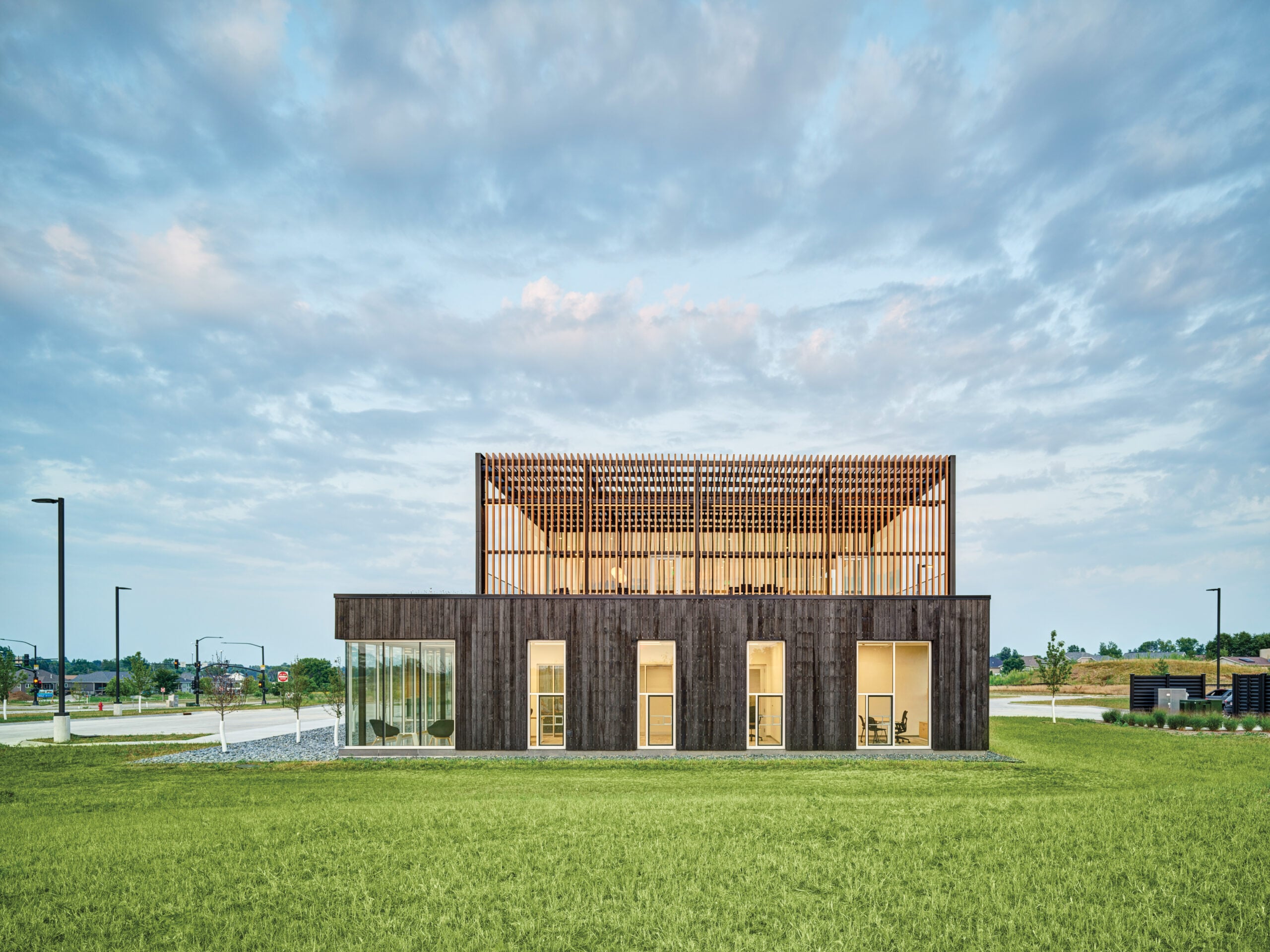
In application, there’s a shift toward design for neurodiversity and systems integration—deeply embedding biophilic design strategies into building systems to yield cobenefits and to protect the biophilic experience from being cost-engineered out of a project. Trauma-informed design and design for neurodiversity, particularly for children and senior populations, are embracing biophilia, with attention to how repeated exposure to nature is both the preventative and healing medicine of building design. Such integrative approaches enable a single—albeit often complex and thoughtfully executed—solution to achieve more.
Lastly, what’s new is the forthcoming second edition of our Nature Inside, A Biophilic Design Guide, to be released by RIBA Publishing in 2026.
The Science of Stress: Fractals and Neuroaesthetics

Anjan Chatterjee
Director, Penn Center for Neuroaesthetics, University of Pennsylvania
Biophilic design promises to restore depleted attention, reduce stress, and improve creativity. Instruction manuals, consultants, and claims abound. The annoying question a scientist like me might ask: Does it work?
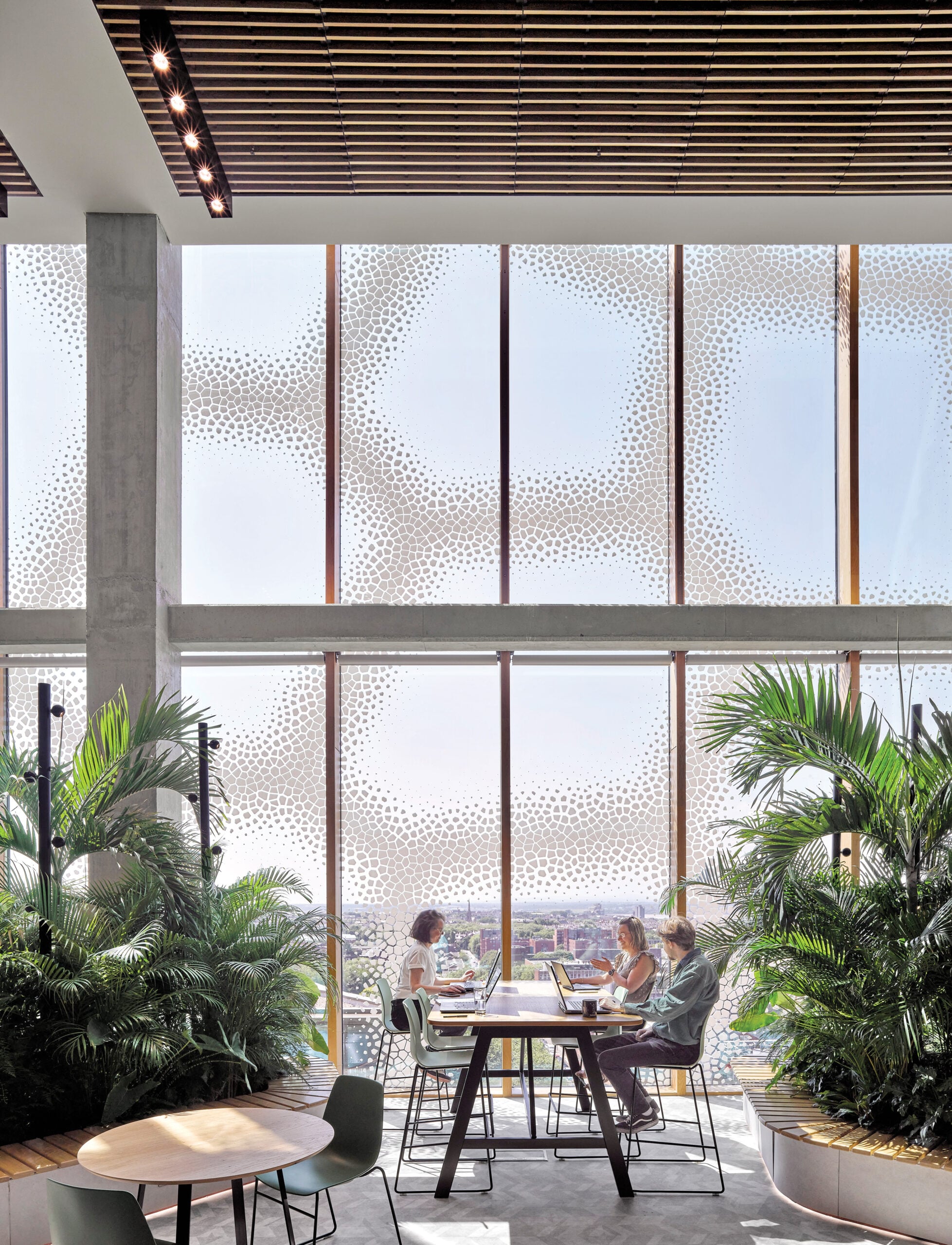
We compared the impact of natural, biophilic, and a control space on aesthetics, attention, mood, and creativity (Holzman et al.01, 2025). The biophilic room with plants, a moss wall, a fir desk, and a bamboo panel on the ceiling that casts a soft, dappled light, had earth tones and textured walls. The rug was handcrafted with a loose, fractal pattern. The control room identical in size and shape to the biophilic room.
What did we find? Aesthetic appreciation using dimensions of coherence, fascination, and hominess (Coburn et al.02, 2020) was greatest for the natural environment, followed by the biophilic room, which was more pleasing than the control room. We did not find differences in attention, working memory, or mood across the spaces. People were more creative in nature than in either interior.
Rather than decide that biophilic design does not have salutary effects, null experimental results raise further questions. Perhaps we missed a critical biophilic ingredient. Perhaps people need to be in the space for longer durations. Perhaps biophilic design works better for targeted populations, such as attention restoration for people with attention deficit disorder and stress reduction for anxious people.
What’s next in biophilic design? We need well-designed empirical studies to show how and why, for whom and under what conditions, biophilic design is helpful.
- 01 Holzman, D., Meletaki, V., Bobrow, I., Weinberger, A., Jivraj, R. F., Green, A., & Chatterjee, A. (2025). “Natural beauty and human potential: Examining aesthetic, cognitive, and emotional states in natural, biophilic, and control environments.” Journal of Environmental Psychology, 104, 102591.
- 02 Coburn, A., Vartanian, O., Kenett, Y. N., Nadal, M., Hartung, F., Hayn-Leichsenring, G., Navarrete, G., González-Mora, J. L., & Chatterjee, A. (2020). “Psychological and neural responses to architectural interiors.” Cortex; a journal devoted to the study of the nervous system and behavior, 126, 217–241.
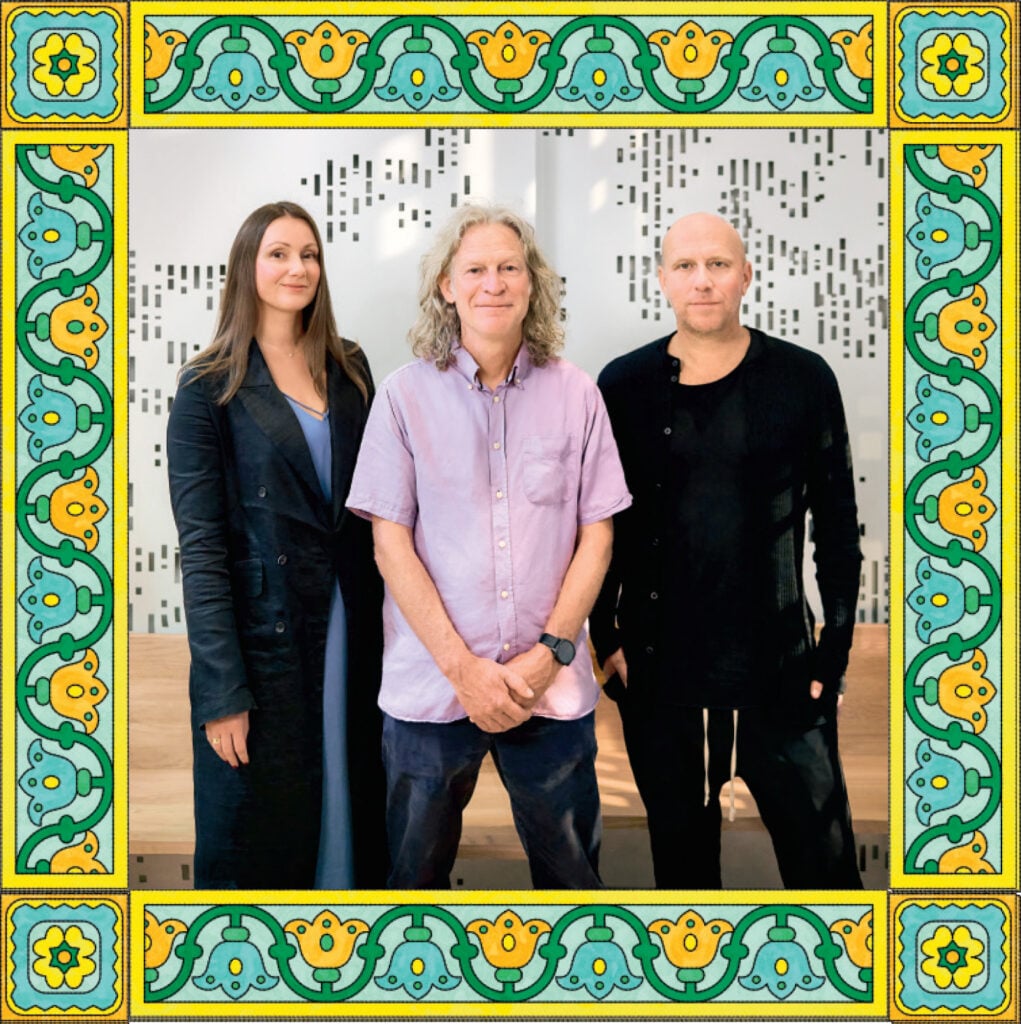
ScienceDesignLab Cofounders
Dr. Anastasija Lesjak, 13&9Design | Dr. Richard Taylor, University of Oregon | Martin Lesjak, 13&9 Design and INNOCAD architecture
For biophilic designs to be impactful, it is necessary to determine the precise characteristics of nature that promote people’s health and well-being. Our biophilic journey began with psychology experiments funded by NASA. It was concerned about astronauts’ health as they ventured
into space and left nature’s scenery behind. By spending 90 percent of their time indoors, people on Earth similarly separate from nature.
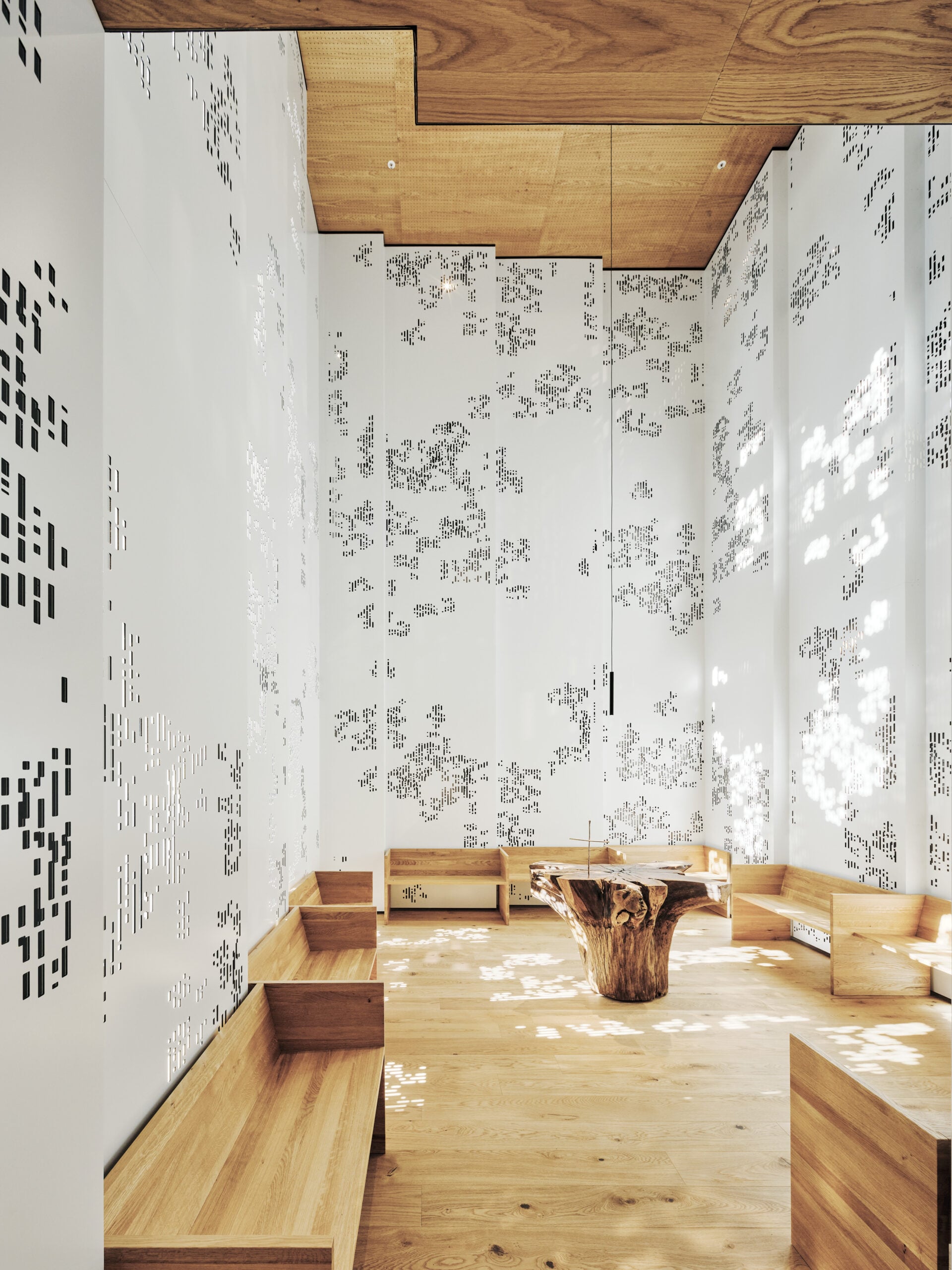
We found that natural patterns called fractals reduce people’s stress dramatically. Eight years ago, we formed the ScienceDesignLab to create fractal patterns for the built environment that combine the science of stress reduction with artistic design. Our fractal designs feature patterns that repeat at different sizes, generating rich visual complexity. Human eyes have evolved to crave this complexity through millions of years of exposure to nature’s fractals.
Recognizing that buildings are fundamentally different environments from nature, our computer programs adapt the complexity of fractals to accommodate the needs of the occupants and their tasks. The Fractal Chapel at the University Hospital in Graz, Austria, is an example of our human-focused, science-informed designs. In addition to applying our patterns to flooring, walls, ceilings, and lighting, our future designs will include fractal sounds and textures, immersing occupants in a multisense “atmosphere” of fractals analogous to natural experiences.
Beyond Mitigation: Regenerative Design

Erin Rovalo
Vice President, Community, Living Future Institute
The next frontier of biophilic design won’t be satisfied with scattering greenery across sterile surfaces. Research points toward dose and pattern: 120 minutes of nature each week improves mental health (Bratman et al.01, 2019; White et al.02, 2019), while midcomplexity fractals measurably reduce stress (Taylor et al.03, 2011). Tomorrow’s spaces will be calibrated, not decorative—tuned like instruments to deliver evidence-based “doses” of nature across sight lines, sounds, textures, and air. Sustained, multisensory encounters matter more than singular gestures.
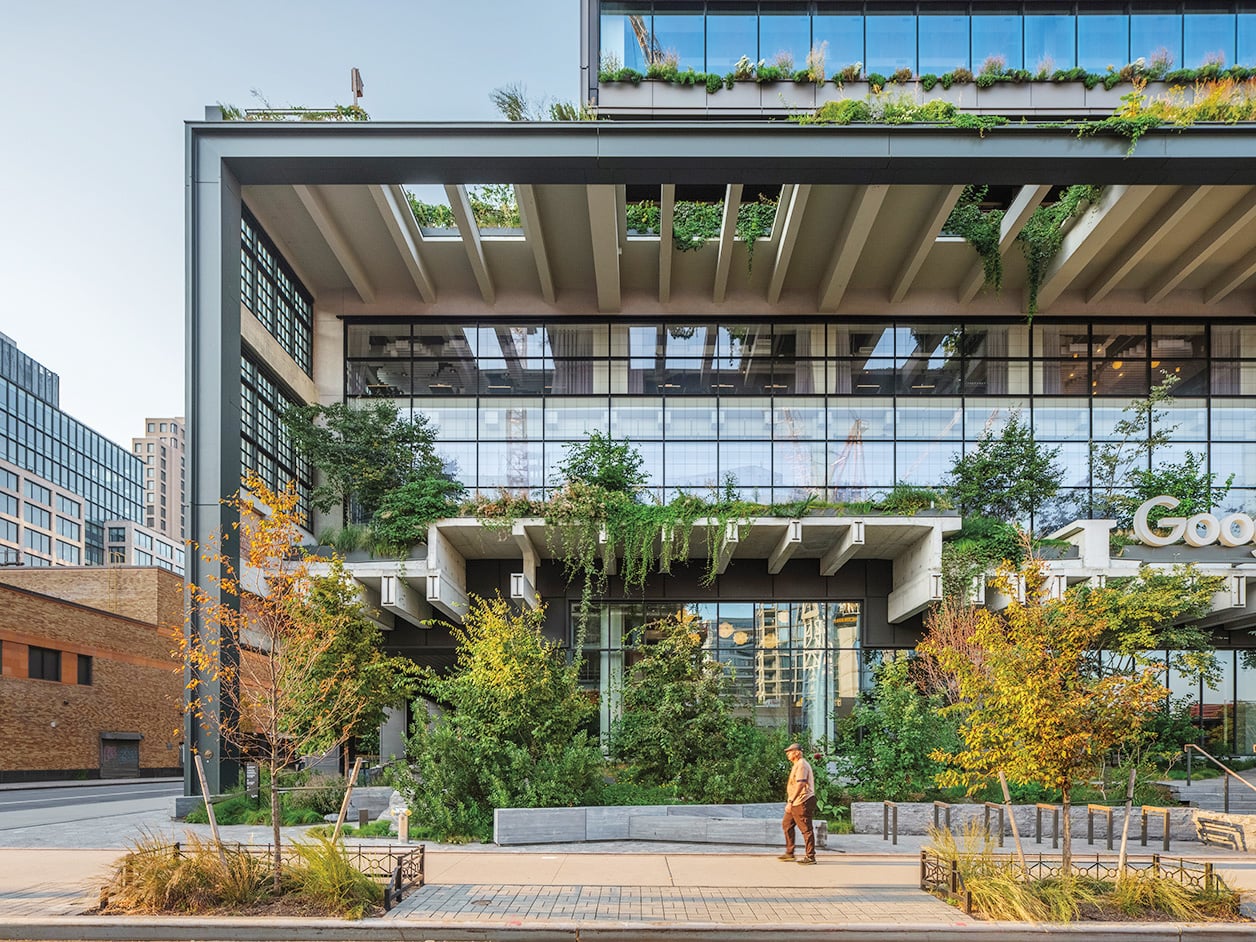
The bigger leap is regenerative. We’re moving beyond buildings that mitigate harm toward architecture that performs like an ecosystem. The Living Building Challenge provides a framework: projects like the Stanley Center for Peace and Security or Google’s Gradient Canopy don’t just reference nature—they generate clean water, produce energy, grow food, and create habitat. Here, biophilic and climate design converge.
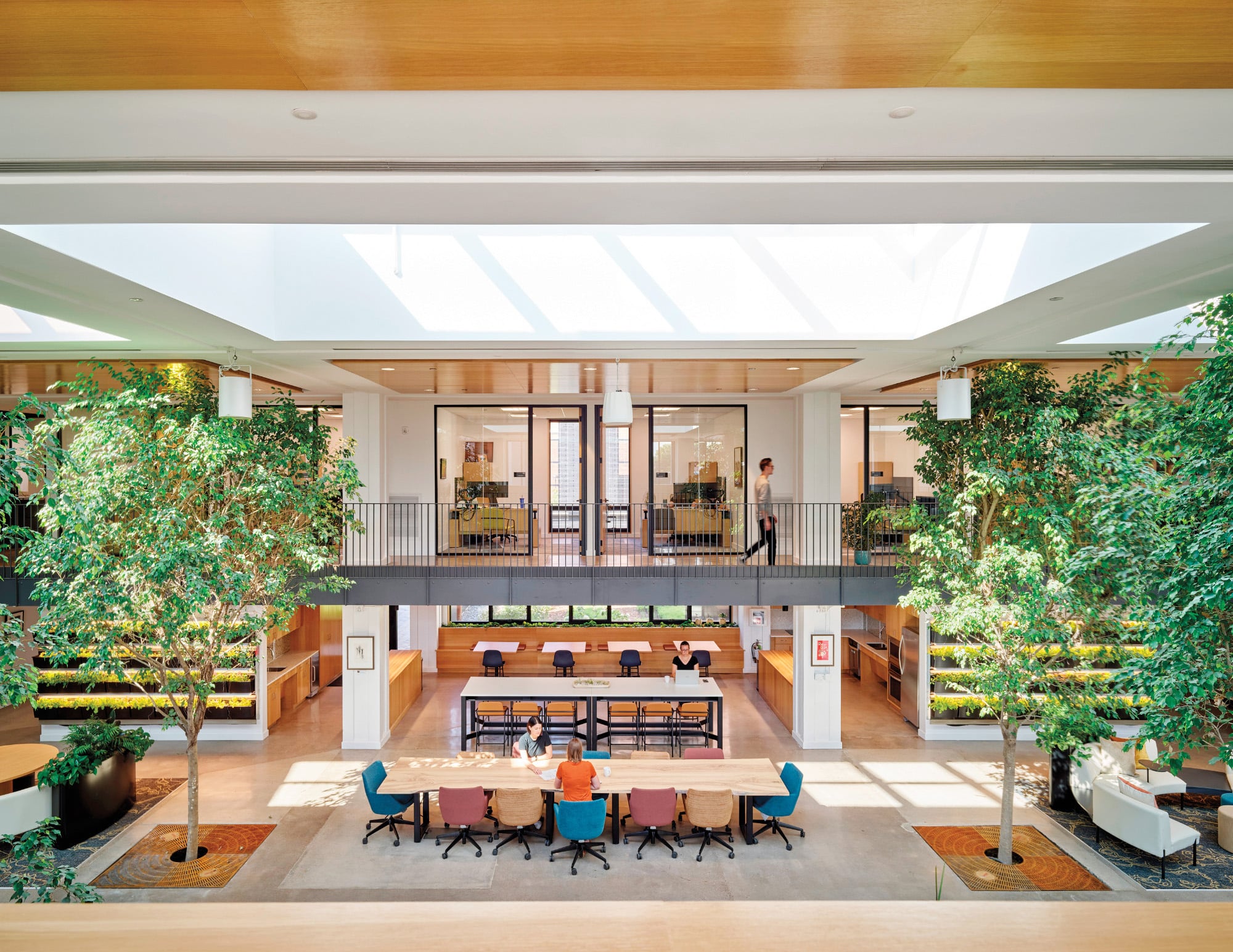
A second horizon is the interface of nature and technology. Kahn’s “technological nature”04 research and more recent subsequent studies show digital proxies can soothe but never replace the real. The challenge is weaving sensor-rich, AI-driven systems that amplify natural rhythms, dynamic daylighting, acoustic landscapes, and indoor ecosystems without flattening them into simulation.
What’s next? Biophilic design as performance standard: cities and buildings acting as forests, rivers, and reefs, and restoring planetary and human vitality.
- 01 White, M. P., Alcock, I., et al. (2019). “Spending at least 120 minutes a week in nature is associated with good health and wellbeing.” Scientific Reports, 9(1), 7730.
- 02 Bratman, G. N., Anderson, C. B., et al. (2019). “Nature and mental health: An ecosystem service perspective.” Science Advances, 5(7).
- 03 Taylor, R. P., Spehar, B., et al. (2011). “Perceptual and physiological responses to the visual complexity of fractal patterns.” Nonlinear Dynamics, Psychology, and Life Sciences, 15(1), 27–52.
- 04 Kahn, P. H., Jr. (2011). “Technological nature: Adaptation and the future of human life.” MIT Press.

Rick Cook
Founding Partner, COOKFOX Architects
The next chapter of biophilic design will see architectural typologies evolving into truly living systems. Where earlier strategies focused on adding plants or maximizing daylight, the next generation must embed nature at every level of design—from dynamic lighting to habitat productivity, even at the scale of the Aero Biome. COOKFOX’s St. John’s Terminal exemplifies this shift: the project fosters ecological richness by selecting plantings that sustain biodiversity from the macro- to the microscale.
As biophilic architecture matures, it must reckon with human diversity. Neurodiverse users and people with different sensory profiles and abilities demand more than biophilic aesthetics—they require environments tuned to variable thresholds of sound, texture, light, and enclosure, emphasizing refuge, natural rhythms, and material cues as strategies to support different modes of experience.
The strongest biophilic work will be deeply human-centric: buildings that heal not just through visible greenery but by reconceiving relationships between built systems and ecosystems. In so doing, architecture becomes a medium for interspecies dialogue—from microbiomes to migratory species—and deepens our understanding of what environments truly support life.
Would you like to comment on this article? Send your thoughts to: [email protected]
Latest
Viewpoints
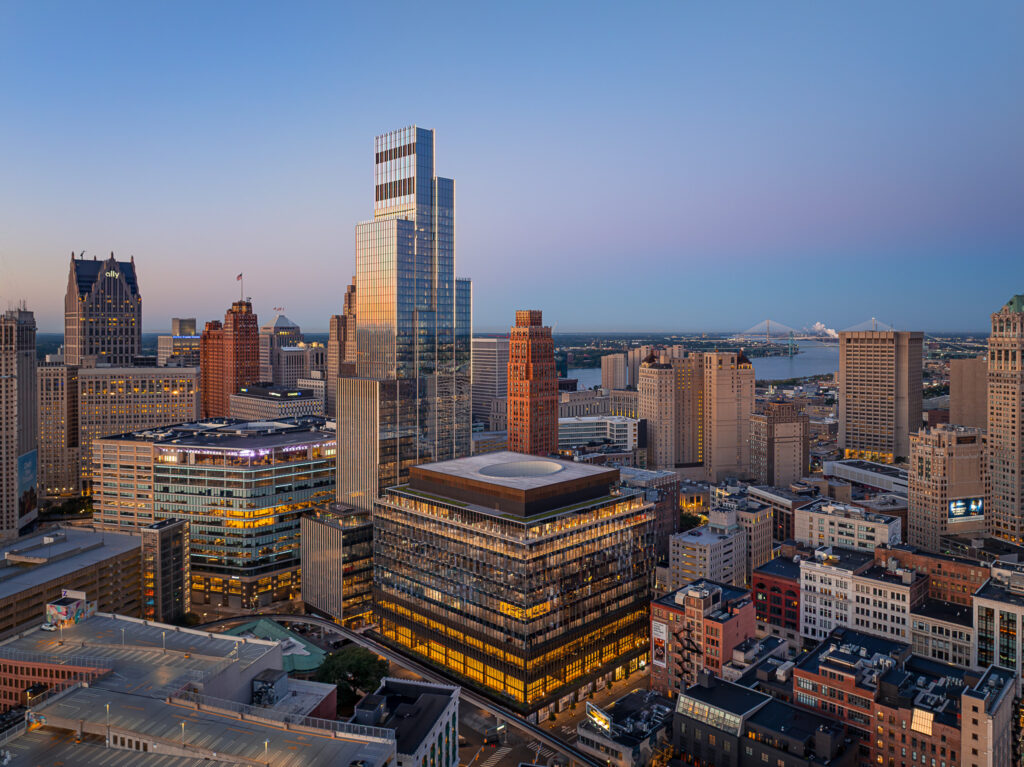
Detroit Month of Design: A City’s Work in Progress
Now in its 16th year, the celebration offers insights into the Motor City’s ongoing accomplishments without glossing over its hurdles.
Projects
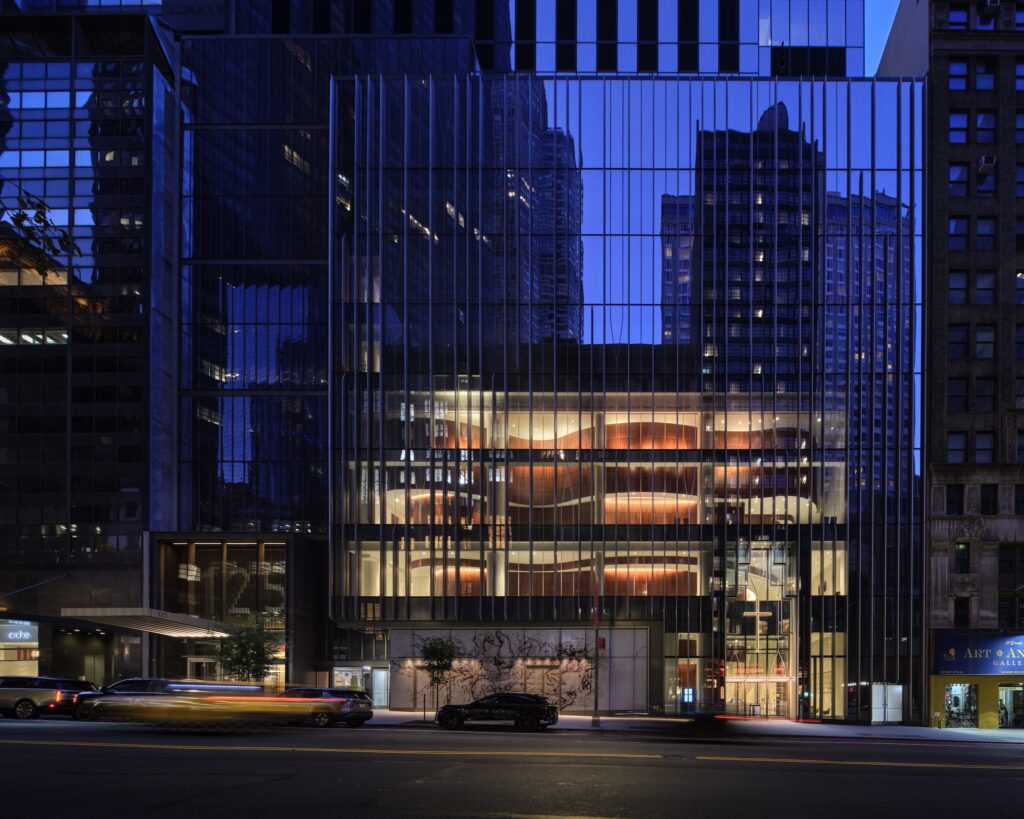
How a Hybrid Building Helped an Historic Manhattan Congregation Remain in Place
On Billionaire’s Row, FX Collaborative designed a new home for Calvary Baptist Church combined with an office tower.